AD0-E605 Adobe Real-TimeCustomer Data Profile Developer Expert(RTCDP) Free Practice Exam Questions (2026 Updated)
Prepare effectively for your Adobe AD0-E605 Adobe Real-TimeCustomer Data Profile Developer Expert(RTCDP) certification with our extensive collection of free, high-quality practice questions. Each question is designed to mirror the actual exam format and objectives, complete with comprehensive answers and detailed explanations. Our materials are regularly updated for 2026, ensuring you have the most current resources to build confidence and succeed on your first attempt.
A team of developers at a digital marketing agency is setting up the Real-Time CDP for their client and they need to understand the implications of their data ingestion tactics in relation to their license. Which of these factors contributes to the calculation of Total Data Volume?
A company uses Real-Time Customer Profile and provides the following Customer Profile schema to the data architect in charge of designing the Real-Time Customer Profile:

They have business requirements to carry out customer segmentation based on purchasing behavior, demographic data (including gender), and multi-channel marketing activities and need to consider data consistency, and minimizing system complexity for future data ingestion and updates.
What would be the recommended modeling approach to accommodate these requirements?
A company is onboarding multiple external data sources into Adobe Real-Time CDP and they want to ensure that the profile merge is performed efficiently. In what two ways could they configure the Identity Service to facilitate an efficient profile merge? (Choose two.)
An administrator of a multinational corporation is configuring attribute-based access control (ABAC) within Adobe RTCDP for the purpose of restricting data access based on both geographical location and department. Which two steps are essential in this ABAC configuration? (Choose two.)
In the context of Adobe's Real-Time CDP, what defines an Identity Graph?
A data engineer is concerned about a sudden increase in ingestion errors during data acquisition from a streaming source to Adobe Experience Platform (AEP). Which monitoring capability should the engineer enable in AEP to understand the cause of each ingestion failure?
How does the Adobe Real-Time CDP manage data when multiple records, coming from different sources but belonging to the same customer, are processed?
A marketing manager wants to activate a segment across multiple channels for consistent and personalized messaging. What is the key consideration when activating this audience from the Adobe Real-Time CDP?
A data architect is tasked with maintaining synchronization between Edge and Adobe Real-Time CDP profiles in a dynamic data environment. The developer needs to determine the frequency and extent of the synchronization between Edge and Adobe Real-Time CDP profiles. What is the primary factor that should be used to complete this task?
An organization is tracking three types of identifiers for their customers: email, mobile number, and customer relationship management (CRM) ID and wants to merge identities in the Real-Time Customer Profile and segment audiences in Adobe Experience Platform. Which strategy would be used?
What is the core function of alerts in the Adobe Real-Time CDP?
A company is implementing Adobe Real-Time CDP (RTCDP) and is concerned about how license usage is calculated and what measures to take to prevent overages. How can the company effectively and proactively manage the Total Data Volume measurement to avoid exceeding licensed volumes?
A financial institution is implementing Adobe Real-Time CDP and has critical data coming from multiple sources, raising data security concerns. What is the recommended Adobe Experience Platform feature to use to ensure this sensitive data, such as customer's financial details and transactional data, is handled properly?
A customer is bringing their brand data using Mobile and Web SDK into AEP to use for brand marketing using Adobe Real-Time CDP. The client has a license limited to 5 million Addressable Audience. What strategy should be adopted by the Data Architect to keep profile count in check and within license limits?
A company has two identities (CRM ID and Email ID) that can be used to define their customers in their customer relationship management (CRM) system However, not all customers have provided their Email ID. but all customers have a unique CRM ID The CRM data stored in the system takes the form:

The company wishes to construct a single view of their customer in Real-time Customer Profile. Which two steps would they take to avoid having Incomplete customer profiles'' (Choose two.)
A marketer wants to create an Audience of all individuals who have clicked on a specific link on the company website in the last 7 days and have bought a product from the website in the last 30 days. What is the best way to create this Audience within Adobe Experience Platform?
A data engineer has loaded several profile fragments onto a Real-Time Customer Profile The profile fragments use an Individual Profile class-based schema, where user-id is the primary identity. The engineer checks each fragment, as follows:
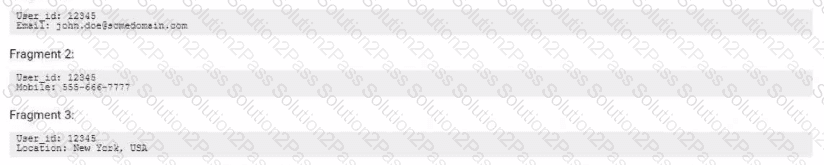
However, upon Inspection of the profile, they realize that only the email from Fragment 1 appears, while mobile and location from Fragments 2 and 3 do not.
What is the most likely reason for the missing data in Real-Time Customer Profile'
A company is looking to model their data architecture in Adobe Real-Time CDP that includes customer transactions across multiple platforms. What is the approach to define identity graph for a customer in Adobe Real-Time CDP to track a customer's activities across multiple platforms?
A data architect is designing a Real-Time Customer Profile to capture user interactions across multiple channels for an online media company. The company tracks user interactions such as article reads, video views, and ad clicks across its website, app, and email newsletters. Currently, the Real-Time Customer Profile schema design contains a User Profile Class and an Experience Event Class. The Experience Event Class captures each interaction as a separate event record and contains an identity field (user_id) linking to the user profile.
Upon review, the data architect realizes that the schema design is unable to accurately capture the sequence of interactions made by a single user during one session (defined as a continuous period of activity without more than 30 minutes of inactivity).
How should the data architect modify the schema design to better capture the sequence of user interactions within a single session in the Real-Time Customer Profile?
A financial institution is migrating its customer transaction data from a relational database (RDBMS) to Adobe Real-Time CDP. The institution's transaction records include data points like customer ID, account type, transaction type, transaction amount, and transaction date. The data architect must ensure the transaction data can be linked to individual customer profiles in Adobe Real-Time CDP while also ensuring the data model maintains performance for real-time analysis and personalization use cases. What is the best approach to model this data in Adobe Real-Time CDP's NoSQL data model?