TM3 BCS ISTQB Certified Tester Advanced Level - Test Management v3.0 Free Practice Exam Questions (2026 Updated)
Prepare effectively for your BCS TM3 ISTQB Certified Tester Advanced Level - Test Management v3.0 certification with our extensive collection of free, high-quality practice questions. Each question is designed to mirror the actual exam format and objectives, complete with comprehensive answers and detailed explanations. Our materials are regularly updated for 2026, ensuring you have the most current resources to build confidence and succeed on your first attempt.
Which of the following characteristics of risk-based techniques is not appropriate to a more heavyweight risk-based technique?
Ability to act with confidence is an important skill for a person to perform successfully in a project or team.
To which area of competence does "ability to act with confidence" belong?
You are involved in the selection of a test management tool and have decided to calculate the ROI for the two potential tools: TestMaker and ImproveIT.
TestMaker is priced at €15,000 with yearly maintenance costs of €1,500. Its traceability to requirements feature is strong and the defect management process can easily be customised to meet the needs of the organisation. Effort for test management activities is expected to decrease by 20%.
ImproveIT is priced at €20,000 with yearly maintenance costs of €2,500. Its traceability feature is also strong and has a high level of usability. It also has interesting options for adding extensions to its features in the future. Effort for test management activities is expected to decrease by 30%.
Based on the calculated ROI, which tool would you suggest?
You are a test manager developing a master test plan. As part of the master test plan, you are defining exit criteria for the various test levels.
Which of the following exit criteria would be most appropriate and SMART for component testing, and which one would be most appropriate and SMART for system testing?
i. 95% of the tests prepared are executed successfully
ii. All test cases have been run
iii. 80% decision coverage for all tests run
iv. At least 30 defects have been found
v. At least two weeks of test execution
vi. No more open defects
You are a process improver and have decided to use the data from the defect management system to identify and drive improvement actions… Which of the following options could have been identified as missing from the defect reports to be used for process improvement?
Which of the following is not true regarding applying a model-based approach, e.g., TMMi, for improvements at project level?
Assume that you are using traceability to manage test case coverage against test conditions. During test analysis, three test conditions were identified. Test design for system testing has been completed and 10 test cases (TC1 to TC10) have been designed, as described by the following traceability matrix (“C” indicates a critical test case, while “NC” indicates a non-critical test case):
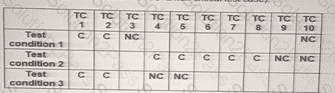
[traceability matrix not visible in the prompt]
The exit criterion for system testing states that each test condition must have all the associated critical test cases successfully executed (passed) AND all associated non-critical test cases at least executed.
The following is the situation after three days of system testing:
TC1, TC2, TC4, TC5, TC7, TC9: passed
TC3, TC10: failed (with an associated open defect report)
TC6, TC8: not run
Management wants to decide whether to release the system. You advise them that the system does not yet meet the defined exit criteria.
Based only on the given information, which test condition does not yet meet the stated exit criterion?
In an Agile context, defects are often fixed without writing a formal defect report. However, there are some conditions where it is good practice to write a defect report, even in an Agile context.
When is a defect report typically not written in an Agile context?
Your company is considering purchasing a test tool suite from a respectable vendor. Your manager has searched the internet for comparable products, but none of them meet his specific requirements. A tool demonstration has been arranged for next week and your team has been invited to attend. The tool suite consists of a test management tool, test execution tool, and a requirements management tool. There is a possibility of adding a performance testing tool at a later stage.
You have decided to attend the demo but raise some issues beforehand regarding expectations.
Which two issues from the options provided below should at least be raised?
Which of the following tools help to understand which part of the test object has been exercised by testing?
You are a test manager in charge of integration, system, and user acceptance testing for a bank. You are working on a project to upgrade an existing ATM to allow customers to obtain cash advances from supported credit cards.
The system should allow cash advances from €20 to €500 (both inclusive) for all supported credit cards. The supported credit cards are American Express, VISA, Eurocard, and Mastercard. The system should be easy to use for all users, including new users. The organisation is currently in a transition to Agile and already well on its way.
In the test plan, the following items are listed under the heading"Items and features to be tested":
All supported credit cards
Language localisation
Valid and invalid advance
Usability
Response time
Which of the following topics would be most important for you to address in detail in the test plan?
The stakeholders matrix is a strategic tool to be used by test managers and is composed of four quadrants.
Which quadrant is described by the following statements?
Typically do not have a strong interest in day-to-day tasks
Their decisions are critical for resource allocation and high-level project direction
Assume you are a test manager of a project that develops software in the medical domain. You are responsible for analysing the organisational test strategy and the project context to choose the appropriate test approach.
You consider the following factors:
Detailed requirements of high quality are available
Parts of the software to be developed are expected to be safety critical
Internal audits and an external audit by a government agency are expected to take place, as such traceability and evidence are important elements for the test approach
A release date has been defined, and a marketing campaign has already been scheduled
The project works according to the sequential V-model lifecycle
The independent test team has a lot of domain knowledge but has also been trained and has experience in using test design techniques
Which of the following test approaches would be most appropriate for this project?
The following defect management process is in use at a company… What is the most important recommendation you would make for the defect report template in this process?
You are a tester working in an Agile team in the finance domain. The team consists of 6 members, and you are the only tester. The team is responsible for the development and maintenance of a mobile front-end application. The application is considered to be critical with respect to customer impact and market branding.
You have been asked to identify which test management activity needs to be performed within the team to enhance test maturity and achieve a higher level of product quality.
Which test management activity would you recommend the team should adopt?