Pre-Winter Sale Special - Limited Time 70% Discount Offer - Ends in 0d 00h 00m 00s - Coupon code: xmaspas7

Easiest Solution 2 Pass Your Certification Exams

Anthropic CCDV-F Practice Test Questions Answers

Exam Code: CCDV-F (Updated 95 Q&As with Explanation)
Exam Name: Claude Certified Developer-Foundations
Last Update: 21-Sep-2026
Demo:  Download Demo

PDF + Testing Engine
Testing Engine
PDF
$43.5   $144.99
$33   $109.99
$30   $99.99

Questions Include:

  • Single Choice: 95 Q&A's

  • Reliable Solution To Pass CCDV-F Claude Certified Developer Certification Test

    Our easy to learn CCDV-F Claude Certified Developer-Foundations questions and answers will prove the best help for every candidate of Anthropic CCDV-F exam and will award a 100% guaranteed success!

    Why CCDV-F Candidates Put Solution2Pass First?

    Solution2Pass is ranked amongst the top CCDV-F study material providers for almost all popular Claude Certified Developer certification tests. Our prime concern is our clients’ satisfaction and our growing clientele is the best evidence on our commitment. You never feel frustrated preparing with Solution2Pass’s Claude Certified Developer-Foundations guide and CCDV-F dumps. Choose what best fits with needs. We assure you of an exceptional CCDV-F Claude Certified Developer-Foundations study experience that you ever desired.

    A Guaranteed Anthropic CCDV-F Practice Test Exam PDF

    Keeping in view the time constraints of the IT professionals, our experts have devised a set of immensely useful Anthropic CCDV-F braindumps that are packed with the vitally important information. These Anthropic CCDV-F dumps are formatted in easy CCDV-F questions and answers in simple English so that all candidates are equally benefited with them. They won’t take much time to grasp all the Anthropic CCDV-F questions and you will learn all the important portions of the CCDV-F Claude Certified Developer-Foundations syllabus.

    Most Reliable Anthropic CCDV-F Passing Test Questions Answers

    A free content may be an attraction for most of you but usually such offers are just to attract people to clicking pages instead of getting something worthwhile. You need not surfing for online courses free or otherwise to equip yourself to pass CCDV-F exam and waste your time and money. We offer you the most reliable Anthropic CCDV-F content in an affordable price with 100% Anthropic CCDV-F passing guarantee. You can take back your money if our product does not help you in gaining an outstanding CCDV-F Claude Certified Developer-Foundations exam success. Moreover, the registered clients can enjoy special discount code for buying our products.

    Anthropic CCDV-F Claude Certified Developer Practice Exam Questions and Answers

    For getting a command on the real Anthropic CCDV-F exam format, you can try our CCDV-F exam testing engine and solve as many CCDV-F practice questions and answers as you can. These Anthropic CCDV-F practice exams will enhance your examination ability and will impart you confidence to answer all queries in the Anthropic CCDV-F Claude Certified Developer-Foundations actual test. They are also helpful in revising your learning and consolidate it as well. Our Claude Certified Developer-Foundations tests are more useful than the VCE files offered by various vendors. The reason is that most of such files are difficult to understand by the non-native candidates. Secondly, they are far more expensive than the content offered by us. Read the reviews of our worthy clients and know how wonderful our Claude Certified Developer-Foundations dumps, CCDV-F study guide and CCDV-F Claude Certified Developer-Foundations practice exams proved helpful for them in passing CCDV-F exam.
    CCDV-F Questions and Answers

    Question # 1

    You are deciding between Claude models for a task. The team has identified three relevant tradeoff dimensions: quality, latency, and cost.

    The right model is the one that...

    A.

    Satisfies the task's latency requirement first, then is evaluated against quality and cost thresholds to confirm the selection is acceptable across all three dimensions.

    B.

    Meets the task's cost target within a defined latency budget, with quality validated against a representative sample of inputs after the model is selected.

    C.

    Fits the task's quality, latency, and cost requirements together, recognizing that improving one dimension typically affects the others.

    D.

    Meets the task's quality requirements at an acceptable latency, with cost reviewed separately once the quality and latency bar has been established.

    Question # 2

    You are designing an agent that handles a complex claim-processing workflow. Each claim moves through fact extraction, eligibility evaluation, and a decision step. The three subtasks have distinct success criteria, and some claims require iteration between fact extraction and eligibility evaluation before a decision can be reached.

    Which agent pattern would you apply?

    A.

    A graph-based pattern that lets the agent move between subtasks based on the state of each claim, with each subtask evaluated against its own criteria.

    B.

    A streaming pattern that emits partial decisions as the agent processes each claim, refining the output until a final decision emerges from the stream.

    C.

    A single tool-use loop pattern that gives one agent access to all the tools needed for fact extraction, eligibility evaluation, and decision-making.

    D.

    A linear chain pattern that processes every claim through fact extraction, then eligibility evaluation, then decision, with no return paths between subtasks.

    Question # 3

    Your Claude application's error handling currently logs every API error with the same severity level. The team wants to differentiate between errors that should page an on-call engineer and errors that should be logged for later review. How would you structure the error handling?

    A.

    Page on every error, on the grounds that paging guarantees that no error is missed by the team during normal operation across the application's lifecycle.

    B.

    Disable logging for any error that does not page, treating non-paging errors as not worth recording for later review either.

    C.

    Categorize errors by severity based on impact and recoverability, then route each category to the appropriate channel for paging or logging.

    D.

    Log every error with the same severity, on the grounds that differentiating severity adds complexity that does not pay off in most application setups over time.

    Question # 4

    You are integrating Claude into an application written in Python. The Claude SDK provides a Python client that wraps the underlying REST API.

    How would you integrate the SDK?

    A.

    Call the REST API directly with raw HTTP requests so the application avoids the SDK's abstraction between the application code and the API.

    B.

    Use the Claude Python SDK and let it handle authentication, retries, and response parsing through its standard documented patterns for Python integrations.

    C.

    Use a different LLM provider's SDK and translate the responses into Claude's API shape so the application can switch providers in the future.

    D.

    Skip the SDK and embed Claude calls in shell commands invoked from Python, so that the application runs the calls outside the main Python process.

    Question # 5

    A teammate has asked how the Claude SDK handles transient API errors, such as a temporary network issue or a brief rate-limit response. They want to know whether the application code needs to handle every transient error or whether the SDK provides any default behavior.

    How would you describe the SDK's default behavior?

    A.

    The SDK provides default retry behavior for transient errors up to a fixed number of attempts, and this behavior is not configurable.

    B.

    The SDK provides default retry behavior for network errors but surfaces rate-limit responses directly to the application code, which must implement its own retry logic for those cases.

    C.

    The SDK logs transient errors to a default error stream and continues execution without retrying, leaving the application code responsible for detecting and responding to failed calls.

    D.

    The SDK provides default retry behavior for many transient errors, and the application code can configure or extend that behavior as needed.

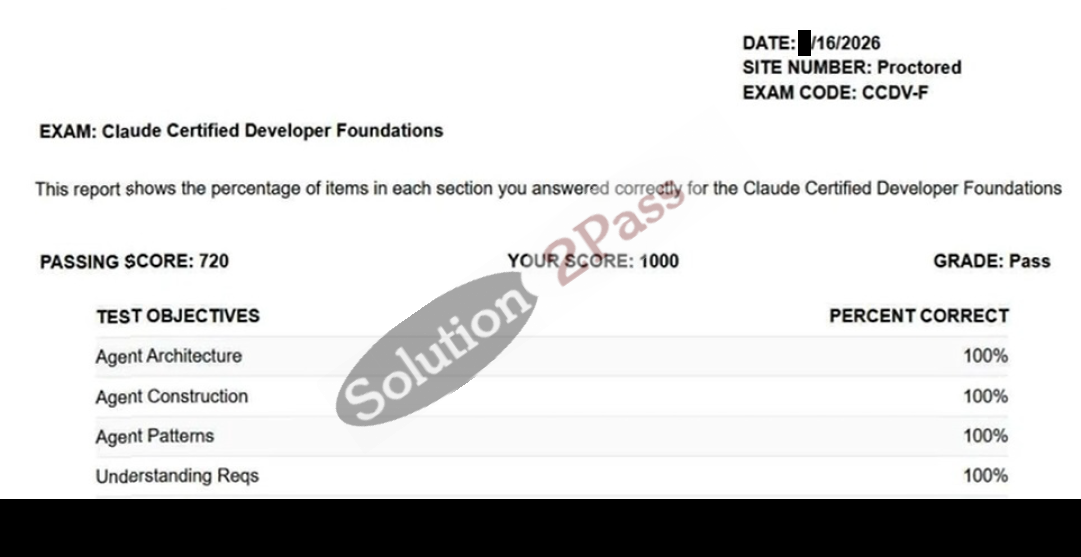
    Authenticated Outcomes from Solution2Pass Clients

    Proof that working through our platform training leads directly to an official passing status.

    Confirmed
    Validated CCDV-F certification score card 1
    VIEW FULL SCORECARD
    Copyright © 2014-2026 Solution2Pass. All Rights Reserved