CS0-003 CompTIA CyberSecurity Analyst CySA+ Certification Exam Free Practice Exam Questions (2026 Updated)
Prepare effectively for your CompTIA CS0-003 CompTIA CyberSecurity Analyst CySA+ Certification Exam certification with our extensive collection of free, high-quality practice questions. Each question is designed to mirror the actual exam format and objectives, complete with comprehensive answers and detailed explanations. Our materials are regularly updated for 2026, ensuring you have the most current resources to build confidence and succeed on your first attempt.
During a routine review of DNS logs, a security analyst observes that Host X has been making frequent DNS requests to domains with random alphanumeric strings, such as ajd8ekthj.xyz. IPS anomaly rules are blocking these domains. This behavior started shortly after a new software installation on the host. Which of the following should the analyst do first to determine whether Host X has been compromised?
During the log analysis phase, the following suspicious command is detected-

Which of the following is being attempted?
A user downloads software that contains malware onto a computer that eventually infects numerous other systems. Which of the following has the user become?
A security analyst is responding to an indent that involves a malicious attack on a network. Data closet. Which of the following best explains how are analyst should properly document the incident?
An incident response analyst notices multiple emails traversing the network that target only the administrators of the company. The email contains a concealed URL that leads to an unknown website in another country. Which of the following best describes what is happening? (Choose two.)
A vulnerability scan of a web server that is exposed to the internet was recently completed. A security analyst is reviewing the resulting vector strings:
Vulnerability 1: CVSS: 3.0/AV:N/AC: L/PR: N/UI : N/S: U/C: H/I : L/A:L
Vulnerability 2: CVSS: 3.0/AV: L/AC: H/PR:N/UI : N/S: U/C: L/I : L/A: H
Vulnerability 3: CVSS: 3.0/AV:A/AC: H/PR: L/UI : R/S: U/C: L/I : H/A:L
Vulnerability 4: CVSS: 3.0/AV: P/AC: L/PR: H/UI : N/S: U/C: H/I:N/A:L
Which of the following vulnerabilities should be patched first?
An organization has tracked several incidents that are listed in the following table:
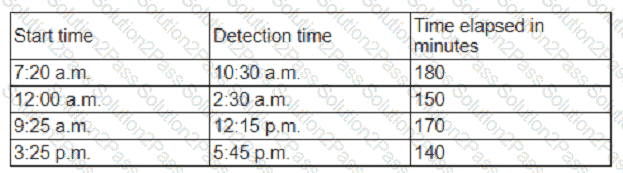 Which of the following is the organization ' s MTTD?
A vulnerability analyst is writing a report documenting the newest, most critical vulnerabilities identified in the past month. Which of the following public MITRE repositories would be best to review?
A threat hunter seeks to identify new persistence mechanisms installed in an organization ' s environment. In collecting scheduled tasks from all enterprise workstations, the following host details are aggregated:
Which of the following actions should the hunter perform first based on the details above?
After an upgrade to a new EDR, a security analyst received reports that several endpoints were not communicating with the SaaS provider to receive critical threat signatures. To comply with the incident response playbook, the security analyst was required to validate connectivity to ensure communications. The security analyst ran a command that provided the following output:
ComputerName: comptia007
RemotePort: 443
InterfaceAlias: Ethernet 3
TcpTestSucceeded: False
Which of the following did the analyst use to ensure connectivity?
A security analyst runs the following command:
# nmap -T4 -F 192.168.30.30
Starting nmap 7.6
Host is up (0.13s latency)
PORT STATE SERVICE
23/tcp open telnet
443/tcp open https
636/tcp open ldaps
Which of the following should the analyst recommend first to harden the system?
Which of the following is a reason why proper handling and reporting of existing evidence are important for the investigation and reporting phases of an incident response?
A security analyst discovers an ongoing ransomware attack while investigating a phishing email. The analyst downloads a copy of the file from the email and isolates the affected workstation from the network. Which of the following activities should the analyst perform next?
Which of the following is a commonly used four-component framework to communicate threat actor behavior?
An analyst is investigating a phishing incident and has retrieved the following as part of the investigation:
cmd.exe /c c:\Windows\System32\WindowsPowerShell\v1.0\powershell.exe -WindowStyle Hidden -ExecutionPolicy Bypass -NoLogo -NoProfile -EncodedCommand < VERY LONG STRING >
Which of the following should the analyst use to gather more information about the purpose of this command?
Which of the following would a security analyst most likely use to compare TTPs between different known adversaries of an organization?
Which of the following best explains the importance of communicating with staff regarding the official public communication plan related to incidents impacting the organization?
A security analyst would like to integrate two different SaaS-based security tools so that one tool can notify the other in the event a threat is detected. Which of the following should the analyst utilize to best accomplish this goal?
An analyst receives threat intelligence regarding potential attacks from an actor with seemingly unlimited time and resources. Which of the following best describes the threat actor attributed to the malicious activity?
Which of the following is an important aspect that should be included in the lessons-learned step after an incident?