New Year Sale Special - Limited Time 70% Discount Offer - Ends in 0d 00h 00m 00s - Coupon code: xmaspas7

Easiest Solution 2 Pass Your Certification Exams

FCSS_LED_AR-7.6 Fortinet NSE 6 - LAN Edge 7.6 Architect Free Practice Exam Questions (2026 Updated)

Prepare effectively for your Fortinet FCSS_LED_AR-7.6 Fortinet NSE 6 - LAN Edge 7.6 Architect certification with our extensive collection of free, high-quality practice questions. Each question is designed to mirror the actual exam format and objectives, complete with comprehensive answers and detailed explanations. Our materials are regularly updated for 2026, ensuring you have the most current resources to build confidence and succeed on your first attempt.

Page: 1 / 1
Total 40 questions

You are setting up a captive portal to provide Wi-Fi access for visitors. To simplify the process, your team wants visitors to authenticate using their existing social media accounts instead of creating new accounts or entering credentials manually.

Which two actions are required to enable this functionality? (Choose two.)

A.

Set up a remote open authorization (OAuth) server for each selected social media platform.

B.

Configure only the email login option because a social media login cannot be used with captive portals.

C.

Enable Account Login as the authentication type and configure a remote LDAP server.

D.

Set up the FortiAuthenticator internal database as the primary source for user credentials

E.

Configure the social login profiles for the supported platforms.

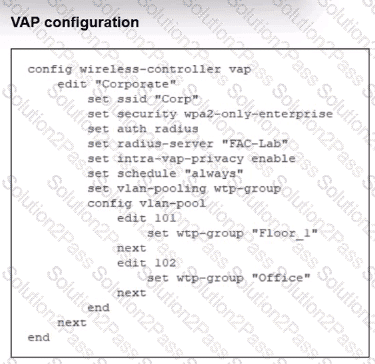
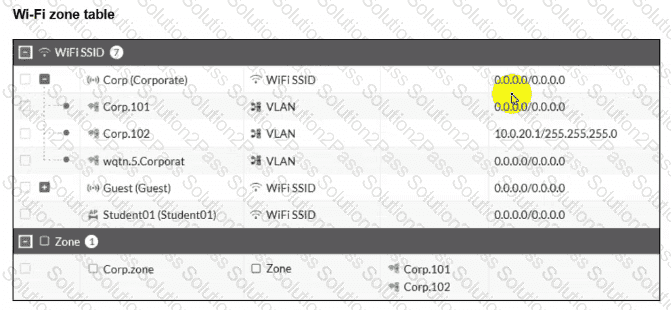
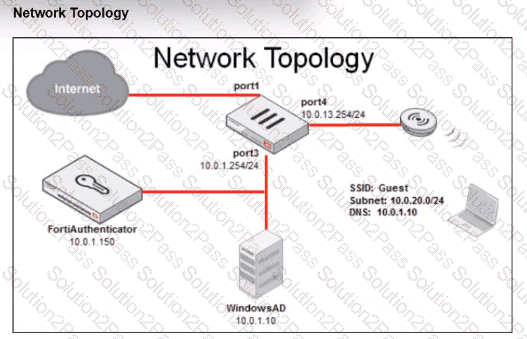
Refer to the exhibit.

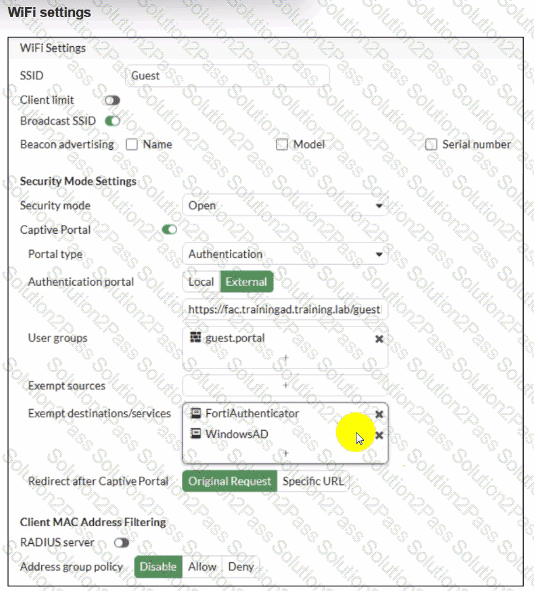
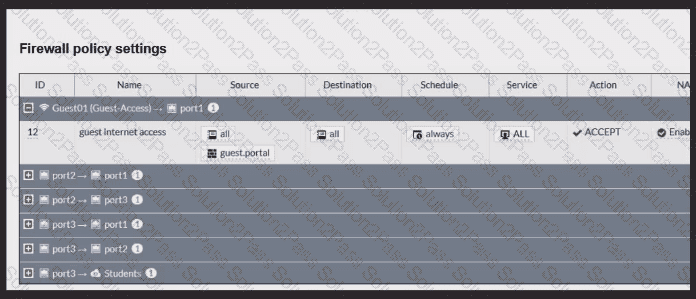
Review the exhibits to analyze the network topology, SSID settings, and firewall policies.

FortiGate is configured to use an external captive portal for authentication to grant access to a wireless network. During testing, it was found that users attempting to connect to the SSID cannot access the captive portal login page.

What configuration change should be made to resolve this issue to allow users to access the captive portal?

A.

Change the SSID security mode to WPA2-Enterprise for authentication.

B.

Disable HTTPS redirection for the captive portal authentication page.

C.

Exclude FortiAuthenticator and Windows AD address objects from filtering.

D.

A firewall policy allowing Guest SSID traffic to reach FortiAuthenticator and Windows AD.

A network administrator connects a new FortiGate to the network, allowing it to automatically discover andI register with FortiManager.

What occurs after FortiGate retrieves the FortiManager address?

A.

FortiGate establishes a secure tunnel to FortiManager over TCP port 541.

B.

The device needs to be manually authorized on FortiManager.

C.

FortiGate configures its interface settings based on a DHCP response from FortiManager.

D.

FortiGate sends a discovery request to all devices on the local network using UDP port 1068.

A conference center wireless network provides guest access through a captive portal, allowing unregistered users to self-register and connect to the network. The IT team has been tasked with updating the existing configuration to enforce captive portal authentication over a secure HTTPS connection. Which two steps should the administrator take to implement this change? (Choose two.)

A.

Enable HTTP redirect in the user authentication settings.

B.

Create a new SSID with the HTTPS captive portal URL.

C.

Disable HTTP administrative access on the guest SSID to enforce HTTPS connection.

D.

Update the captive portal URL to use HTTPS on FortiGate and FortiAuthenticator.

What is the expected behavior when enabling auto TX power control on a FortiAP interface?

A.

FortiGate monitors the signal strength of nearby AP interfaces and adjusts its own transmit power every 30 seconds to match the signal strength of the adjacent AP

B.

FortiGate measures the signal strength of nearby FortiAP interfaces every 30 seconds and adjusts their transmit power to ensure they remain detectable at -70 dBm.

C.

FortiGate periodically measures the signal strength of the weakest associated client and adjusts the AP radio power to align with the detected signal strength of that client.

D.

The AP periodically evaluates the signal strength of its own transmission from the client perspective and adjusts its power to ensure the signal is detected at -70 dBm.

Refer to the exhibits.

Examine the FortiGate configuration, FortiAnalyzer logs, and FortiGate widget shown in the exhibits.

Security Fabhc quarantine automation has been configured to isolate compromised devices automatically. FortiAnalyzer has been added to the Security Fabric, and an automation stitch has been configured to quarantine compromised devices.

To test the setup, a device with the IP address 10.0.2.1 that is connected through a managed FortiSwitch attempts to access a malicious website. The logs on FortiAnalyzer confirm that the event was recorded, but the device does not appear in the FortiGate quarantine widget.

Which two reasons could explain why FortiGate is not quarantining the device? (Choose two.)

A.

The IOC action should include only the FortiSwitch in the quarantine.

B.

The SSL inspection should be set to deep-Inspection

C.

The malicious website is not recognized as an indicator of compromise (IOC) by FortiAnalyzer.

D.

The threat detection services license is missing or invalid under FortiAnalyzer.

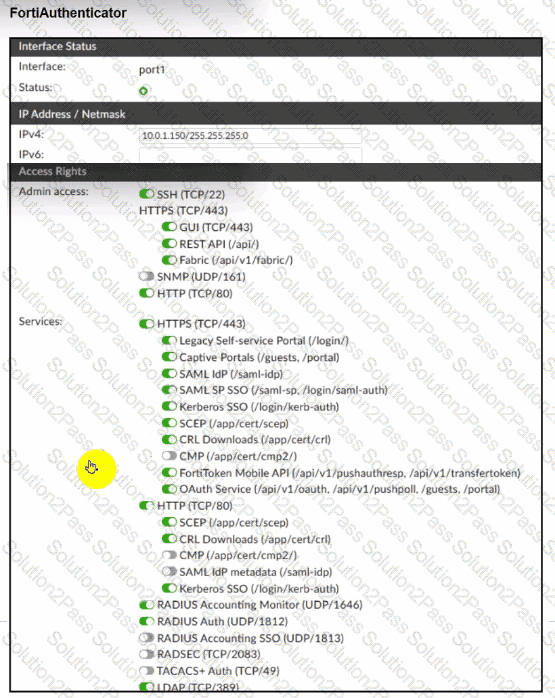
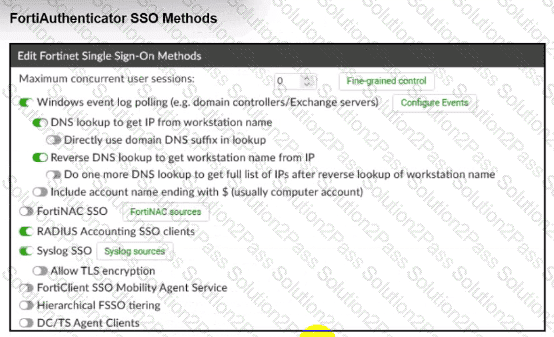
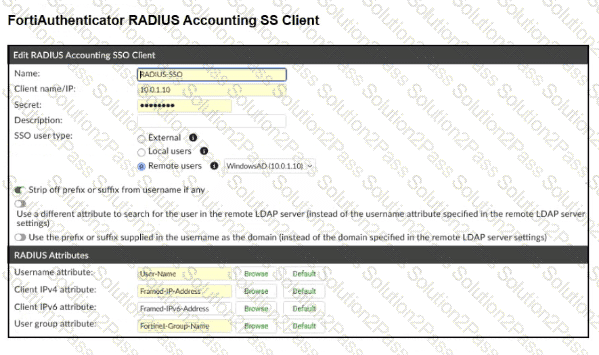
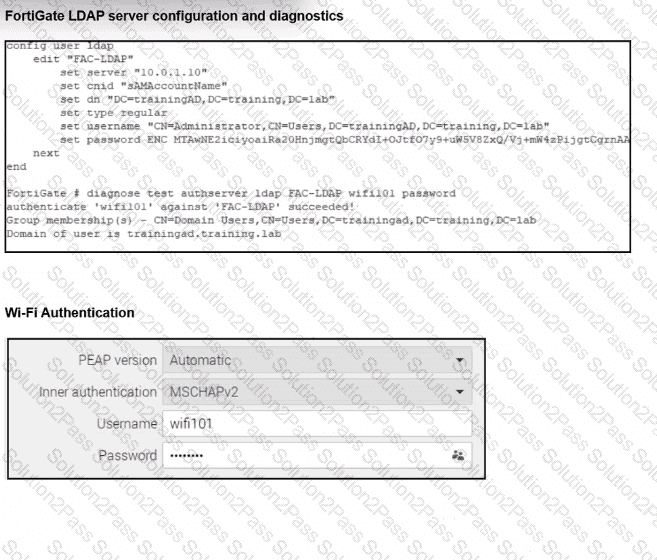
You are troubleshooting a Syslog-based single sign-on (SSO) issue on FortiAuthenticator, where user authentication is not being correctly mapped from the syslog messages. You need a tool to diagnose the issue and understand the logs to resolve it quickly.

Which tool in FortiAuthenticator can you use to troubleshoot and diagnose a Syslog SSO issue?

A.

Debug logs > Remote Servers > Syslog Viewer

B.

Parsing Test Tool

C.

Debug logs > SSO Sessions page

D.

Debug logs > Single Sign-On > Syslog SSO

Refer to the exhibits.

A set of SSID profiles has been configured on FortiManager, and an AP profile has been assigned to a group of AP managed by FortiGate. However, none of the designated SSIDs are being broadcast by these APs.

Which configuration change is required to make the APs broadcast these SSIDs as intended?

A.

Adjust the AP profile to ensure all SSIDs are configured in a supported mode, either bridge or tunnel, but not a mix of both.

B.

Change the AP profile to use a platform that supports the configured mix of SSIDs.

C.

Choose Manual in the SSIDs setting and select the SSIDs to broadcast.

D.

Set the Transmit Power Mode to Auto.

Refer to the exhibits.

Examine the FortiGate RSSO configuration shown in the exhibit.

FortiGate is set up to use RSSO for user authentication. It is currently receiving RADIUS accounting messages through port3. The incoming RADIUS accounting messages contain the username in the User-Name attribute and group membership in the Class attribute. You must ensure that the users are authenticated through these RADIUS accounting messages and accurately mapped to their respective RSSO user groups.

Which three critical configurations must you implement on the FortiGate device? (Choose three.)

A.

The RADIUS Attribute Value setting configured for an RSSO user group should match the class RADIUS attribute value in the RADIUS accounting message.

B.

RSSO user groups should be assigned to all firewall policies.

C.

Device detection and Security Fabric Connection should be enabled on port3

D.

The sso-attribute CLI setting in the RSSO agent configuration should be set to Class.

E.

The rsso-endpoint-attribute CLI setting in the RSSO agent configuration should be set to User-Name.

You are deploying a FortiSwitch device managed by FortiGate in a secure network environment. To ensure accurate communication, you must identify which protocols are required for communication and control between FortiGate and FortiSwitch.

Which three protocols are used by FortiGate to manage and control FortiSwitch devices? (Choose three.)

A.

SNMP can be used by FortiGate to manage FortiSwitch devices by monitoring their status.

B.

UHTTPS is usea;by FortiGate to securely manage and configure FortiSwitch devices.

C.

FortiGate uses the Fortilink protocol to establish communication with FortiSwitch.

D.

CAPWAP is used to establish the control channel between FortiSwitch and FortiGate.

E.

IGMP is required for managing communication between FortiGate and FortiSwitch devices in multicast environments.

In a Windows environment using AD machine authentication, how does FortiAuthenticator ensure that a previously authenticated device is maintaining its network access once the device resumes operating after sleep or hibernation?

A.

It temporarily assigns the device to a guest VLAN until full reauthentication is completed.

B.

It sends a wake-on-LAN packet to trigger reauthentication.

C.

It uses machine authentication based on the device IP address.

D.

It caches the MAC address of authenticated devices for a configurable period of time.

Refer to the exhibits.

Examine the FortiManager configuration and FortiGate CLI output shown in the exhibit.

The NAC feature is being tested with a device connected to port2 on managed FortiSwitch S224SPTF19005867. The NAC policy has been applied to port2, and traffic was generated from the test device. However, the traffic from the test device does not match the NAC policy and remains in the onboarding VLAN.

What are two possible reasons why the test device is not being correctly classified by the NAC policy? (Choose two.)

A.

Device detection is not enabled on VLAN 4089.

B.

The device operating system detected by FortiGate is not Linux.

C.

Management communication between FortiGate and FortiSwitch is down.

D.

The MAC address configured on the NAC policy is incorrect.

Page: 1 / 1
Total 40 questions
Copyright © 2014-2026 Solution2Pass. All Rights Reserved