H12-323_V2.0 Huawei HCIP-WLAN V2.0 Free Practice Exam Questions (2026 Updated)
Prepare effectively for your Huawei H12-323_V2.0 HCIP-WLAN V2.0 certification with our extensive collection of free, high-quality practice questions. Each question is designed to mirror the actual exam format and objectives, complete with comprehensive answers and detailed explanations. Our materials are regularly updated for 2026, ensuring you have the most current resources to build confidence and succeed on your first attempt.
Among the SISO, SIMO, MISO, and MIMO transmission systems on a WLAN, only MIMO can simultaneously transmit two copies of a signal.
STAs roam from one subnet to another during Layer 3 roaming. To let the STAs access the original network after roaming, ensure their traffic is forwarded to the original subnet through CAPWAP tunnels.
In Portal authentication scenarios where the WAC acts as the access device, Portal users cannot be authenticated. Which of the following could cause this issue?
CHOOSE FOUR
During acceptance testing of a customer’s wireless network, an engineer discovers that a terminal has a poor service experience. The engineer uses CampusInsight’s user journey function to check the terminal’s service experience, as shown below. Which of the following could cause the poor service experience?
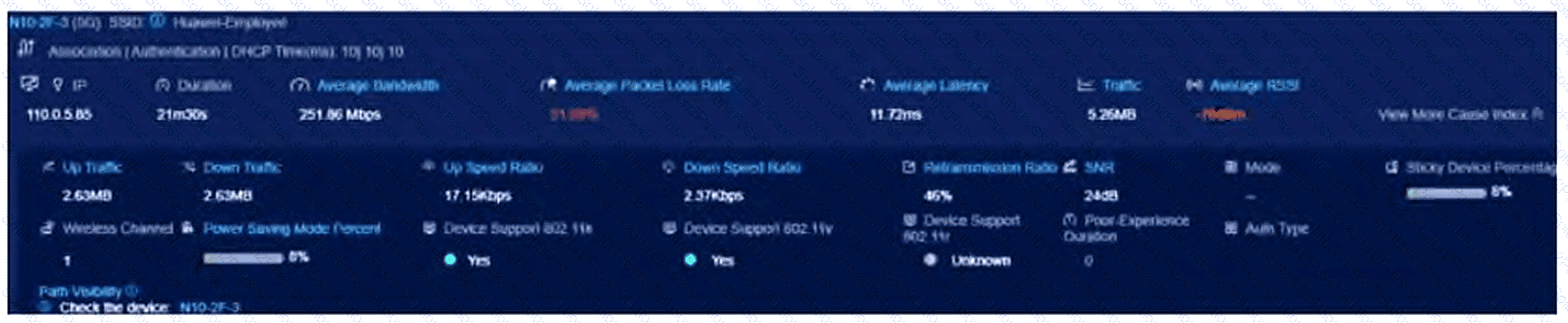
Original exhibit: Q48 Enlarged Exhibit
Which of the following tools are typically used for WLAN optimization?
CHOOSE FOUR
CAPWAP is an application-layer protocol for communication between WACs and Fit APs. Its TCP-based transmission mechanism provides reliable data delivery, improving WLAN stability.
In a network with Huawei's CloudCampus Solution deployed, an AP cannot come online on iMaster NCE-Campus. Which of the following could cause this issue?
CHOOSE THREE
In inter-WAC roaming scenarios, WACs can be placed into different groups. STAs can roam among WACs within the same group, which is called a mobility group. A WAC can serve as the mobility server for multiple mobility groups, but it can be added to only one mobility group.
Which statement below is false regarding STA roaming on a WLAN?
For the parking-lot scenario shown, it is recommended to deploy APs above lanes and at intersections as well, to provide continuous signal coverage.
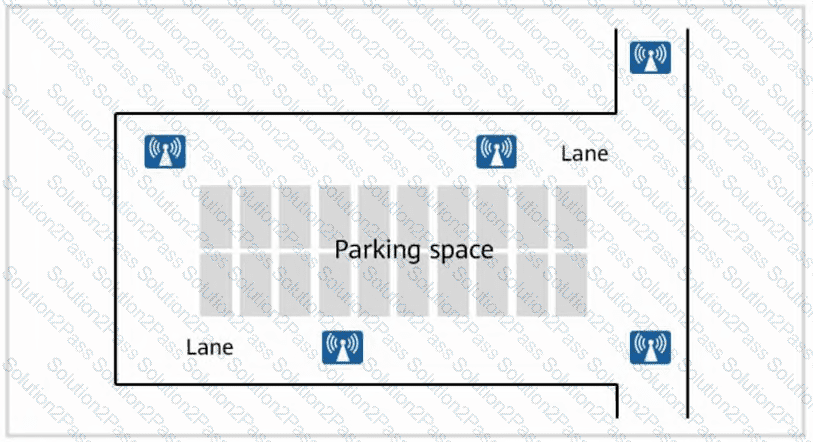
Original exhibit: Q25 Parking Exhibit
What is the maximum number of spatial streams that a 3x2 MIMO WLAN system supports?
Which of the following statements are accurate about performing a WLAN site survey?
CHOOSE All that Apply
Which of the following statements is false about the N+1 backup scenario shown in the figure?
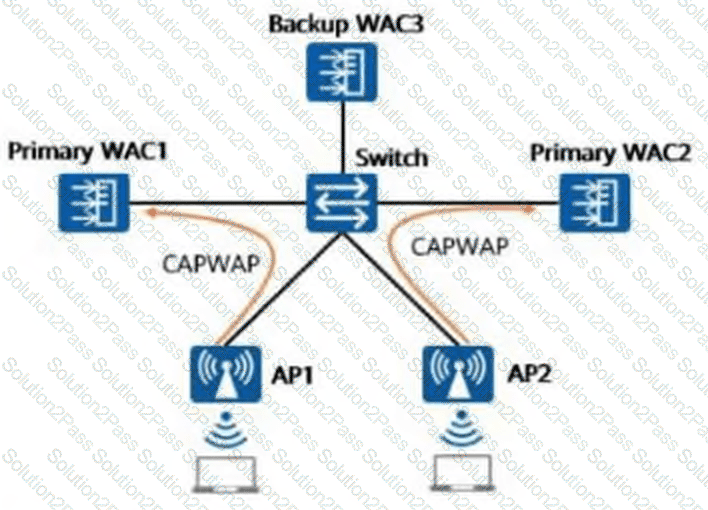
Original exhibit: Q54 Enlarged Exhibit
When using the CloudCampus APP for Wi-Fi experience, network security tests—such as ARP spoofing and DNS hijacking—can be conducted in addition to basic coverage-effect and service-experience testing.
Which WAC reliability networking modes require the active and standby WACs to use the same models and software versions?
CHOOSE TWO
An AP steers a STA when that STA satisfies the steering conditions. STAs running voice or video services are not steered.