JN0-364 Juniper Service Provider Routing and Switching - Specialist (JNCIS-SP) Free Practice Exam Questions (2026 Updated)
Prepare effectively for your Juniper JN0-364 Service Provider Routing and Switching - Specialist (JNCIS-SP) certification with our extensive collection of free, high-quality practice questions. Each question is designed to mirror the actual exam format and objectives, complete with comprehensive answers and detailed explanations. Our materials are regularly updated for 2026, ensuring you have the most current resources to build confidence and succeed on your first attempt.
Exhibit:
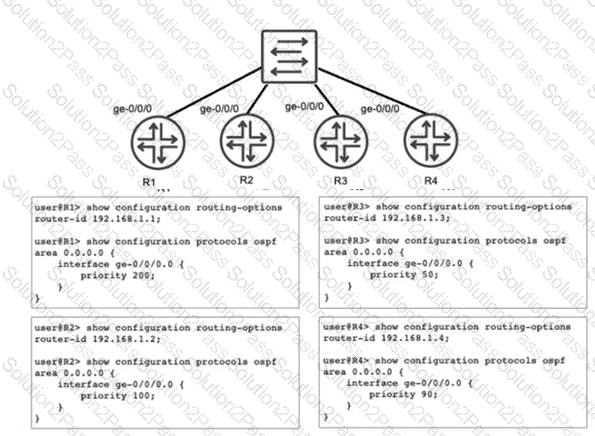
Referring to the exhibit, you have configured R1, R2, R3, and R4 to be a part of OSPF area 0 and you have connected them to a broadcast segment. Assuming all four routers come online within one minute of each other, which router becomes the DR and which router becomes the BDR?
Which two statements are correct about TLVs in IS-IS? (Choose two.)
You are designing an MPLS network and want to ensure that traffic traverses an LSP between PE routers that follow an explicit path through the core. Which protocol would accomplish this task?
By default, which routing table contains a list of all ingress LSPs?
You are configuring BGP on a Juniper router to peer with an external provider. After committing the configuration, the BGP session remains in the Idle state. Which configuration issue would prevent the BGP session from progressing beyond the Idle state?
Exhibit:
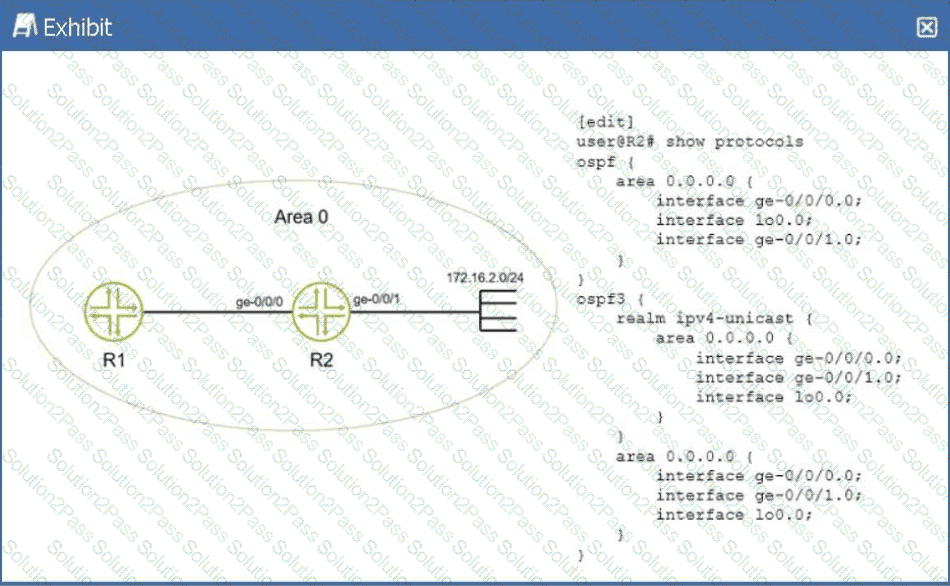
You have configured IPv4 and IPv6 in your network and all OSPF neighbors are established. You apply the configuration shown in the exhibit. Which statement is true in this scenario?
You are troubleshooting a Level 1 IS-IS router that has an adjacency with a Level 1/2 router. Which two statements are correct in this scenario? (Choose two.)
Which IS-IS packet type will establish and maintain neighbor relationships?
Which BGP attribute is optional, transitive, and is passed unchanged to other BGP peers if not recognized?
For two or more switches to participate in the same MSTP region, which parameter must match?
You are asked to configure interfaces on Juniper devices to support dual VLAN tags. In this scenario, which two interface statements would accomplish this task? (Choose two.)
Exhibit:
user@R1> show route 10.16.2.0/23 exact detail
inet.0: 12 destinations, 12 routes (11 active, 0 holddown, 1 hidden)
10.16.2.0/23 (1 entry, 1 announced)
*Aggregate Preference: 130
Next hop type: Reject
Address: 0x8f3fd44
Next-hop reference count: 2
State:
Age: 1:39:21
Task: Aggregate
Announcement bits (1): 0-KRT
AS path: I (LocalAgg)
Flags: Depth: 0 Active
AS path list:
AS path: I Refcount: 2
Contributing Routes (2):
10.16.2.0/24 proto Direct
10.16.3.0/24 proto Direct
Which destination IP address will be matched by the aggregate route shown in the exhibit?
You are a network architect designing a brand new network. You want to deploy RSVP LSPs in this network. You are currently in the process of choosing whether to run OSPF or IS-IS as your interior gateway protocol. In this scenario, which two statements are correct about IGP traffic engineering extensions in an RSVP network? (Choose two.)
Exhibit:
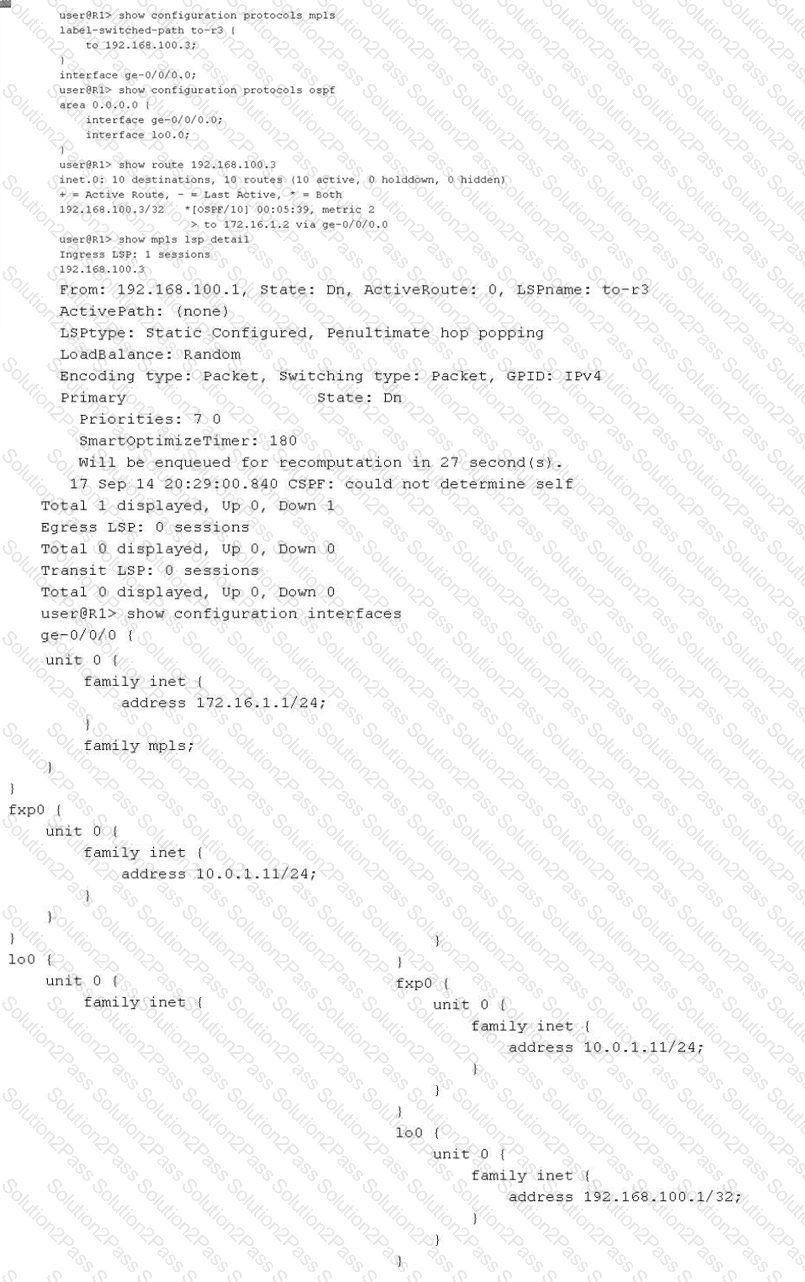
You have configured an MPLS LSP to 192.168.100.3. However, the LSP is in the down state. Referring to the exhibit, which two actions would solve this problem? (Choose two.)
In an OSPF network, what is a purpose of a designated router?
Which two statements about graceful restart are correct? (Choose two.)
Which two events cause a static route to be removed from a routing table? (Choose two.)
You are configuring BGP for IPv6 operations. In this scenario, which two statements are correct? (Choose two.)
What are three default BGP advertisement rules? (Choose three.)