Spring Sale Special - Limited Time 70% Discount Offer - Ends in 0d 00h 00m 00s - Coupon code: xmaspas7

Easiest Solution 2 Pass Your Certification Exams

JN0-481 Juniper Data Center - Specialist (JNCIS-DC) Free Practice Exam Questions (2026 Updated)

Prepare effectively for your Juniper JN0-481 Data Center - Specialist (JNCIS-DC) certification with our extensive collection of free, high-quality practice questions. Each question is designed to mirror the actual exam format and objectives, complete with comprehensive answers and detailed explanations. Our materials are regularly updated for 2026, ensuring you have the most current resources to build confidence and succeed on your first attempt.

Page: 1 / 1
Total 65 questions

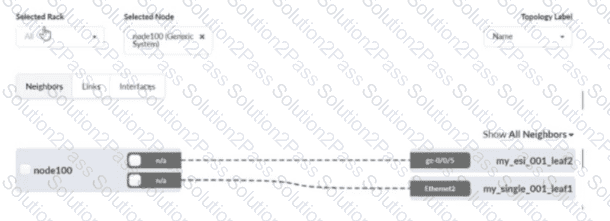
What is correct about the selected device shown in the exhibit?
A.

It is a peer switch.

B.

It is an external generic system.

C.

It is an internal generic system.

D.

It is an access switch.

You must enable ECMP load balance in your three-stage eBGP IP Clos fabric. In this scenario, which two features are required? (Choose two.)

A.

A load-balance policy applied to the forwarding table

B.

multipath multiple-as applied to the BGP group

C.

A load-balance policy applied to the BGP group

D.

multihop applied to the BGP group

What are two available Juniper Apstra template types? (Choose two.)

A.

Collapsed

B.

Rack-based

C.

Compressed

D.

Device-based

You are allowed to assign tags for which three objects? (Choose three.)

A.

Virtual networks

B.

Interfaces

C.

Generic systems

D.

Property sets

E.

Device profiles

You want to gracefully take a device out of service to perform an OS upgrade. How would you accomplish this task using Juniper Apstra?

A.

After selecting the device in the Staged tab, you would select Deploy Mode then Upgrade.

B.

After selecting the device in the Active tab, you would select Deploy Mode then Drain.

C.

After selecting the device in the Dashboard tab, you would select Deploy Mode then Upgrade.

D.

After selecting the device in the Staged tab, you would select Deploy Mode then Drain.

The same connectivity template is applied to the ge-0/0/6 interface on both borderleaf1 and borderleaf2 nodes. This connectivity template describes the intended configuration of the eBGP session between each of the borderleaf nodes and the external router. You want to ensure that the 172.23.x/24 routes are not installed in the borderleaf nodes’ Finance routing table.
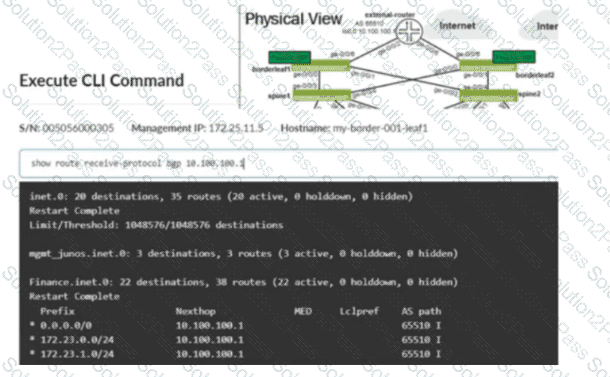
Referring to the exhibit, what would you change in Juniper Apstra to accomplish this task?

A.

Add an aggregate prefix to the routing policy.

B.

Modify the import policy to only allow the default route.

C.

Select the “Expect Default IPv4 Route” checkbox.

D.

Modify the export policy to only allow the default route.

You are trying to deploy a five-stage template to a blueprint as shown in the exhibit. You cannot see your template name in the list of available templates.
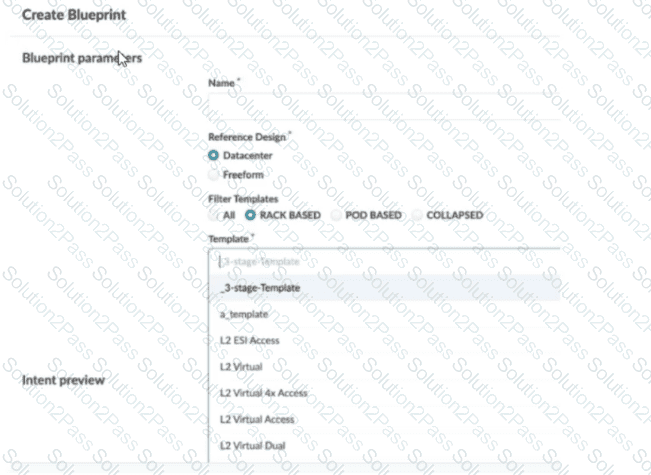
In this scenario, which statement is correct?

A.

The Collapsed option should be selected.

B.

You must include “five-stage” in the template name for it to appear in the list.

C.

The Pod Based option should be selected.

D.

Only Freeform-type blueprints support five-stage templates.

What are three phases of the Juniper Apstra data center life cycle? (Choose three.)

A.

Configuration

B.

Design

C.

Installation

D.

Operational phase

E.

Deployment

What does VXLAN use to uniquely label and identify broadcast domains?

A.

VLAN ID

B.

Agent Circuit Identifier (ACI)

C.

Virtual Network Identifier (VNI)

D.

End System Identifier (ESI)

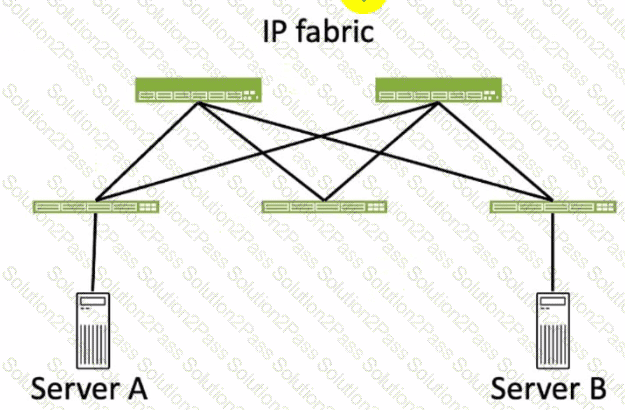
Exhibit.

Referring to the exhibit, how many broadcast domains will an Ethernet frame pass through when traversing the IP fabric from Server A to Server B?

A.

1

B.

4

C.

2

D.

3

You are assigning managed devices to a blueprint, for a fully functioning IP fabric. In the Juniper Apstra UI, which mode should you choose for this task?

A.

Deploy

B.

Ready

C.

Not Set

D.

Drain

You are using Juniper Apstra to create your DC fabric. The fabric requires the use of configlets and requires a property set, which you call “test.” While creating the property set, you encounter an error message.
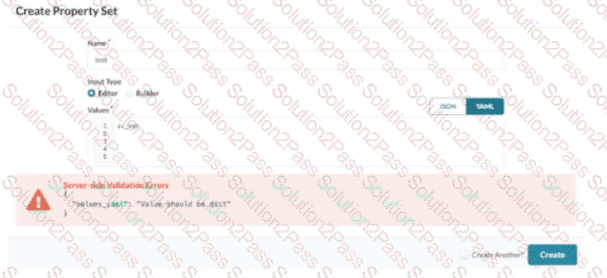
Referring to the exhibit, how would you correct the error?

A.

Use the Builder option for input type of YAML.

B.

Remove the trailing blank lines.

C.

Change to JSON and click Create.

D.

Use valid YAML syntax of key: value.

Which two actions are required during Juniper Apstra's deploy phase? (Choose two.)

A.

Assign device profiles to the blueprint.

B.

Assign user roles to the blueprint.

C.

Assign interlace maps to the blueprint.

D.

Assign resources to the blueprint.

What is the purpose of an interface map in Juniper Apstra?

A.

An interface map associates a logical device with a device profile.

B.

An interface map specifies a connection between the interfaces of two devices.

C.

An interface map specifies the number of ports and the port speeds of a logical device

D.

An interface map specifies the connections between racks in a template.

The analytics probe shown in the exhibit is enabled.
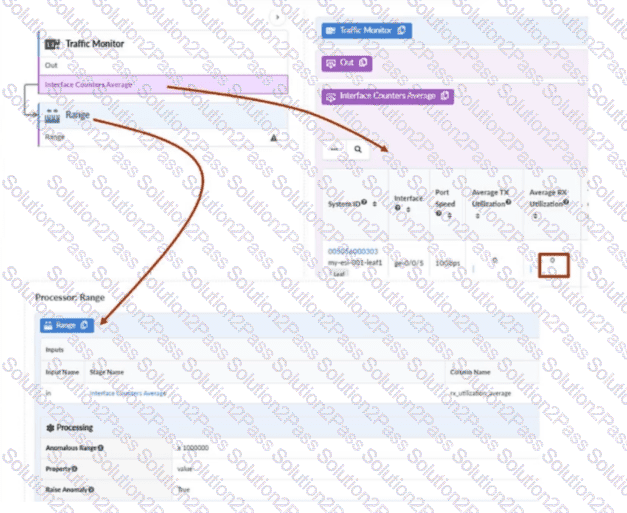
The ge-0/0/5 interface on the my-esl-001-leaf1 node receives an average of greater than 1 Mbps of traffic. Which two statements are correct in this scenario? (Choose two.)

A.

A probe anomaly will be raised.

B.

The indicator for the Analytics tab in the blueprint will turn red.

C.

The indicator for the Active tab in the blueprint will turn red.

D.

A service anomaly will be raised.

What are two types of virtual networks defined inside Juniper Apstra software? (Choose two.)

A.

VLAN

B.

L3 VPN

C.

VXLAN

D.

L2 VPN

What is the purpose of an EVPN Ethernet segment identifier (ESI)?

A.

To provide a hop count between devices

B.

To identify Layer 2 frame types for filtering purposes

C.

To specify a BGP community

D.

To prevent loops within a LAG connection

Which attribute enables Juniper Apstra to scale and manage thousands of devices with a single server instance?

A.

Apstra is installed as a cloud resource.

B.

Apstra is based on NGINX.

C.

Apstra is available as an OVA.

D.

Apstra is a distributed state system.

Juniper Apstra provides five different predefined user roles. Given this information, what is the main difference between the administrator and the user role?

A.

The user role can only be assigned to specific blueprints.

B.

The user role can make changes to any other role.

C.

The user role cannot make any changes to other user types.

D.

The user role can only make changes to the view role.

Page: 1 / 1
Total 65 questions
Copyright © 2014-2026 Solution2Pass. All Rights Reserved