AZ-802 Microsoft Administering Windows Server Free Practice Exam Questions (2026 Updated)
Prepare effectively for your Microsoft AZ-802 Administering Windows Server certification with our extensive collection of free, high-quality practice questions. Each question is designed to mirror the actual exam format and objectives, complete with comprehensive answers and detailed explanations. Our materials are regularly updated for 2026, ensuring you have the most current resources to build confidence and succeed on your first attempt.
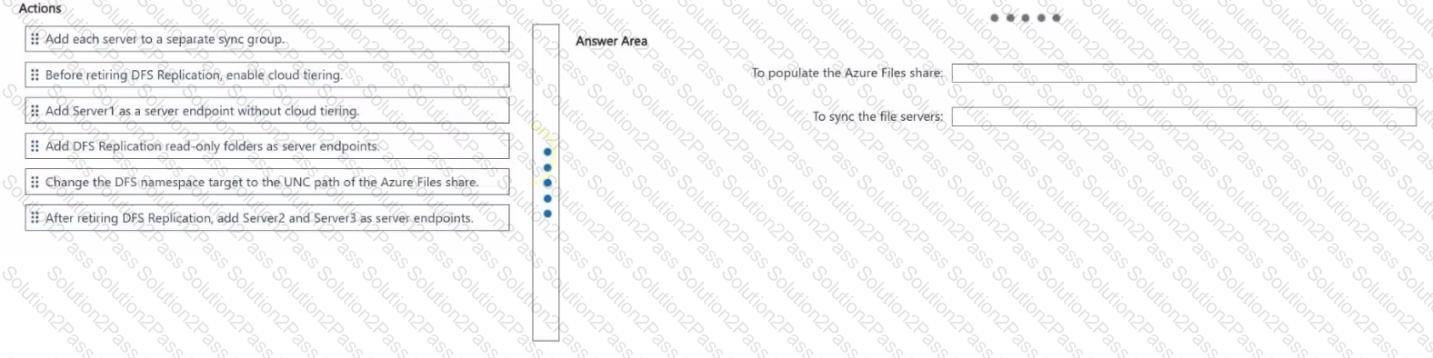
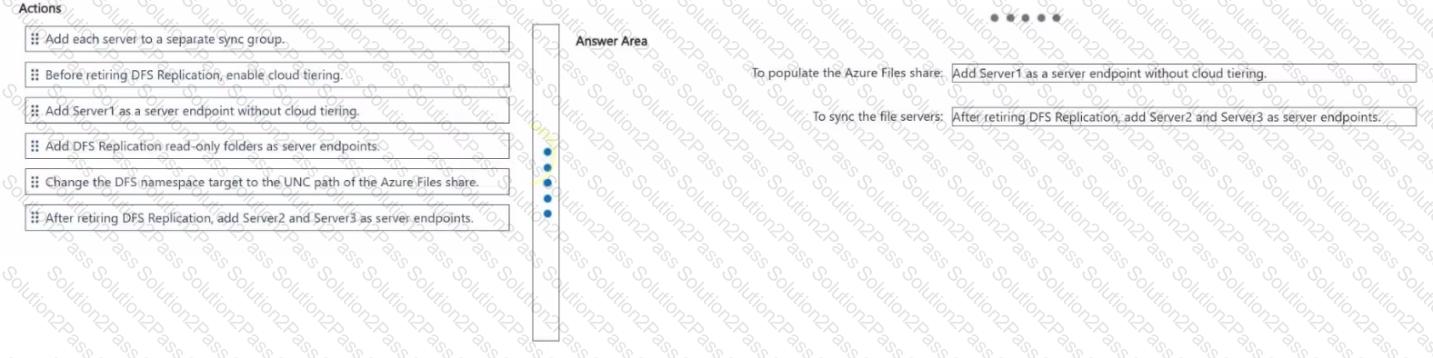
Your network contains an on-premises Active Directory Domain Services (AD DS) domain named contoso.com. The domain contains three file servers named Server1, Server2, and Server3.
You have a domain-based Distributed File System (DFS) share named \\contoso.com\shares\Projects. Projects has folder targets on each file server. DFS Replication replicates Projects between the servers.
You need to migrate the replication for Projects from DFS Replication to Azure File Sync by using an existing Azure Files share. The solution must meet the following requirements:
• Preserve the current domain UNC path.
• After the migration, sync the changes from all the servers by using Azure File Sync.
• Ensure that the Azure Files share contains the Projects data before DFS Replication is retired.
What should you do? To answer, drag the appropriate actions to the correct requirements. Each action may be used once, more than once, or not at all. You may need to drag the split bar between panes or scroll to view content.
NOTE: Each correct selection is worth one point.

Your on-premises datacenter contains physical servers and Hyper-V virtual machines.
You have an Azure subscription.
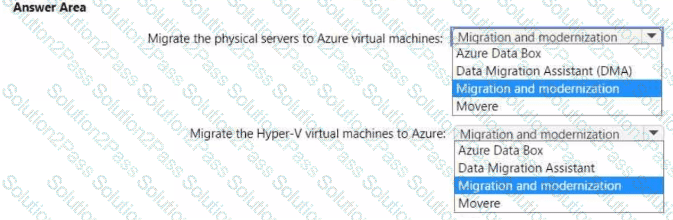
You plan to use Azure Migrate to perform the following tasks:
• Migrate the physical servers to Azure virtual machines.
• Migrate the Hyper-V virtual machines to Azure.
What should you use for each task? To answer, select the appropriate options in the answer area. NOTE: Each correct selection is worth one point.

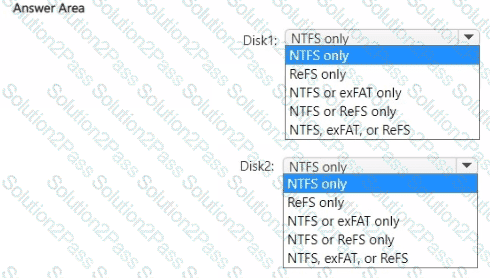
You have a Windows server named Server1. You add two 4-TB hard drives named Disk1 and Disk2 to Server1. You need to format the drives. The solution must meet the following requirements: • Disk1 must support disk level quotas. • Disk2 must support Data Deduplication. Which type of file system should you use for each drive? To answer, select the appropriate options in the answer area. NOTE: Each correct selection is worth one point.

You have an Azure subscription that contains the virtual networks shown in the following table: VNet1 (Subnet11, Subnet12, West US), VNet2 (Subnet21, West US), VNet3 (Subnet31, Central US). You deploy a virtual machine named VM1 that runs Windows Server. VM1 is connected to Subnet11. You plan to add an additional network interface named NIC1 to VM1. To which subnets can NIC1 be attached?
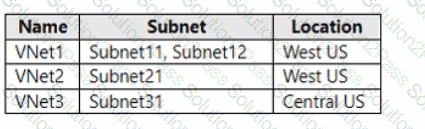
Virtual network/subnet/region table
You have an on-premises server that runs Windows Server and contains the folders shown in the following table. You have an Azure subscription. You plan to implement Azure File Sync. Which folders can be added as Azure File Sync server endpoints?
You have an Azure subscription that contains the virtual machines shown in the following table. You plan to use Azure Site Recovery to replicate supported virtual machines to a secondary Azure region. Which virtual machines can be replicated by using Azure Site Recovery? (Exhibit: VMs with their security type and OS.)
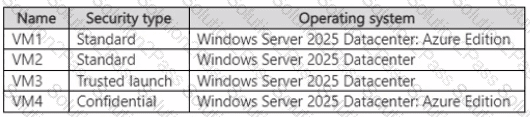
Virtual machines with their security type and operating system
Technical requirements: Promote a new server named DC4 that runs Windows Server 2022 to a domain controller. Replicate the virtual machines from Cluster2 to an Azure Recovery Services vault. Centrally manage performance alerts in Azure for all the domain controllers. Ensure that User1 can recover objects from the Active Directory Recycle Bin. Migrate Share1 to Server2, including all the share and folder permissions. Back up Server4 and all data to an Azure Recovery Services vault. Use Hyper-V Replica to protect the virtual machines in Cluster3. Implement BitLocker Drive Encryption (BitLocker) on Server4. Whenever possible, use the principle of least privilege. You need to meet the technical requirements for Share1. What should you use?
Technical requirements: Promote a new server named DC4 that runs Windows Server 2022 to a domain controller. Replicate the virtual machines from Cluster2 to an Azure Recovery Services vault. Centrally manage performance alerts in Azure for all the domain controllers. Ensure that User1 can recover objects from the Active Directory Recycle Bin. Migrate Share1 to Server2, including all the share and folder permissions. Back up Server4 and all data to an Azure Recovery Services vault. Use Hyper-V Replica to protect the virtual machines in Cluster3. Implement BitLocker Drive Encryption (BitLocker) on Server4. Whenever possible, use the principle of least privilege. You need to meet the technical requirements for Cluster3. What should you include in the solution?
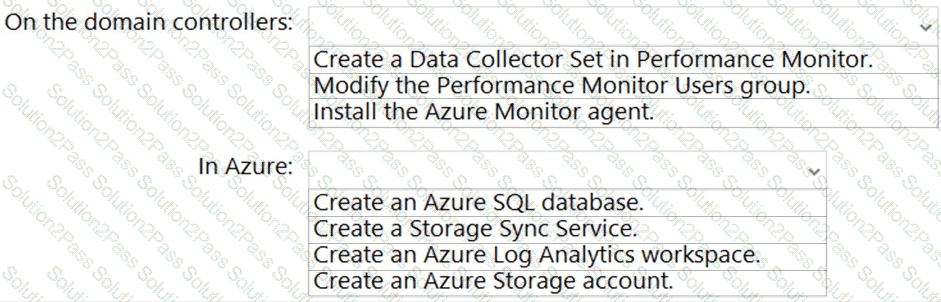
You need to implement alerts for the domain controllers. The solution must meet the technical requirements.
What should you do on the domain controllers, and what should you create on Azure? To answer, select the appropriate options in the answer area.
NOTE: Each correct selection is worth one point.
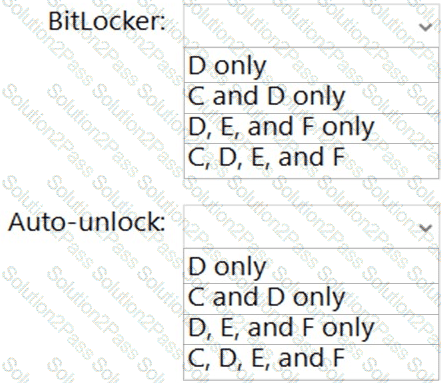
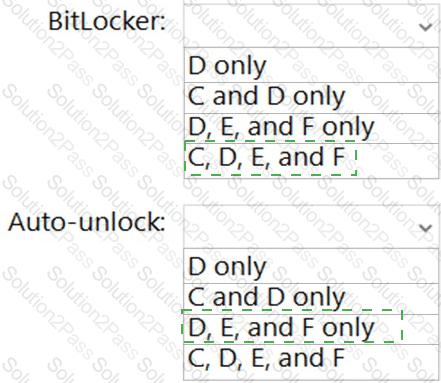
You need to configure BitLocker on Server4.
On which volumes can you turn on BitLocker, and on which volumes can you turn on auto-unlock? To answer, select the appropriate options in the answer area.
NOTE: Each correct selection is worth one point.
Technical requirements: Promote a new server named DC4 that runs Windows Server 2022 to a domain controller. Replicate the virtual machines from Cluster2 to an Azure Recovery Services vault. Centrally manage performance alerts in Azure for all the domain controllers. Ensure that User1 can recover objects from the Active Directory Recycle Bin. Migrate Share1 to Server2, including all the share and folder permissions. Back up Server4 and all data to an Azure Recovery Services vault. Use Hyper-V Replica to protect the virtual machines in Cluster3. Implement BitLocker Drive Encryption (BitLocker) on Server4. Whenever possible, use the principle of least privilege. You need to back up Server4 to meet the technical requirements. What should you do first?
Technical requirements: Promote a new server named DC4 that runs Windows Server 2022 to a domain controller. Replicate the virtual machines from Cluster2 to an Azure Recovery Services vault. Centrally manage performance alerts in Azure for all the domain controllers. Ensure that User1 can recover objects from the Active Directory Recycle Bin. Migrate Share1 to Server2, including all the share and folder permissions. Back up Server4 and all data to an Azure Recovery Services vault. Use Hyper-V Replica to protect the virtual machines in Cluster3. Implement BitLocker Drive Encryption (BitLocker) on Server4. Whenever possible, use the principle of least privilege. You need to meet the technical requirements for User1. To which group in contoso.com should you add User1?
Technical requirements: Promote a new server named DC4 that runs Windows Server 2022 to a domain controller. Replicate the virtual machines from Cluster2 to an Azure Recovery Services vault. Centrally manage performance alerts in Azure for all the domain controllers. Ensure that User1 can recover objects from the Active Directory Recycle Bin. Migrate Share1 to Server2, including all the share and folder permissions. Back up Server4 and all data to an Azure Recovery Services vault. Use Hyper-V Replica to protect the virtual machines in Cluster3. Implement BitLocker Drive Encryption (BitLocker) on Server4. Whenever possible, use the principle of least privilege. You need to promote DC4 to meet the technical requirements. Which domain controller should be online to meet the technical requirements for DC4?
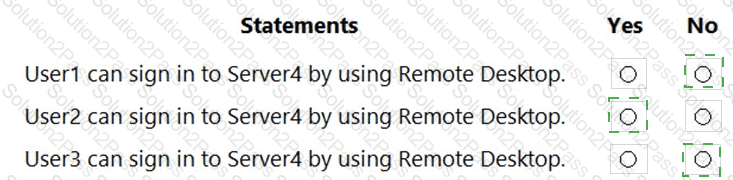
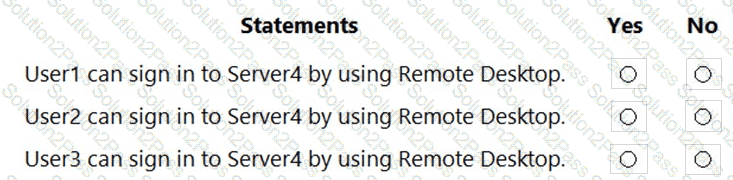
For each of the following statements, select Yes if the statement is true. Otherwise, select No.
NOTE: Each correct selection is worth one point.
Technical requirements: Promote a new server named DC4 that runs Windows Server 2022 to a domain controller. Replicate the virtual machines from Cluster2 to an Azure Recovery Services vault. Centrally manage performance alerts in Azure for all the domain controllers. Ensure that User1 can recover objects from the Active Directory Recycle Bin. Migrate Share1 to Server2, including all the share and folder permissions. Back up Server4 and all data to an Azure Recovery Services vault. Use Hyper-V Replica to protect the virtual machines in Cluster3. Implement BitLocker Drive Encryption (BitLocker) on Server4. Whenever possible, use the principle of least privilege. You need to identify the minimum number of Azure Site Recovery Provider installations required to protect Cluster2. What is the minimum number of installations required?
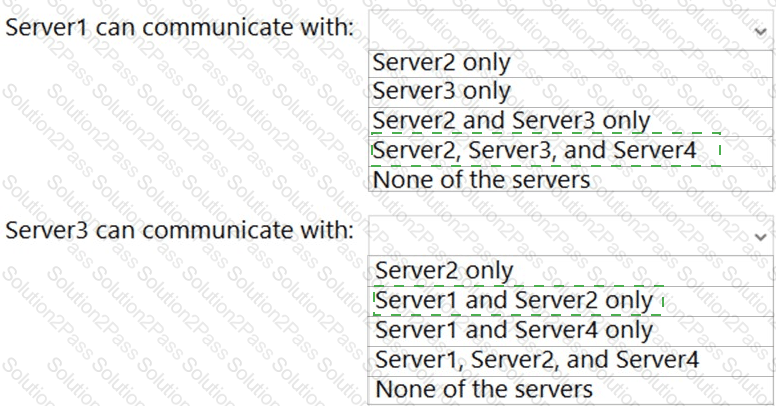
With which servers can Server1 and Server3 communicate? To answer, select the appropriate options in the answer area.
NOTE: Each correct selection is worth one point.
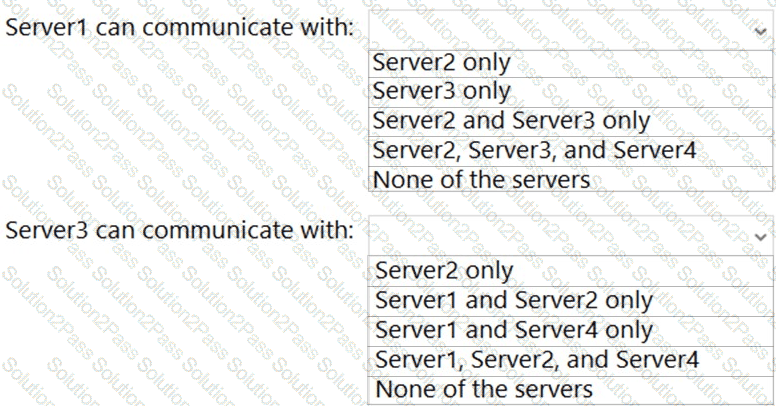
Exhibit

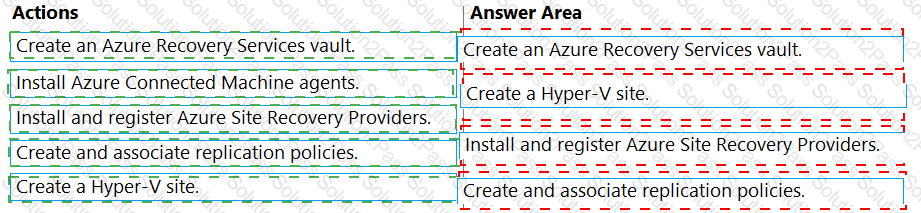
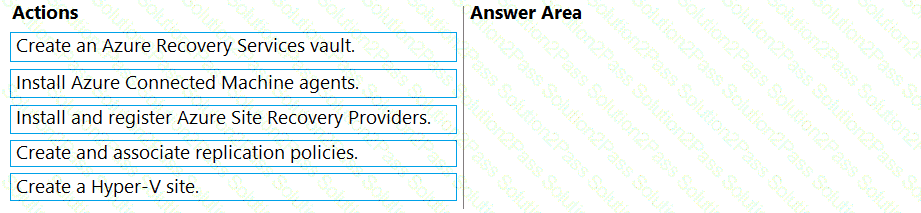
You need to meet the technical requirements for Cluster2.
Which four actions should you perform in sequence before you can enable replication? To answer, move the appropriate actions from the list of actions to the answer area and arrange them in the correct order.
What is the effective minimum password length for User1 and Admin1? To answer, select the appropriate options in the answer area.
NOTE: Each correct selection is worth one point.
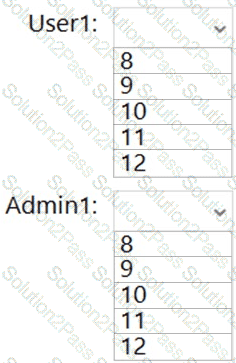
Exhibit

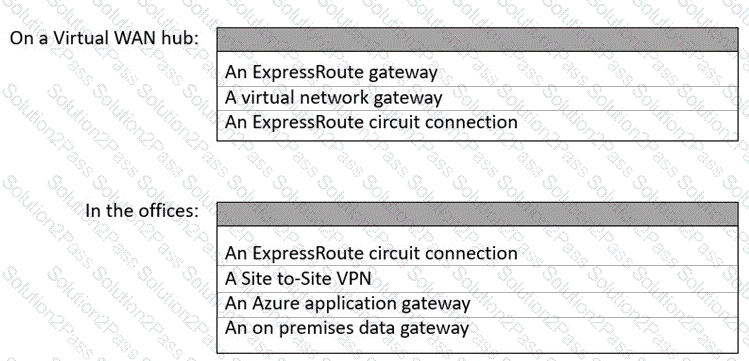
You need to configure network communication between the Seattle and New York offices. The solution must meet the requirements. What should you configure? To answer, select the appropriate options in the answer area. NOTE: Each correct selection is worth one point.

You need to configure remote administration to meet the security requirements. What should you use?