Pre-Summer Sale Special - Limited Time 70% Discount Offer - Ends in 0d 00h 00m 00s - Coupon code: xmaspas7

Easiest Solution 2 Pass Your Certification Exams

CPHQ NAHQ Certified Professional in Healthcare Quality Examination Free Practice Exam Questions (2026 Updated)

Prepare effectively for your NAHQ CPHQ Certified Professional in Healthcare Quality Examination certification with our extensive collection of free, high-quality practice questions. Each question is designed to mirror the actual exam format and objectives, complete with comprehensive answers and detailed explanations. Our materials are regularly updated for 2026, ensuring you have the most current resources to build confidence and succeed on your first attempt.

Page: 6 / 9
Total 813 questions

The chairperson of the governing body has requested an annual report on improvements in patient care. The report should include

A.

the names of physicians who fall below the threshold of standards of care.

B.

a detailed description of all quality activities.

C.

an overview of the quality program, specifying the effects on patient care.

D.

the results of peer review.

A graph shows a 50% complication rate for appendectomies. Which of the following would be most important to assist the reader in interpreting the data?

A.

Sample size

B.

Groups excluded

C.

Source data

D.

Method of data collection

Which type of data could best be used to help identify health-determinant information in apatient population?

A.

payor claims

B.

preventive care checklist

C.

patient satisfaction

D.

event reporting

A healthcare quality professional partners with the chief nursing officer (CNO) to implement a safety champion program to promote barcode medication scanning. What conclusion can be made from the data?

Unit

Pre (%)

Post (%)

Safety Champion Rounds

A

55

85

20

B

46

48

18

C

51

50

3

A.

Safety champion rounding was ineffective and should be reconsidered on unit C

B.

The CNO should reinforce safety champion rounding on unit A

C.

A different strategy should be used on unit B

D.

The use of safety champions was effective on unit B

Leadership wants to leverage technology as a strategy for improvement of patient safety. Which of the following best illustrates this is occurring?

A.

A decrease is noted in the number of adverse events reported in the electronic incident reporting system.

B.

Staff are unable to move past a required double check without a second staff member using their log-in.

C.

There is an increase in workarounds recorded by the barcode medication administration system (BCMA).

D.

There is less oral communication of the team, replaced by communication in the electronic medical record.

Consider the following data set:

DRG | Reimbursement | Cost

079 | $4,500 | $15,000

089 | $6,800 | $23,500

127 | $3,500 | $25,000

468 | $8,200 | $12,500

475 | $12,000 | $40,000

Which of the following is the best way to illustrate the relationship between reimbursement and cost?

A.

Mean

B.

Standard deviation

C.

Pie chart

D.

Scatter diagram

Criteria used to evaluate a team’s performance generally include productivity, individual growth, and:

A.

Leadership

B.

Attendance

C.

Satisfaction

D.

Acquiescence

A key concept in patient safety planning is to design procedures that

A.

meet the needs of individual departments.

B.

standardize patient care practices.

C.

make errors non-transparent.

D.

prevent all occurrences.

A health system is designing a new wellness program and wants to incorporate social determinants of health. Which of the following should be considered?

A.

How often patients have moved in the last year

B.

Average age of individuals in the community

C.

Types of patients' health insurance

D.

Percent of families with multigenerational households

Survey results for three clinics are shown below:

Measure

Clinic A

Clinic B

Clinic C

Target

Complaints (per 1,000 visits)

16

5

17

< 5

Compliments (per 1,000 visits)

8

14

> 10

Wait time (average minutes)

20

18

< 15

Based on these findings, the organization should:

A.

Enforce a complaint training program

B.

Identify customer service strategies

C.

Provide training on decreasing wait times

D.

Continue to track and trend results

Which of the following is the role a healthcare quality professional should play in strategic planning?

A.

Provide data on performance indicators.

B.

Review and redefine annual objectives.

C.

Develop the vision, mission, and goals.

D.

Identify causes of lost revenue.

Which of the following is an outcome indicator for a radiology unit?

A.

Utilization of CT scan for low back pain

B.

Contrast-induced complications

C.

Mammography result turnaround time

D.

"Time-out" performed for interventional cases

A pharmacy staff member informs a healthcare quality professional that use of a particularly expensive drug has been increasing over the past six months. Which of the following is the next best step?

A.

Collect data related to the administration and monitoring of the effects of this drug

B.

Recommend peer reviews of prescribing practitioners

C.

Continue to monitor the pharmacy data for an additional six months

D.

Collect data related to the prescribing and dispensing patterns for this drug

In reviewing information offered by the Agency for Healthcare Research and Quality (AHRQ), the quality improvement (QI) specialist recognizes that the three broad aims pursued by the National Quality Strategy are

A.

reduce medical waste, use Lean, and achieve equity and better access to care.

B.

reduce complications, reduce readmissions, and improve health outcomes.

C.

better care, healthy people/health communities, and affordable care.

D.

triple aim, reduce utilization, and affordable care.

A patient safety manager is asked to recommend the best action to reduce medication errors at a hospital. Which of the following is the most appropriate next step?

A.

Re-educate the nursing staff on correct medication administration procedures.

B.

Conduct research on implementation of a bar code medication administration system.

C.

Ask the unit managers to counsel staff following medication errors.

D.

Drill down onthe data to identify trends before making recommendations.

Which of the following should be used to show beginning and ending times for an activity along a timeline?

A.

Control chart

B.

Fishbone diagram

C.

Pareto chart

D.

Gantt chart

What is the primary purpose of a balanced scorecard?

A.

Translating the vision and strategic objectives into performance measures.

B.

Providing leadership with an overview of the organization's culture.

C.

Creating departmental objectives that are aligned with the strategic plan objectives.

D.

Linking performance improvement initiatives with financial incentives.

A Pharmacy and Therapeutics Committee has reviewed the following control chart for presentation to a governing body:
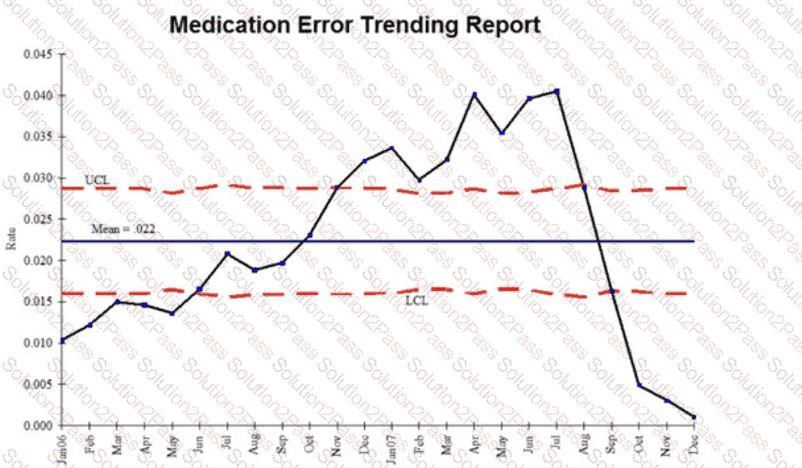
Which of the following conclusions is most appropriate?

A.

The strategic goal for improving reporting of errors has been met.

B.

The strategic goal for improving patient safety has been met.

C.

The most serious errors are occurring in the spring and summer.

D.

There has been a significant reduction in reported errors.

After a sentinel event, a root cause analysis (RCA) is performed. Which of the following should be included in the RCA?

A.

Implementing process redesign

B.

Reporting event to the accrediting body

C.

Retraining of individuals involvedThe facility’s compliance rate on pain assessment is shown below:Compliance Rate on Pain AssessmentJanuaryFebruaryMarchPhysicians40%50%20%Nurses80%75%83%Physical Therapists60%55%50%To improve performance, what should be done next?

D.

Disseminate the results to nursing staff.

E.

Continue monitoring for another quarter.

F.

Create an action plan with the department leaders.

G.

Hire a pain management specialist.

A healthcare quality analyst compiles and analyzes data to facilitate performance improvement opportunities. The most suitable data review to proactively control cost would be which type of review process?

A.

Retrospective

B.

Prospective

C.

Administrative claims

D.

Clinical records

A quality improvement team is studying the incidence of ear infections in pediatric patients. In addition to the incidence of infection, the team would like to know the predominate age groups affected. Preliminary data indicates that the ages of the patients to be studied are as follows:

1, 1, 1, 1, 1, 2, 2, 3, 4, 4

What is the median age of the patients in this study?

A.

1

B.

1.5

C.

2

D.

2.5

A process that is stable can best be identified through using a:

A.

Scatter diagram

B.

Histogram

C.

Run chart

D.

Shewhart chart

Physician quality data reports for all credentialed physicians disseminated at regular Intervals, as generally mandated by accreditation standards, are called

A.

focused professional practice evaluation (FPPE).

B.

CMS star ratings.

C.

quality spot checks.

D.

ongoing professional practice evaluation (OPPE).

The safety reporting system being used by an organization cannot produce reports or information in a usable format. After evaluating the existing system and other products on the market, which of the following should the quality professional do before making recommendations to leadership?

A.

Prepare a comparative analysis based on the information gathered.

B.

Conduct a focus group with participants from other sites within the organization.

C.

Interview current users of the other identified products.

D.

Create a potential implementation plan for the preferred product.

Which of the following is a quality improvement opportunity in care transitions at the clinician level?

A.

Identify barriers to discharge for an unfunded homeless patient

B.

Sponsor quality improvement projects related to reducing readmissions

C.

Facilitate strategic planning of outpatient follow-up for discharged patients

D.

Dedicate resources to address average length-of-stay discrepancies

Continued evaluation of a quality improvement initiative occurs within which of the following phases of the DMAIC process?

A.

Measure

B.

Analyze

C.

Improve

D.

Control

Secondary prevention Is Primarily Intended to

A.

eliminate risk factors for a disease.

B.

prevent disease or disease process.

C.

focus on early detection and treatment of disease.

D.

reduce moderate disability associated with advanced disease.

Which of the following led to large data sets being available to healthcare quality professionals?

A.

Electronic health records and health information exchanges

B.

Healthcare and health quality blogs

C.

Data from state public health agencies

D.

Patient wearable devices

A program to improve individuals' dietary habits has had success in some neighborhoods but not others. Based on the data (higher poverty and non-English speakers correlate with lower success), what is an approach that would make the program successful in more neighborhoods?

A.

Increase efforts to disseminate program information at senior centers.

B.

Distribute vouchers to subsidize the cost of healthy food.

C.

Hire dieticians to specifically reach out to adults who have not completed college.

D.

Make program-related information available in common languages spoken.

A CEO has directed a quality improvement council to develop objectives to meet an identified goal. When developing objectives, the council must remember to

A.

keep the objectives specific to the short term.

B.

tie the objectives to theorganization’s financial performance.

C.

use the Plan-Do-Study-Act cycle of continuous improvement.

D.

state the end result or desired outcome.

Page: 6 / 9
Total 813 questions
Copyright © 2014-2026 Solution2Pass. All Rights Reserved