Spring Sale Special - Limited Time 70% Discount Offer - Ends in 0d 00h 00m 00s - Coupon code: xmaspas7

Easiest Solution 2 Pass Your Certification Exams

4A0-205 Nokia Optical Networking Fundamentals Free Practice Exam Questions (2026 Updated)

Prepare effectively for your Nokia 4A0-205 Nokia Optical Networking Fundamentals certification with our extensive collection of free, high-quality practice questions. Each question is designed to mirror the actual exam format and objectives, complete with comprehensive answers and detailed explanations. Our materials are regularly updated for 2026, ensuring you have the most current resources to build confidence and succeed on your first attempt.

Page: 1 / 1
Total 59 questions

How many PM bins can be stored, for each data collection point, on PSS systems?

A.

120 x 15-min bins, 60 x 1-day bins and 1 raw bin.

B.

200 x 15-min bins, 90 x 1-day bins and 1 raw bin.

C.

4 x 15-min bins and 1 x 1-day bin.

D.

33 x 15-min bins, 8 x 1-day bins and 1 raw bin.

How does a Raman pump work in the 1830 specific implementation?

A.

The amplification is done simultaneously for all channels as they enter the board.

B.

As the incoming signal power increase, the gain of the amplifier is reduced.

C.

The pump light travels in the same direction of the signal, amplifying it while it flows in the fiber towards the following node.

D.

The pump light travels in the opposite direction of the signal to be amplified, amplifying it while it arrives from the adjacent node.

In which of the following forms does the TTI byte provide information on network elements?

A.

Source (SAPI) and Destination (DAPI) Access Point Identifiers

B.

Source and destination IP addresses and overhead

C.

Source and destination MAC addresses

D.

Source and destination time-slot identifiers

Which of the following is NOT a troubleshooting functionality of the Wavelength Tracker?

A.

Tracing a service along an optical path.

B.

Testing a node's internal fiber connectivity before service provisioning.

C.

Performing channel power monitoring.

D.

Detecting unexpected or missing channels.

With reference to the image, where is the OPS card placed to provide the OMSP protection?
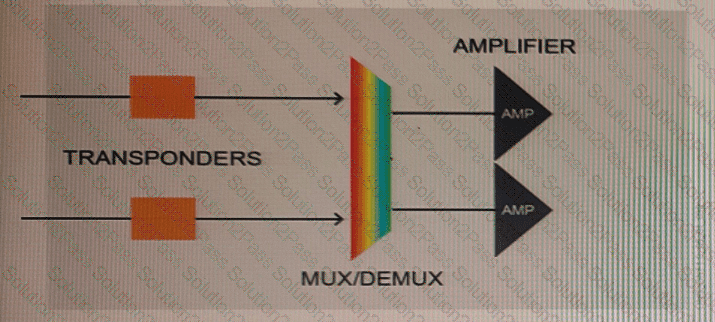
A.

After the amplifiers

B.

Between the mux/demux and the amplifier

C.

Between the transponders and the mux/demux

D.

Before the transponder, on the client side, towards the external device

Is it possible to mix PSS-24x and PSS-8x shelves In an SWDM configuration?

A.

Yes, as both can be equipped within the same node

B.

No, as they are not compatible and cannot be used within the same node

C.

Yes, but the PSS-24X shelf must be configured as a master

D.

Yes, but the PSS-8X shelf must be configured as a master

Which of the following are the main reasons for fiber attenuation?

A.

Refraction and reflection

B.

Scattering and absorption

C.

Chromatic dispersion (CD) and polarization mode dispersion

D.

Small channel spacing

What is the metro area network?

A.

The metro area network is that portion of network that passes through a city to provide connections to several customers.

B.

The metro area network is located between access and core domains.

C.

The metro area network is made of OCS/SWDM nodes only, as no pure photonic nodes are used here.

D.

The metro area network is located in between two access area networks and made of photonic nodes only (no OCS/SWDM nodes are used there).

What is the main function of an optical amplifier?

A.

Demodulating the incoming signal

B.

Compensating for optical power attenuation

C.

Compensating for chromatic dispersion

D.

Compensating for attenuation through an optical-electrical-optical amplification

What is the purpose of the NFM-T deploy menu?

A.

It is used to deploy additional shelves to existing SWDM nodes.

B.

It is used to import EPT files to deploy the network based on the EPT design.

C.

It is used to deploy new operators (administrator, observers, and so on) to access the platform.

D.

It is used to create new network instances, such as physical connections, infrastructures and services.

What is a Shared Risk Group (SRG)?

A.

A set of fibers that share the same latency risk

B.

A set of boards that share the same failure risk

C.

A set of nodes that share a common risk of hardware failure

D.

A set of network resources that share a common failure risk

When monitoring the quality of the received signal in WDM, an open eye indicates:

A.

Low noise

B.

High distortion

C.

High jitter

D.

Presence of high inter-symbolic interference

In which window(s) does the attenuation reach its minimum peak?

A.

First window (850 nm)

B.

Second window (1300 nm)

C.

Third window (1550 nm)

D.

Both first and second windows

How can a mesh network be upgraded so that more services can be transported?

A.

Configuring new WSS cards is the most effective way to give flexibility and network bandwidth to an existing mesh network.

B.

The Protection and Restoration Combined (PRC) mechanism can enable more bandwidth but only for the protected services.

C.

Upgrading the network to coherent transmission is the only effective way to enable more bandwidth to the existing mesh network.

D.

Upgrading link capacity and/or installing new links provides more bandwidth to the existing mesh network.

What is a trail?

A.

An entity to encapsulate a low order signal into a high order container

B.

A transparent transport of a client signal

C.

A link between end points to increase the power budget of the optical link

D.

A physical link between two optical amplifiers

Which use case is most suitable for the deployment of a star topology?

A.

Access networks, for collecting traffic towards the main central node

B.

ASON networks, to protect traffic via GMPL5 protocols

C.

Backbone networks, for supporting protection routes

D.

SNCP-protected links

Which of the following statements about Optical Add/Drop Multiplexers (OADMs) is FALSE?

A.

OADMs allow the user to terminate specific services through transponders.

B.

OADMs allow the user to pass-through specific services at the wavelength optical level (express channels).

C.

OADMs always require O-E-O conversion when passing-through optical channels.

D.

There are two main general classes of OADMs: FOADMs and ROADMs.

Page: 1 / 1
Total 59 questions
Copyright © 2014-2026 Solution2Pass. All Rights Reserved