Pre-Summer Sale Special - Limited Time 70% Discount Offer - Ends in 0d 00h 00m 00s - Coupon code: xmaspas7

Easiest Solution 2 Pass Your Certification Exams

Google Professional-Cloud-DevOps-Engineer Practice Test Questions Answers

Exam Code: Professional-Cloud-DevOps-Engineer (Updated 201 Q&As with Explanation)
Exam Name: Google Cloud Certified - Professional Cloud DevOps Engineer Exam
Last Update: 06-May-2026
Demo:  Download Demo

PDF + Testing Engine
Testing Engine
PDF
$43.5   $144.99
$33   $109.99
$30   $99.99

Questions Include:

  • Single Choice: 184 Q&A's
  • Multiple Choice: 17 Q&A's

  • Professional-Cloud-DevOps-Engineer Overview

    Google Professional-Cloud-DevOps-Engineer Exam Overview

    Overview Description
    Certification Google Professional Cloud DevOps Engineer
    Exam Code GCP
    Delivery Platform Online proctored exam
    Prerequisites Experience with Google Cloud Platform and DevOps methodologies (recommended)
    Exam Duration 2 hours
    Number of Questions 50-60 Multiple Choice and Multiple Select
    Passing Score Not publicly disclosed, but generally around 70%

    Reliable Solution To Pass Professional-Cloud-DevOps-Engineer Cloud DevOps Engineer Certification Test

    Our easy to learn Professional-Cloud-DevOps-Engineer Google Cloud Certified - Professional Cloud DevOps Engineer Exam questions and answers will prove the best help for every candidate of Google Professional-Cloud-DevOps-Engineer exam and will award a 100% guaranteed success!

    Why Professional-Cloud-DevOps-Engineer Candidates Put Solution2Pass First?

    Solution2Pass is ranked amongst the top Professional-Cloud-DevOps-Engineer study material providers for almost all popular Cloud DevOps Engineer certification tests. Our prime concern is our clients’ satisfaction and our growing clientele is the best evidence on our commitment. You never feel frustrated preparing with Solution2Pass’s Google Cloud Certified - Professional Cloud DevOps Engineer Exam guide and Professional-Cloud-DevOps-Engineer dumps. Choose what best fits with needs. We assure you of an exceptional Professional-Cloud-DevOps-Engineer Google Cloud Certified - Professional Cloud DevOps Engineer Exam study experience that you ever desired.

    A Guaranteed Google Professional-Cloud-DevOps-Engineer Practice Test Exam PDF

    Keeping in view the time constraints of the IT professionals, our experts have devised a set of immensely useful Google Professional-Cloud-DevOps-Engineer braindumps that are packed with the vitally important information. These Google Professional-Cloud-DevOps-Engineer dumps are formatted in easy Professional-Cloud-DevOps-Engineer questions and answers in simple English so that all candidates are equally benefited with them. They won’t take much time to grasp all the Google Professional-Cloud-DevOps-Engineer questions and you will learn all the important portions of the Professional-Cloud-DevOps-Engineer Google Cloud Certified - Professional Cloud DevOps Engineer Exam syllabus.

    Most Reliable Google Professional-Cloud-DevOps-Engineer Passing Test Questions Answers

    A free content may be an attraction for most of you but usually such offers are just to attract people to clicking pages instead of getting something worthwhile. You need not surfing for online courses free or otherwise to equip yourself to pass Professional-Cloud-DevOps-Engineer exam and waste your time and money. We offer you the most reliable Google Professional-Cloud-DevOps-Engineer content in an affordable price with 100% Google Professional-Cloud-DevOps-Engineer passing guarantee. You can take back your money if our product does not help you in gaining an outstanding Professional-Cloud-DevOps-Engineer Google Cloud Certified - Professional Cloud DevOps Engineer Exam exam success. Moreover, the registered clients can enjoy special discount code for buying our products.

    Google Professional-Cloud-DevOps-Engineer Exam Topics Breakdown


    Exam Section Percentage of Questions Description
    Bootstrapping a Google Cloud organization for DevOps 17% Designing the overall resource hierarchy, implementing IAM and security best practices, and configuring billing and monitoring.
    Building and implementing CI/CD pipelines for a service 23% Selecting appropriate CI/CD tools (Cloud Build, Cloud Functions), designing effective pipelines, and integrating with source control and testing tools.
    Applying site reliability engineering practices to a service 23% Implementing monitoring, logging, alerting strategies, and incident response best practices to ensure service reliability.
    Implementing service monitoring strategies 21% Using Cloud Monitoring, Logs Explorer, and other tools to gain insights into service health and performance.
    Optimizing the service performance 16% Scaling resources, identifying performance bottlenecks, and implementing techniques for continuous performance optimization.

    Google Professional-Cloud-DevOps-Engineer Cloud DevOps Engineer Practice Exam Questions and Answers

    For getting a command on the real Google Professional-Cloud-DevOps-Engineer exam format, you can try our Professional-Cloud-DevOps-Engineer exam testing engine and solve as many Professional-Cloud-DevOps-Engineer practice questions and answers as you can. These Google Professional-Cloud-DevOps-Engineer practice exams will enhance your examination ability and will impart you confidence to answer all queries in the Google Professional-Cloud-DevOps-Engineer Google Cloud Certified - Professional Cloud DevOps Engineer Exam actual test. They are also helpful in revising your learning and consolidate it as well. Our Google Cloud Certified - Professional Cloud DevOps Engineer Exam tests are more useful than the VCE files offered by various vendors. The reason is that most of such files are difficult to understand by the non-native candidates. Secondly, they are far more expensive than the content offered by us. Read the reviews of our worthy clients and know how wonderful our Google Cloud Certified - Professional Cloud DevOps Engineer Exam dumps, Professional-Cloud-DevOps-Engineer study guide and Professional-Cloud-DevOps-Engineer Google Cloud Certified - Professional Cloud DevOps Engineer Exam practice exams proved helpful for them in passing Professional-Cloud-DevOps-Engineer exam.

    Google Professional-Cloud-DevOps-Engineer Exam Dumps FAQs

    The Google Professional-Cloud-DevOps-Engineer exam is a certification exam that assesses your ability to implement processes throughout the systems development lifecycle using Google-recommended methodologies and tools. It evaluates your skills in building and deploying software and infrastructure delivery pipelines, optimizing and maintaining production systems and services, and balancing service reliability with delivery speed.

    The Google Professional-Cloud-DevOps-Engineer exam is ideal for IT professionals with experience in:

    • DevOps practices and principles
    • Cloud computing, preferably Google Cloud Platform (GCP)
    • Software development and infrastructure management
    • Site Reliability Engineering (SRE) concepts

    There are no particular requisites for taking this exam. Only the exam candidates should have required knowledge on the content of the Google Professional-Cloud-DevOps-Engineer exam syllabus. They should also develop their hand-on exposure on the all topics.

    The Google Professional-Cloud-DevOps-Engineer exam focuses on your ability to:

    • Bootstrap a GCP organization for DevOps: Configure IAM, quotas, billing, and resource management.
    • Build and implement CI/CD pipelines: Utilize Cloud Build, Cloud Functions, and Cloud Deployment Manager.
    • Apply SRE practices to a service: Design for high availability, scalability, and observability using tools like Cloud Monitoring and Cloud Logging.
    • Implement service monitoring strategies: Define metrics, alerts, and dashboards to ensure service health.
    • Optimize and maintain production systems: Leverage autoscaling, managed services, and cost optimization techniques.

    The Google Professional-Cloud-DevOps-Engineer exam consists of 50-60 multiple choice and multiple select questions.

    Solution2Pass money back guarantee secures our clients from loss of money and time. This special offer also testifies the quality and effectiveness of Solution2Pass Q&As to award you success in exam. Take back your money in full if our product doesn’t bring success to you.

    Yes, Solution2Pass Professional-Cloud-DevOps-Engineer practice questions are carefully crafted by subject matter experts, drawing inspiration from real Cloud DevOps Engineer Exam formats and content. Our Professional-Cloud-DevOps-Engineer study materials closely mirror the official testing experience.

    If you diligently utilize our Professional-Cloud-DevOps-Engineer real questions and still fail the exam, Solution2Pass offer a 100% money-back guarantee.

    Professional-Cloud-DevOps-Engineer Questions and Answers

    Question # 1

    Your team has recently deployed an NGINX-based application into Google Kubernetes Engine (GKE) and has exposed it to the public via an HTTP Google Cloud Load Balancer (GCLB) ingress. You want to scale the deployment of the application's frontend using an appropriate Service Level Indicator (SLI). What should you do?

    A.

    Configure the horizontal pod autoscaler to use the average response time from the Liveness and Readiness probes.

    B.

    Configure the vertical pod autoscaler in GKE and enable the cluster autoscaler to scale the cluster as pods expand.

    C.

    Install the Stackdriver custom metrics adapter and configure a horizontal pod autoscaler to use the number of requests provided by the GCLB.

    D.

    Expose the NGINX stats endpoint and configure the horizontal pod autoscaler to use the request metrics exposed by the NGINX deployment.

    Question # 2

    You are responsible for the reliability of a high-volume enterprise application. A large number of users report that an important subset of the application’s functionality – a data intensive reporting feature – is consistently failing with an HTTP 500 error. When you investigate your application’s dashboards, you notice a strong correlation between the failures and a metric that represents the size of an internal queue used for generating reports. You trace the failures to a reporting backend that is experiencing high I/O wait times. You quickly fix the issue by resizing the backend’s persistent disk (PD). How you need to create an availability Service Level Indicator (SLI) for the report generation feature. How would you define it?

    A.

    As the I/O wait times aggregated across all report generation backends

    B.

    As the proportion of report generation requests that result in a successful response

    C.

    As the application’s report generation queue size compared to a known-good threshold

    D.

    As the reporting backend PD throughout capacity compared to a known-good threshold

    Question # 3

    You are performing a semiannual capacity planning exercise for your flagship service. You expect a service user growth rate of 10% month-over-month over the next six months. Your service is fully containerized and runs on Google Cloud Platform (GCP). using a Google Kubernetes Engine (GKE) Standard regional cluster on three zones with cluster autoscaler enabled. You currently consume about 30% of your total deployed CPU capacity, and you require resilience against the failure of a zone. You want to ensure that your users experience minimal negative impact as a result of this growth or as a result of zone failure, while avoiding unnecessary costs. How should you prepare to handle the predicted growth?

    A.

    Verity the maximum node pool size, enable a horizontal pod autoscaler, and then perform a load test to verity your expected resource needs.

    B.

    Because you are deployed on GKE and are using a cluster autoscaler. your GKE cluster will scale automatically, regardless of growth rate.

    C.

    Because you are at only 30% utilization, you have significant headroom and you won't need to add any additional capacity for this rate of growth.

    D.

    Proactively add 60% more node capacity to account for six months of 10% growth rate, and then perform a load test to make sure you have enough capacity.

    Question # 4

    You support a high-traffic web application with a microservice architecture. The home page of the application displays multiple widgets containing content such as the current weather, stock prices, and news headlines. The main serving thread makes a call to a dedicated microservice for each widget and then lays out the homepage for the user. The microservices occasionally fail; when that happens, theserving thread serves the homepage with some missing content. Users of the application are unhappy if this degraded mode occurs too frequently, but they would rather have some content served instead of no content at all. You want to set a Service Level Objective (SLO) to ensure that the user experience does not degrade too much. What Service Level Indicator {SLI) should you use to measure this?

    A.

    A quality SLI: the ratio of non-degraded responses to total responses

    B.

    An availability SLI: the ratio of healthy microservices to the total number of microservices

    C.

    A freshness SLI: the proportion of widgets that have been updated within the last 10 minutes

    D.

    A latency SLI: the ratio of microservice calls that complete in under 100 ms to the total number of microservice calls

    Question # 5

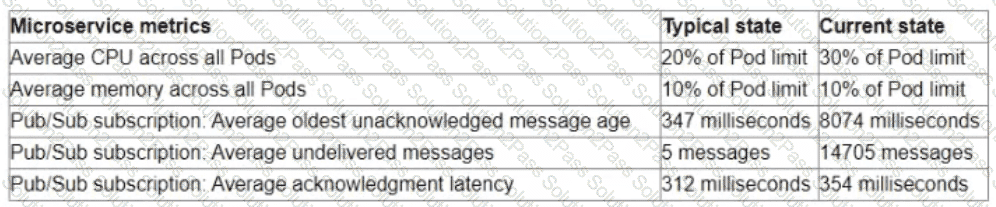
    You are the on-call Site Reliability Engineer for a microservice that is deployed to a Google Kubernetes Engine (GKE) Autopilot cluster. Your company runs an online store that publishes order messages to Pub/Sub and a microservice receives these messages and updates stock information in the warehousing system. A sales event caused an increase in orders, and the stock information is not being updated quickly enough. This is causing a large number of orders to be accepted for products that are out of stock You check the metrics for the microservice and compare them to typical levels.

    You need to ensure that the warehouse system accurately reflects product inventory at the time orders are placed and minimize the impact on customers What should you do?

    A.

    Decrease the acknowledgment deadline on the subscription

    B.

    Add a virtual queue to the online store that allows typical traffic levels

    C.

    Increase the number of Pod replicas

    D.

    Increase the Pod CPU and memory limits

    What our customers are saying

    Kuwait Kuwait
    Emily Carter
    The Professional Cloud DevOps Engineer practice test covered real CI/CD, monitoring, and SRE questions, and the PDF questions with explanations were extremely helpful.
    Copyright © 2014-2026 Solution2Pass. All Rights Reserved