Pre-Summer Sale Special - Limited Time 70% Discount Offer - Ends in 0d 00h 00m 00s - Coupon code: xmaspas7

Easiest Solution 2 Pass Your Certification Exams

PPAN01 Proofpoint Certified Threat Protection Analyst Exam Free Practice Exam Questions (2026 Updated)

Prepare effectively for your Proofpoint PPAN01 Certified Threat Protection Analyst Exam certification with our extensive collection of free, high-quality practice questions. Each question is designed to mirror the actual exam format and objectives, complete with comprehensive answers and detailed explanations. Our materials are regularly updated for 2026, ensuring you have the most current resources to build confidence and succeed on your first attempt.

Page: 1 / 1
Total 52 questions

What is the primary function of the People Page in the Threat Protection Workbench and TAP Dashboard?

A.

To manage user permissions and access controls.

B.

To configure email filtering rules for specific users.

C.

To track user engagement with phishing simulations.

D.

To help identify and prioritize users affected by threats.

Which filter category in the TAP Dashboard helps identify threats targeting VIPs or specific geographies?

A.

At Risk

B.

Targeted

C.

Impacted

D.

Highlighted

An analyst wants to use the Threats page in TAP Dashboard to review all messages related to a phishing campaign that contain an attachment. What is the correct method to filter these messages?

A.

Use the threat filter to set the category, grouping, and type.

B.

Open the Impacted tab to display users exposed to a threat.

C.

Type campaign: phishing & type: attachment into the search bar.

D.

Select the Highlighted tab to review Notable Techniques.

An analyst is reviewing the Notable Senders section in Proofpoint Supplier Threat Protection.
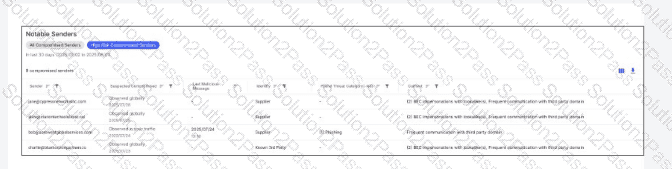
Based on the data shown in the exhibit, which vendor’s email activity should be investigated first?

A.

charlie@bluehorizonpartners.io

B.

alice@clariontechsolutions.net

C.

bob@aerowestglobalservices.com

D.

jane@cypressnetworksinc.com

For which two reasons should organizations customize their incident response plans based on NIST SP 800-61 or another incident response standard? (Select two.)

A.

To make it more generic so that it can be used to respond to incidents from new attack vectors.

B.

To document the contact information for each of the security analysts at your managed security services provider.

C.

To change the order of operations in the Incident Response Lifecycle processes to match ISO 12035.

D.

To meet unique requirements relating to the organization’s mission, size, structure, and functions.

E.

To improve incident response effectiveness and efficiency by creating a repeatable process and documented handoffs.

What is the purpose of Smart Search?

A.

Trace and analyze information about files downloaded from a user's computer.

B.

Trace and analyze information about messages processed by the Proofpoint Protection Server.

C.

Trace and analyze information about user clicks on external websites.

D.

Trace and analyze information about firewall breaches.

Refer to Exhibit:

X-Proofpoint-Banner-Trigger: inbound

MIM-version: 1.0

Content-Type: multipart/mixed; boundary="boundary-1698346305"

X-CLX-Shades: MLX

X-Proofpoint-Virus-Version: vendor=baseguard

engine=ICAP:2.0.272,Aquarius:18.0.987,Hydra:6.0.619,FMLib:17.11.176.26 definitions=2023-10-26_22,2023-10-26_01,2023-05-22_02

X-Proofpoint-Spam-Details: rule=spam policy=default score=89 bulkscore=0 phishscore=0 mlxlogscore=-91 suspectscore=0 malwarescore=0 adultscore=0 spamscore=89 classifier=spam adjust=0 reason=mlx scancount=l engine=8.12.0-2310240000 definitions=main-2310260209

In the process of reviewing a false positive, you see the following email header. What was the reason the message was quarantined by the Proofpoint Protection Server?

A.

A custom spam rule caused the message to be quarantined.

B.

An anti-virus rule forced the message to be quarantined.

C.

The recipient's personal block list forced quarantine of the message.

D.

A content policy rule (DLP/compliance) forced quarantine of the message.

Which activity is part of the Preparation phase in the NIST lifecycle?

A.

Restoring systems from backups.

B.

Documenting postmortem reports.

C.

Identifying compromised accounts.

D.

Conducting response drill scenarios.

You would like to view the total number of uncleared threats or false positives that have been interacted with by users over the past 2 weeks. How can this be accomplished on the TAP Dashboard?

A.

On the Threats page, select Last 14 days and click on the “Intended” column header.

B.

On the Threats page, select Last 14 days and click on the “At Risk” column header.

C.

On the Threats page, select Last 14 days and click on the “Impacted” column header.

D.

On the Threats page, select Last 14 days and click on the “Highlighted” column header.

Which of the following is an item that should be included in an incident report as part of the post-incident debrief?

A.

Network diagrams

B.

Incident response plan

C.

Adversary tactics and techniques

D.

Proofpoint threat landscape reporting

What is a defining characteristic of Advanced Persistent Threat (APT) actors?

A.

They primarily use social engineering to gain access.

B.

They operate independently without government affiliation.

C.

They focus on short-term financial scams.

D.

They are state-sponsored and target strategic assets.

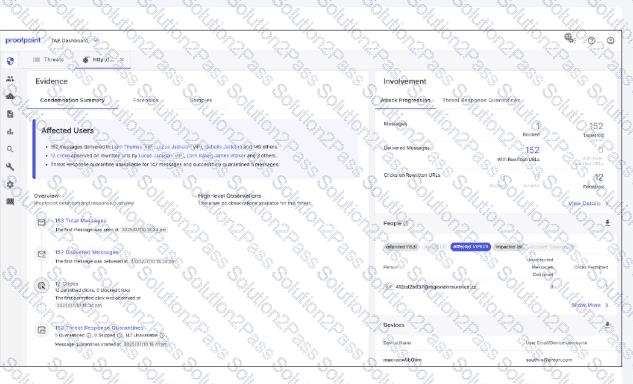
Exhibit:

What can be determined by the threat information shown in the exhibit?

A.

Five messages containing this threat were pulled from mailboxes after delivery.

B.

The URLs related to the threat were rewritten after the threat was discovered.

C.

More than 150 messages containing this threat were unclicked or were deleted.

D.

The VIP user clicked on the non-rewritten URL in the threat message.

What best describes the nature of the NIST incident response lifecycle?

A.

A cyclical process focused on continuous improvement.

B.

A linear process from detection to recovery.

C.

A reactive-only approach to cyber threats.

D.

A one-time checklist for handling incidents.

Which scenario would prevent URL Defense from rewriting a URL?

A.

The URL is contained in a PDF attachment.

B.

The user has clicked the URL before.

C.

The URL is hosted on a secure HTTPS domain.

D.

The email was not flagged as malicious.

A college student receives the email shown in the exhibit.
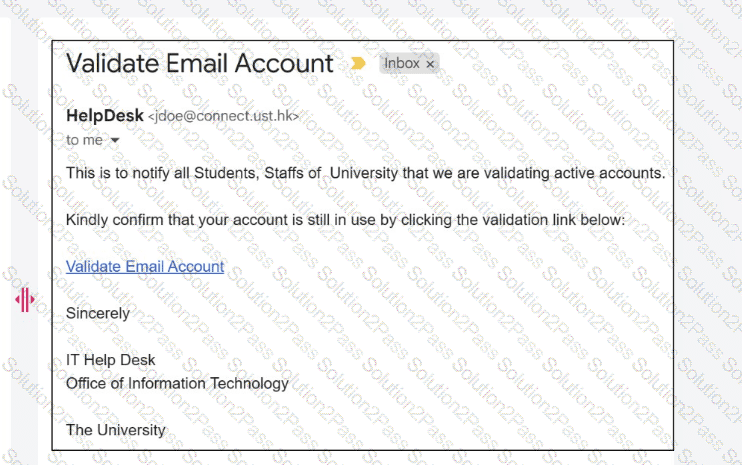
What type of attack is being performed?

A.

Domain Hijacking

B.

Display Name Spoofing

C.

Lookalike Domain

D.

Reply-To Spoofing

Page: 1 / 1
Total 52 questions
Copyright © 2014-2026 Solution2Pass. All Rights Reserved