Black Friday Speed Sale: Save 75% on Every Exam Bundle! Use coupon code below now! - Ends in 0d 00h 00m 00s - Coupon code: stp75

Easiest Solution 2 Pass Your Certification Exams

ADA-C02 Snowflake SnowPro Advanced: Administrator Free Practice Exam Questions (2026 Updated)

Prepare effectively for your Snowflake ADA-C02 SnowPro Advanced: Administrator certification with our extensive collection of free, high-quality practice questions. Each question is designed to mirror the actual exam format and objectives, complete with comprehensive answers and detailed explanations. Our materials are regularly updated for 2026, ensuring you have the most current resources to build confidence and succeed on your first attempt.

Page: 1 / 1
Total 60 questions

Which benefits result from creating and maintaining resource monitors in Snowflake?

Choose three

A.

The cost of running a resource monitor is only 10% of a credit, per day of operation.

B.

Multiple resource monitors can be applied to a single virtual warehouse.

C.

Resource monitors add no additional load to virtual warehouse compute.

D.

Multiple triggers can be configured across various virtual warehouse thresholds.

E.

Resource monitor governance is tightly controlled and monitors can only be created by the ACCOUNTADMIN role or users with the CREATE MONITOR privilege.

F.

Resource monitors can be applied to more than one virtual warehouse.

A large multinational company with numerous operating regions needs data to be shared bidirectionally among all offices: from the head office to regional offices and among regional offices themselves. The company holds a Snowflake account, with its European operations deployed in Microsoft Azure in a single region, while North American regional offices use AWS in a single region as their deployment cloud. This configuration is required to comply with Personal Identifiable Information (PII) regulations in certain European countries. The corporate head office is located in Europe.

How can the data be shared bidirectionally while MINIMIZING costs?

A.

Use data replication everywhere to reduce costs associated with same-region sharing.

B.

Use the PUT command to move files to an Amazon S3 bucket and Azure Blobs, and use an external file management application to move files within the corporate VPC.

C.

Move all the Snowflake accounts to a single region, and implement data sharing.

D.

Use bi-directional data sharing among offices in the same region and replication among offices across the continents.

When adding secure views to a share in Snowflake, which function is required to authorize users from another account to access rows in a base table?

A.

CURRENT_ROLE

B.

CURRENT_ACCOUNT

C.

CURRENT_USER

D.

CURRENT_CLIENT

A company has configured Snowflake replication between two Snowflake accounts, both running Snowflake Enterprise Edition. Replication applies to database APP_DB, which contains only one schema, APP_SCHEMA. The company’s Time Travel retention policy is currently 30 days in both accounts. An Administrator must extend the Time Travel retention policy to 60 days on the secondary database only.

How can this requirement be fulfilled?

A.

Set the data retention policy on the secondary database to 60 days.

B.

Set the data retention policy on the schemas in the secondary database to 60 days.

C.

Set the data retention policy on the primary database to 30 days and the schemas to 60 days.

D.

Set the data retention policy on the primary database to 60 days.

MY_TABLE is a table that has not been updated or changed for several days. On 01 January 2021 at 07:01, a user ran a query that updated this table. The query ID is '8e5d0ca9-005e-44e6-b858-a8f5b37c5726'. It is now 07:30 on the same day.

Which queries allow the user to view the historical data that was in the table before this query ran?

Choose three

A.

SELECT * FROM my_table WITH TIME_TRAVEL(OFFSET = > -60*30);

B.

SELECT * FROM my_table AT(TIMESTAMP = > '2021-01-01 07:00:00'::timestamp);

C.

SELECT * FROM TIME_TRAVEL('MY_TABLE', 2021-01-01 07:00:00);

D.

SELECT * FROM my_table PRIOR TO STATEMENT '8e5d0ca9-005e-44e6-b858-a8f5b37c5726';

E.

SELECT * FROM my_table AT(OFFSET = > -60*30);

F.

SELECT * FROM my_table BEFORE(STATEMENT = > '8e5d0ca9-005e-44e6-b858-a8f5b37c5726');

Which responsibility belongs to the SECURITYADMIN role but is not granted to the USERADMIN role?

A.

Reset a Snowflake user's password

B.

Manage system grants

C.

Create new users

D.

Create new roles

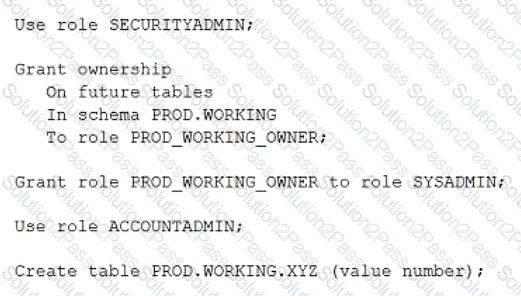
The following SQL commands were run:

Which role or roles can alter or drop table XYZ?

A.

Because ACCOUNTADMIN created the table, only the ACCOUNTADMIN role can alter or drop table XYZ.

B.

SECURITYADMIN, SYSADMIN, and ACCOUNTADMIN can alter or drop table XYZ.

C.

PROD_WORKING_OWNER, ACCOUNTADMIN, and SYSADMIN can alter or drop table XYZ.

D.

Only the PROD_WORKING_OWNER role can alter or drop table XYZ.

If a query matches the definition, will Snowflake always dynamically rewrite the query to use a materialized view?

A.

No, because joins are not supported by materialized views.

B.

No, because the optimizer might decide against it.

C.

No, because the materialized view may not be up-to-date.

D.

Yes, because materialized views are always faster.

The following commands have been run:

Grant usage on database PROD to role PROD_ANALYST;

Grant usage on database PROD to role PROD_SUPERVISOR;

Grant ALL PRIVILEGES on schema PROD.WORKING to role PROD_ANALYST;

Grant ALL PRIVILEGES on schema PROD.WORKING to role PROD_SUPERVISOR;

Grant role PROD_ANALYST to user A;

Grant role PROD_SUPERVISOR to user B;

What authority does each user have on the WORKING schema?

A.

Only user B can create tables, because all privileges were transferred to PROD_SUPERVISOR.

B.

Tables created by either user A or user B will be visible to both users.

C.

All existing tables in schema PROD.WORKING will be visible to both users.

D.

Both user A and user B can create tables in the PROD.WORKING schema.

A company has many users assigned to the ANALYST role who regularly query Snowflake through a reporting tool. The Administrator observes that the ANALYST users continuously keep two small clusters busy and occasionally require three or four clusters of that same size.

B. ased on this scenario, how should the Administrator configure a virtual warehouse to MOST efficiently support this user group?

A.

Create a multi-cluster warehouse with MIN_CLUSTERS set to 1. Give MANAGE privileges to the ANALYST role so this group can start and stop the warehouse, and increase the number of clusters as needed.

B.

Create a multi-cluster warehouse with MIN_CLUSTERS set to 2. Set the warehouse to auto-resume and auto-suspend, and give USAGE privileges to the ANALYST role. Allow the warehouse to auto-scale.

C.

Create a standard X-Large warehouse, which is equivalent to four small clusters. Set the warehouse to auto-resume and auto-suspend, and give USAGE privileges to the ANALYST role.

D.

Create four virtual warehouses (sized Small through XL) and set them to auto-suspend and auto-resume. Have users in the ANALYST role select the appropriate warehouse based on how many queries are being run.

An Administrator must configure a Snowflake virtual warehouse for a new use case with these details:

B. etween 50 and 100 concurrent users will run reports.

C. osts must be minimized according to the number of users active at a particular time.

The virtual warehouse must automatically suspend and resume based on user activity.

Which configuration meets these requirements?

A.

CREATE OR REPLACE WAREHOUSE reporting_wh

WAREHOUSE_SIZE = MEDIUM

AUTO_SUSPEND = 600

AUTO_RESUME = TRUE;

B.

CREATE OR REPLACE WAREHOUSE reporting_wh

WAREHOUSE_SIZE = XXXLARGE

MAX_CLUSTER_COUNT = 10

SCALING_POLICY = STANDARD

AUTO_SUSPEND = 600

AUTO_RESUME = FALSE;

C.

CREATE OR REPLACE WAREHOUSE reporting_wh

WAREHOUSE_SIZE = XXXLARGE

AUTO_SUSPEND = 60

AUTO_RESUME = TRUE;

D.

CREATE OR REPLACE WAREHOUSE reporting_wh

WAREHOUSE_SIZE = MEDIUM

MAX_CLUSTER_COUNT = 10

SCALING_POLICY = STANDARD

AUTO_SUSPEND = 600

AUTO_RESUME = TRUE;

An Administrator receives data from a Snowflake partner. The partner shares a dataset containing multiple secure views. The Administrator wants to configure access so that only specific roles can view specific secure views.

How can this be achieved?

A.

Apply RBAC directly onto the partner's shared secure views.

B.

Individually grant imported privileges onto the schema in the share.

C.

Clone the data and insert it into a company-owned share and apply the desired RBAC on the new tables.

D.

Create views over the incoming shared database and apply the desired RBAC onto these views.

A Snowflake account uses SCIM provisioning for user accounts and has bidirectional synchronization of user identities. An Administrator with access to SECURITYADMIN creates a user in the Snowflake UI by issuing these commands:

The new user, PTORRES, logs in successfully but sees PUBLIC as the default role in the web UI. The following command fails when attempted:

USE DEVELOPER_ROLE;

Why does this command fail?

A.

The DEVELOPER_ROLE needs to be granted to SYSADMIN before user PTORRES will be able to use the role.

B.

The new role can only take effect after USERADMIN has logged out.

C.

USERADMIN needs to explicitly grant the DEVELOPER_ROLE to the new USER.

D.

The new role will only take effect once the identity provider has synchronized by way of SCIM with the Snowflake account.

What are the minimum grants needed on the database, schema, and table to correctly create and manage a stream?

A.

Database: Usage -Schema: Usage -Table: Select, Create Stream

B.

Database: Usage -Schema: Usage -Table: Select

C.

Database: Usage, Create Stream -Schema: Usage -Table: Select

D.

Database: Usage -Schema: Usage, Create Stream -Table: Select

Under what condition does auto-suspend take place for a multi-cluster virtual warehouse?

A.

When there has been no activity on any cluster for the specified period of time.

B.

After a specified period of time when an additional cluster has started on the maximum number of clusters specified for a warehouse.

C.

When the minimum number of clusters is running and there is no activity for the specified period of time.

D.

Auto-suspend does not apply for multi-cluster warehouses.

A virtual warehouse report_wh is configured with AUTO_RESUME=TRUE and AUTO_SUSPEND=300. A user has been granted the accountant role.

An application using the accountant role must use this warehouse to run financial reports and track the compute credits consumed by the warehouse. What minimum warehouse privileges should be granted to the role to satisfy these requirements?

Choose two

A.

OPERATE

B.

MODIFY

C.

MONITOR

D.

USAGE

E.

OWNERSHIP

What is one characteristic of Snowflake’s transaction locking and concurrency model?

A.

A deadlock cannot occur in Snowflake, since concurrently executed queries and DML statements do not block one another.

B.

If two queries are concurrently executed against the same table, one of the two queries will be blocked until the other query completes.

C.

Transaction locking in Snowflake is enforced exclusively at the row and table levels.

D.

Queries executed within a given transaction see that transaction's uncommitted changes.

Which actions are considered breaking changes to data shared with consumers through the Snowflake Marketplace?

Choose two

A.

Dropping a column from a table

B.

Deleting data from a table

C.

Unpublishing the data listing

D.

Renaming a table

E.

Adding region availability to the listing

Page: 1 / 1
Total 60 questions
Copyright © 2014-2026 Solution2Pass. All Rights Reserved