DAA-C01 Snowflake SnowPro Advanced: Data Analyst Exam Free Practice Exam Questions (2026 Updated)
Prepare effectively for your Snowflake DAA-C01 SnowPro Advanced: Data Analyst Exam certification with our extensive collection of free, high-quality practice questions. Each question is designed to mirror the actual exam format and objectives, complete with comprehensive answers and detailed explanations. Our materials are regularly updated for 2026, ensuring you have the most current resources to build confidence and succeed on your first attempt.
A Data Analyst creates a dashboard showing the total credit consumption for each virtual warehouse as follows:
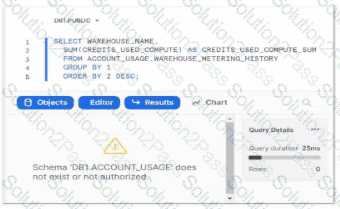
Why is the query failing?
This command was executed:
SQL
SELECT seq4(), uniform(1, 10, RANDOM(12))
FROM TABLE(GENERATOR(TIMELIMIT => NULL))
ORDER BY 1;
How many rows will be generated?
Which Snowflake feature allows users to encapsulate a series of SQL statements into a reusable database object, facilitating modular code development?
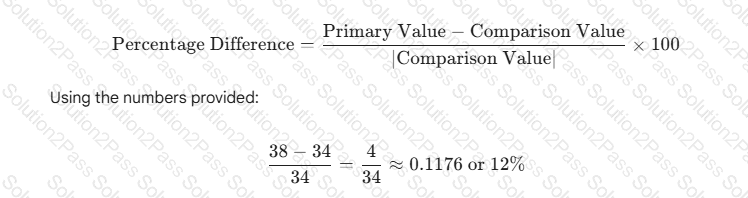
A scorecard tile on a Snowsight dashboard shows a comparison between the industry average employee age (which is 34) and a company's average employee age (which is 38). The scorecard tile looks like this:
Comparison with industry average

How should this tile be interpreted?
A Data Analyst created two tables that are related by a foreign key, using the following commands:

Then the Analyst renamed the referenced table using the following command: ALTER TABLE mother RENAME TO father; What happens to the foreign key after the referenced table is renamed?
What option would allow a Data Analyst to efficiently estimate cardinality on a data set that contains trillions of rows?
A Data Analyst has been analyzing customer data in several worksheets. Each worksheet contains a complex query that provides clean and prepared data for visualizations. The Analyst has also created a Customer Overview dashboard in Snowsight. How should the Analyst add the worksheets in the Customer Analysis database to the dashboard, using the LEAST amount of operational overhead?
A Data Analyst created two functions and one procedures:
The Analyst then runs this query:
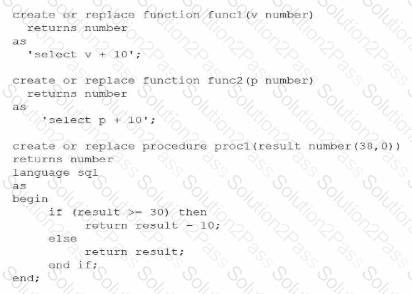
The Analyst then runs this query:

What will be the output?
Why would a Data Analyst use a dimensional model rather than a single flat table to meet BI requirements for a virtual warehouse? (Select TWO).
A Data Analyst creates and populates the following table:
create or replace table aggr(v int) as select * from values (1), (2), (3), (4);
The Analyst then executes this query:
select percentile_disc(0.60) within group (order by v desc) from aggr;
What will be the result?
A Data Analyst needs to rotate a table by transforming a wide table’s columns into rows.

Which operator will be MOST beneficial for producing this output?
How can a Data Analyst automatically create a table structure for loading a Parquet file?
A Data Analyst wants to transform query results. Which transformation option will incur compute costs?
A large, complicated query is used to generate a data set for a report on the most recent month. It is taking longer than expected. A review of the Query Profile shows excessive spilling. How can the performance of the query be improved WITHOUT increasing costs?
A Data Analyst created a model called modelX using SNOWFLAKE.ML.FORECAST. The Analyst needs to predict the next few values and save the result directly into tableX. What step does the Analyst need to take after calling the modelX!FORECAST function?
A Data Analyst needs to temporarily hide a tile in a dashboard. The data will need to be available in the future, and additional data may be added. Which tile should be used?
A Data Analyst has a very large table with columns that contain country and city names. Which query will provide a very quick estimate of the total number of different values of these two columns?
This query is run:
SQL
SELECT
customer.id,
ANY_VALUE(customer.name),
SUM(orders.value)
FROM customer
JOIN orders ON customer.id = orders.customer_id
GROUP BY customer.id;
What is the effect of ANY_VALUE in this syntax?
A Data Analyst created a cost overview dashboard in Snowsight. Management has asked for a system date filter to easily change the time period and refresh the data in all dashboard tiles with a single filter selection.
The system date filter is shown below:
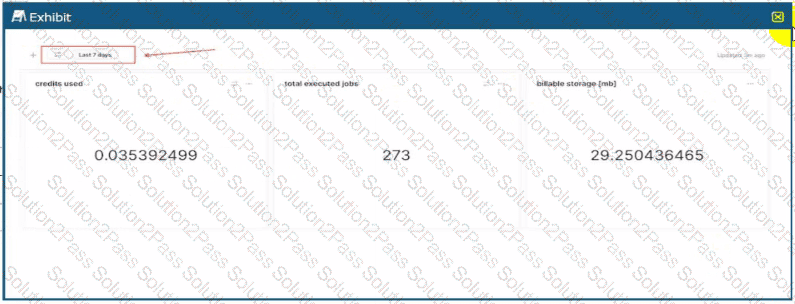
The Analyst wants to apply the filter onto individual dashboard components.
Adding which where clause to the queries will apply the filter as required?