Summer Sale Special - Limited Time 70% Discount Offer - Ends in 0d 00h 00m 00s - Coupon code: xmaspas7

Easiest Solution 2 Pass Your Certification Exams

OG0-093 The Open Group TOGAF 9.2 Combined Part 1 and Part 2 Free Practice Exam Questions (2026 Updated)

Prepare effectively for your The Open Group OG0-093 TOGAF 9.2 Combined Part 1 and Part 2 certification with our extensive collection of free, high-quality practice questions. Each question is designed to mirror the actual exam format and objectives, complete with comprehensive answers and detailed explanations. Our materials are regularly updated for 2026, ensuring you have the most current resources to build confidence and succeed on your first attempt.

Page: 4 / 5
Total 453 questions

Which of the following describes the Architecture Vision document?

A.

A description of individual change increments showing progression from the baseline to target architecture

B.

A detailed schedule for implementation of the target architecture

C.

A high level description of the baseline and target architectures

D.

A joint agreement between the development team and sponsor on the deliverables and quality of an architecture

E.

A set of rules and guidelines to support fulfilling the mission of the organization

Which of the following best describes the purpose of the Statement of Architecture Work?

A.

It contains an assessment of the current architecture requirements

B.

It defines the scope and approach to complete an architecture project

C.

It is sent from the sponsor and triggers the start of an architecture development cycle

D.

It provides a high-level aspirational view of the end architecture project

E.

It provides a schedule for implementation of the target architecture

Which of the following does the TOGAF document define as architectural work product that describes an aspect of the architecture?

A.

Application Platform Interface

B.

Artifact

C.

Building Block

D.

Deliverable

E.

Framework

Which is the final step in the architecture development Phases B, C, and D?

A.

Conduct formal stakeholder review

B.

Define Roadmap components

C.

Resolve impacts across the Architecture Landscape

D.

Create Architecture Definition Document

E.

Select reference models, architecture viewpoints and tools

Which of the following best describes the purpose of the Business Scenarios technique?

A.

To guide decision making throughput the enterprise

B.

To catch errors in a project architecture early

C.

To identify and understand requirements

D.

To identify risk when implementing an architecture project

E.

To highlight shortfalls between the baseline and target architectures

Complete the sentence by selecting the applicable pair of words. A/an _____is used in Phase A to help identify and understand business _____that the architecture has to address.

A.

activity model, perspective

B.

business scenario, requirements

C.

use case, interconnections

D.

architecture view, concerns

E.

business transformation readiness assessment, constraints

Which of the following is a true statement about the TOGAF Technical Reference Model?

A.

The TOGAF Architecture Development Method mandates the use of the Technical Reference Model for large complex architecture projects

B.

The Technical Reference Model is an integral part of the TOGAF Architecture Development Method

C.

The Technical Reference Model should not be modified

D.

The Technical Reference Model includes a set of graphical models and a corresponding taxonomy

E.

The Technical Reference Model provides a direct mapping to the Zachman Framework

Which of the following best describes the state of architecture artifacts as a project progresses through ADM Phases A to D?

A.

The artifacts are transformed into solution architectures

B.

The artifacts become increasingly product focused

C.

The artifacts become increasingly generic and re-usable

D.

The artifacts evolve from generic architectures to organization-specific architectures

E.

The artifacts evolve from common systems architectures to foundation architectures

Which one of the following is defined by TOGAF as: the fundamental organization of a system embodied in its components, their relationship to each other, and the principles guiding its design and evolution?

A.

Architecture

B.

Metamodel

C.

Model

D.

Ontology

E.

Pattern

Which of the following best describes an approach for adapting the ADM in the situation where the business case for doing architecture is not well recognized?

A.

Completion of the Business Architecture should follow the Information Systems Architecture

B.

Create an Architecture Vision and then a detailed Business Architecture

C.

Produce a " cut-down " version of the ADM suitable to the resources available

D.

Tailor the ADM in conjunction with another architecture framework that has deliverables specific to the vertical sector

E.

Tailor the ADM to reflect the relationships with, and dependencies on other management processes within the organization

Which of the following describes the practice by which the enterprise architecture is managed and controlled at an enterprise-wide level?

A.

Architecture governance

B.

Portfolio management

C.

IT governance

D.

Technology governance

E.

Corporate governance

What is an objective of the ADM Implementation Governance Phase?

A.

To provide continual monitoring of the governance framework.

B.

To establish the resources for architecture governance.

C.

To ensure conformance for the target architecture.

D.

To finalize the Implementation and Migration Plan.

Complete the sentence. The Business Transformation Readiness Assessment technique is

primarily focused on ___

A.

determining if the organization is ready to accept change

B.

planning the migration steps needed to achieve the transformation

C.

ensuring that there are adequate trained developers and engineers to implement the solution

D.

ensuring that there is sufficient financial capacity to execute the desired transformation

E.

determining if there is adequate stakeholder support for the implementation process

What are the four dimensions used to scope an architecture?

A.

Strategy, Portfolio, Project, Solution Delivery

B.

Strategy, Segment, Capability, Budget

C.

Business, Data, Application, Technology

D.

Breadth. Depth, Time Period, Architecture Domains

Which of the following statements best describes the Requirements Management process?

A.

It is used to develop requirements for Transition Architectures that deliver business value

B.

It is used to dispose of, address and prioritize architecture requirements

C.

It is used to establish requirements for Phase A

D.

It is used to manage architecture requirements throughout the ADM cycle

E.

It is used to review business requirements

An ADM cycle can be used to establish an Architecture Capability within an organization. Which architecture produced in such a cycle would describe the architecture processes and organization structure?

A.

Business Architecture

B.

Application Architecture

C.

Technology Architecture

D.

Data Architecture

E.

Transition Architecture

Consider the following ADM phases objectives.
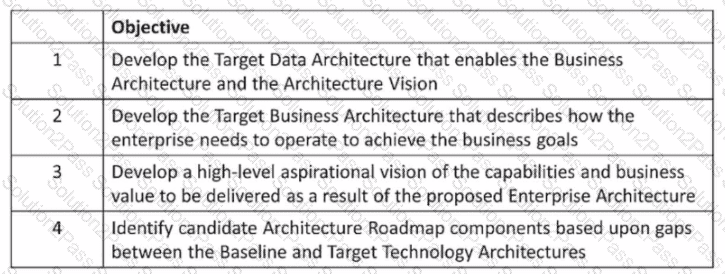
Which phase does each objective match?

A.

1C-2B-3A-4D

B.

1A-2B-3C-4D

C.

1B-2D-3A-4C

D.

1C-2D-3B-4A

During a TOGAF ADM cycle, an architecture can be denoted as Version 1.0. What does this indicate?

A.

A high-level outline architecture

B.

A formally reviewed, detailed architecture

C.

A formally reviewed, preliminary architecture

D.

A draft, detailed architecture

Complete the sentence. All of the following are parts of the conceptual structure of the TOGAF Architecture Governance Framework, except ______

A.

Content

B.

Context

C.

Process Flow Control

D.

Repository

E.

Vision

TOGAF Part VII, Architecture Capability Framework recommends use of an ADM cycle for establishing an architecture practice. In this scenario which architecture would describe the organizational structure for the architecture practice?

A.

Application Architecture

B.

Business Architecture

C.

Data Architecture

D.

Technology Architecture

E.

Transition Architecture

Page: 4 / 5
Total 453 questions
Copyright © 2014-2026 Solution2Pass. All Rights Reserved