3V0-25.25 VMware Certified Advanced Professional - VMware Cloud Foundation 9.0 Networking Free Practice Exam Questions (2026 Updated)
Prepare effectively for your VMware 3V0-25.25 VMware Certified Advanced Professional - VMware Cloud Foundation 9.0 Networking certification with our extensive collection of free, high-quality practice questions. Each question is designed to mirror the actual exam format and objectives, complete with comprehensive answers and detailed explanations. Our materials are regularly updated for 2026, ensuring you have the most current resources to build confidence and succeed on your first attempt.
An administrator is troubleshooting east—west network performance between several virtual machines connected to the same logical segment. The administrator inspects the internal forwarding tables used by ESXi and notices that different tables exist for MAC and IP mapping. Which table on an ESXi host is used to determine the location of a particular workload for frame forwarding?
An NSX Manager cluster has failed. The administrator deployed a new NSX Manager using the latest version and attempted to restore from a backup, but the restore operation failed. What would an administrator do to recover the cluster?
Which of the following statements is true when configuring Remote Tunnel End Points (RTEPs) with NSX Federation?
An architect needs to allow users to deploy multiple copies of a test lab with public access to the internet. The design requires the same machine IPs be used for each deployment. What configuration will allow each lab to connect to the public internet?
An administrator has noticed an issue in a freshly deployed VMware Cloud Foundation (VCF) environment where the BGP neighborship between the Tier-0 gateway and a physical router remains in the Idle state. Pings between the uplink IPs are successful. What is the issue?
An administrator is investigating packet loss reported by workloads connected to VLAN segments in an NSX environment. Initial checks confirm:
• All VMs are powered on
• VLAN segment IDs are consistent across transport nodes
• Physical switch configurations are correct.
Which two NSX tools can be used to troubleshoot packet loss on VLAN Segments? (Choose two.)
Which two statements describe the recommended strategy for configuring and synchronizing security policies across Federated NSX sites? (Choose two.)
An administrator is tasked to enable users to configure an individual VPC, but not create subnets. What three NSX roles would the administrator assign to allow access without the ability to create subnets? (Choose three.)
How should the Global Managers (GMs) and Local Managers (LMs) be distributed to ensure high availability and optimal performance in a multi-site NSX Federation deployment comprised of three sites? (Choose two.)
An administrator is troubleshooting a BGP connectivity issue on a Tier-0 Gateway (Active/Active). The Tier-0 has the following configuration:
• Uplink VLAN 100: 192.168.100.0/24
• Uplink VLAN 101: 192.168.101.0/24
• BGP neighbors configured: 192.168.100.1 and 192.168.101.1
• A single static default route (0.0.0.0/0) exists with next-hop 192.168.100.1.
Symptoms observed on both Edge Nodes:
• Get BGP neighbors —> both neighbors stuck in Idle (Connect) — "No route to peer"
• Ping to 192.168.100.1 and 192.168.101.1 succeeds from the Edge nodes
• Get route shows the default route present only on VLAN 100 interface (fp-eth0), missing on VLAN 101 (fp-eth1)
What is the root cause of both BGP sessions remaining in Idle state?
An administrator has a standalone vSphere 8.0 Update 1a deployment that is running with VMware NSX 4.1.0.2 and has to converge the deployment into a new VMware Cloud Foundation (VCF) instance. How can the administrator accomplish this task?
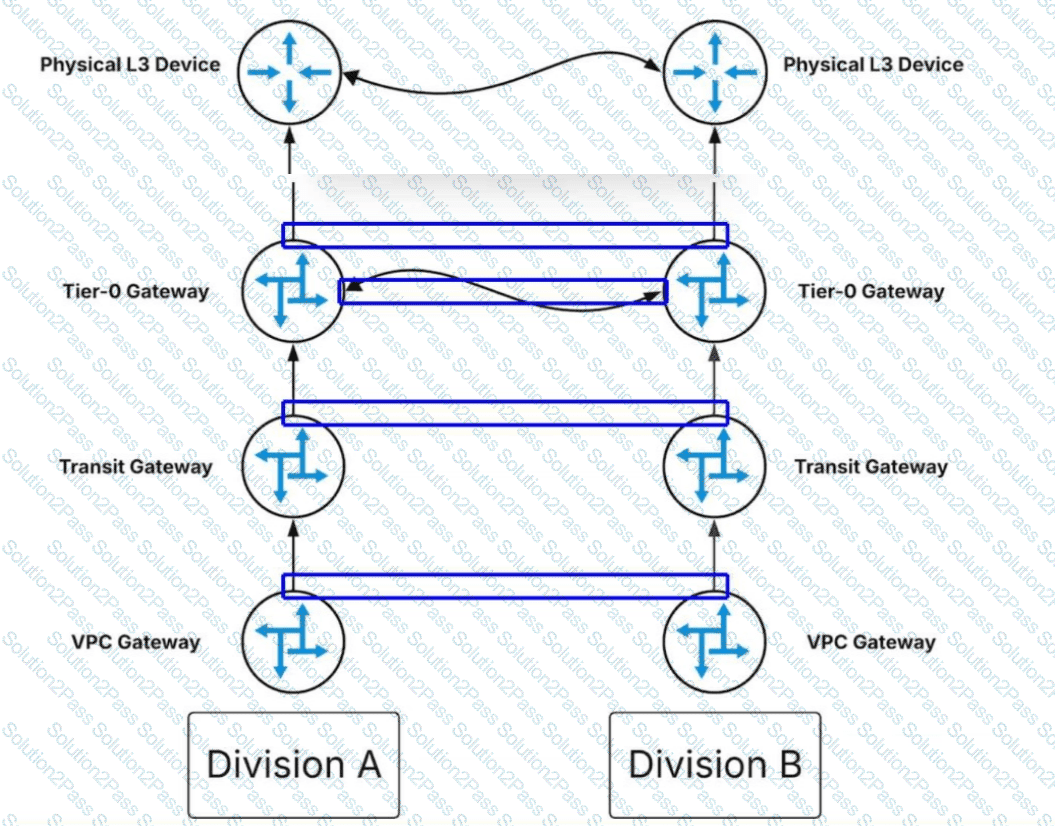
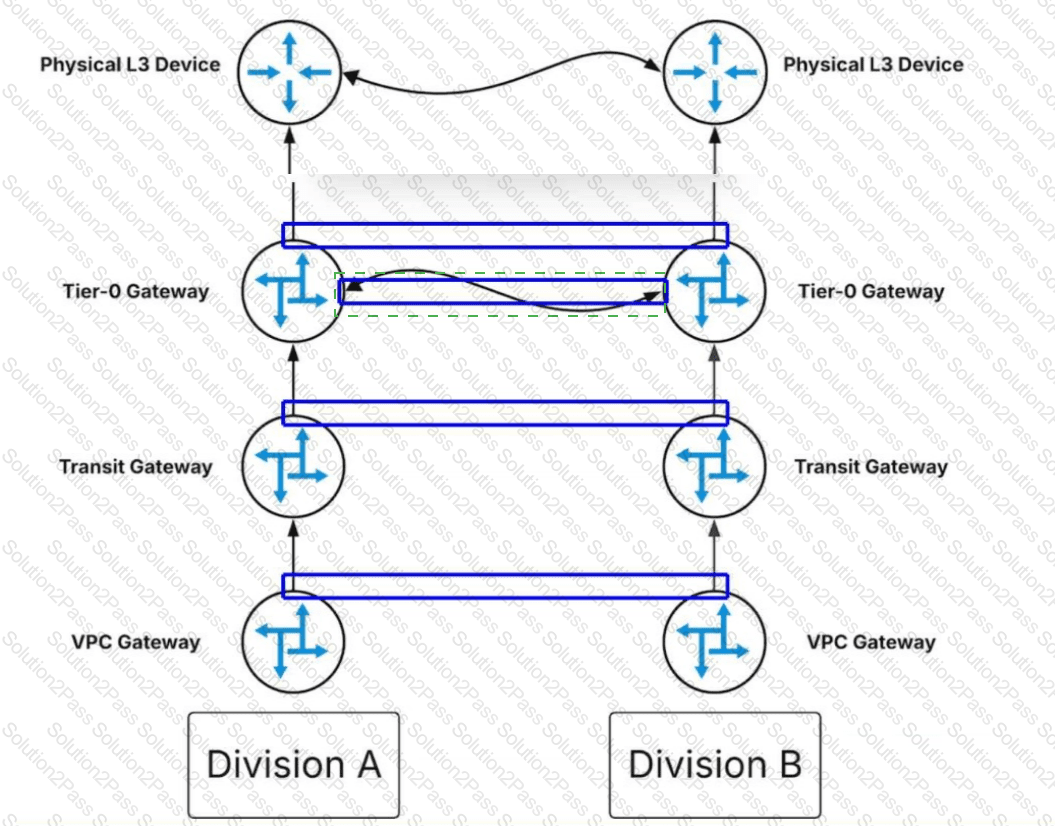
An administrator implements route leaking between the Tier-0 gateways to enhance east/west communication because the physical L3 devices are oversubscribed.
Where should route-maps be configured based on the architecture observed in the diagram?
An administrator is troubleshooting why workloads in NSX cannot reach the external network 10.100.0.0/16. The Tier-0 Gateway is in Active/Active mode and has the following configuration:
• Uplink-1 (VLAN 100): 192.168.100.0/24 -> router R1 at 192.168.100.1
• Uplink-2 (VLAN 101): 192.168.101.0/24 -> router R2 at 192.168.101.1
• A static route for 10.100.0.0/16 was added with both next-hops (192.168.100.1 and 192.168.101.1).
• The Scope of this route is set to Uplink-1.
Symptoms:
• Virtual Machines (VMs) cannot reach 10.100.0.0/16
• Traceroute from the VM stops at the Tier-0 gateway with "Destination Net Unreachable"
• Pings from the Edge nodes to both 192.168.100.1 and 192.168.101.1 are success
What explains why workloads in NSX cannot reach the external network?
An administrator has a vSphere 8 Update 1a with NSX 4.1.0.2 environment. What option can the administrator use to converge this vSphere with NSX environment into a VMware Cloud Foundation (VCF) Workload Domain?
An administrator is configuring Border Gateway Protocol (BGP) routing on a Tier-0 Gateway to optimize north—south traffic flow between the NSX environment and multiple upstream physical routers. The environment includes two external connections that advertise overlapping routes to the same destination networks. To ensure predictable and efficient routing behavior, the administrator decides to manipulate specific BGP attributes on outbound advertisements and inbound route updates. What are two valid BGP Attributes that can be used to influence the route path traffic will take? (Choose two.)
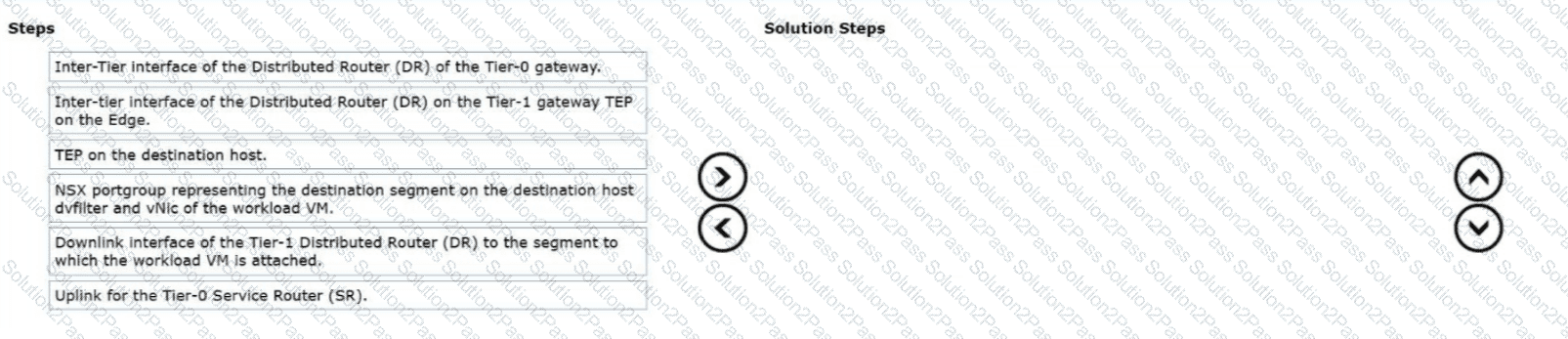
An administrator is upgrading an existing VMware Cloud Foundation (VCF) environment. An NSX Edge Cluster is required to support north-south traffic for a workload domain. How would the administrator initiate the edge cluster deployment?
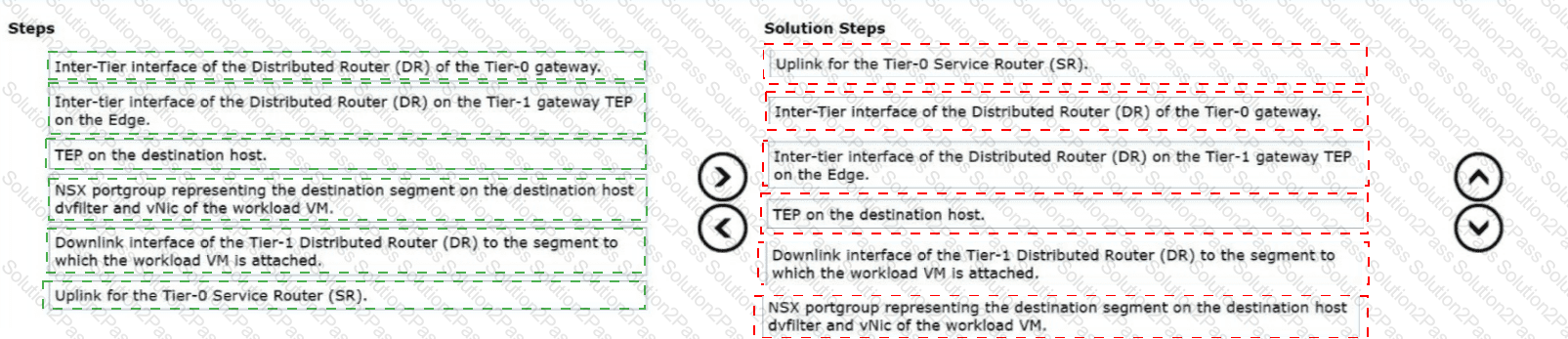
An administrator is responsible for a VMware Cloud Foundation (VCF) Private Cloud. The administrator has been tasked with identifying why there is no data ingress into a
workload domain.
The workload domain has been configured with:
. A dedicated NSX Edge Cluster.
. A Tier 0 gateway.
. A Tier-1 gateway that is configured for Distributed Routing only.
. An NSX segment where a test virtual machine is located.
As part of the exercise, the administrator must map the traffic flow for data ingress into the workload domain to identify the steps that external network traffic will take to
ingress into the workload domain and reach the virtual machine.
Drag and drop the six steps from the Steps list on the right and place them in order in the Solution Steps. (Choose six.)
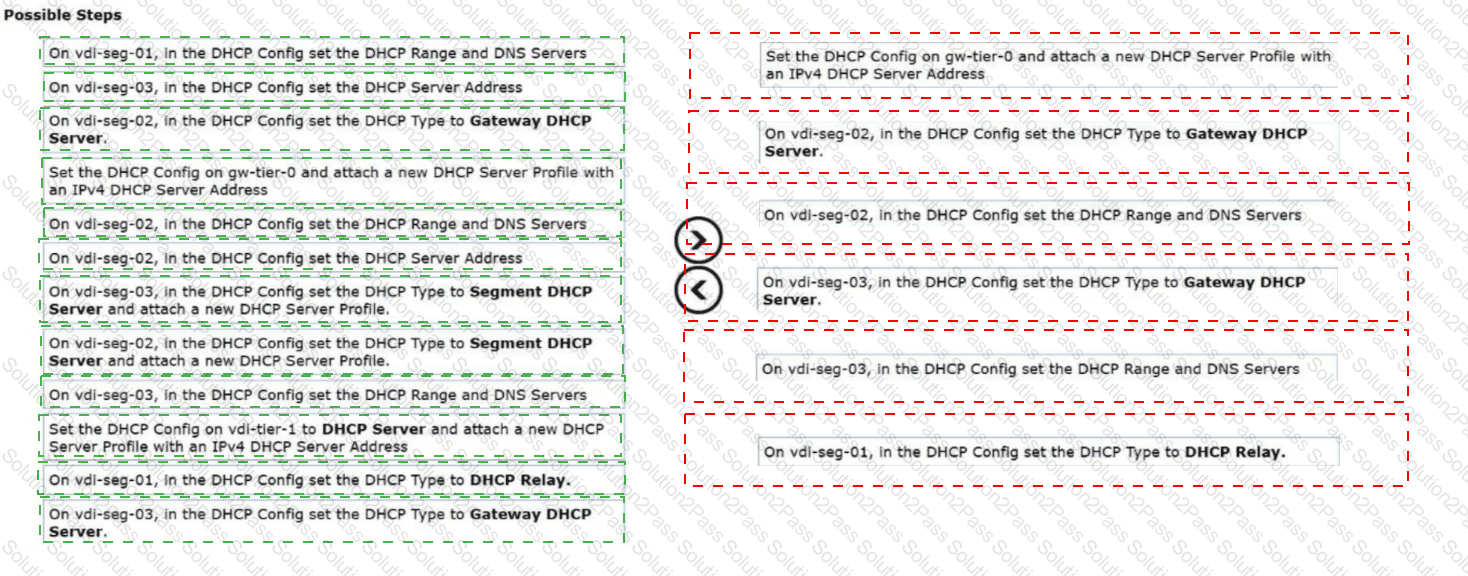
An administrator is responsible for managing a VMware Cloud Foundation (VCF) Private Cloud consisting of a single VCF Fleet with a single Workload Domain.
The administrator has been tasked with configuring NSX to support the new Virtual Desktop Infrastructure (VDI) solution that allows users to securely access a mainframe-
based application located on the physical network. The VDI solution will use a dedicate DHCP solution for each of the the desktop pool segments and static addresses for all
VDI management components.
The administrator completes the following steps towards configuring DHCP:
1. Creates a new tier-1 gateway (vdi-tier-1) and links it to the tier-0 gateway (gw-tier-0).
2. Creates one new segment for vdi management (vdi-seg-01) and connects it to vdi-tier-1.
3. Creates two new segments for virtual desktops (vdi-seg-02 and vdi-seg-03) and connects them to vdi-tier-1.
Drag and drop the six steps from the list of Possible Steps on the left and place them in order in to the Solution Steps. (Choose six.)