Summer Sale Special - Limited Time 70% Discount Offer - Ends in 0d 00h 00m 00s - Coupon code: xmaspas7

Easiest Solution 2 Pass Your Certification Exams

ACD101 Appian Associate Developer Free Practice Exam Questions (2026 Updated)

Prepare effectively for your Appian ACD101 Appian Associate Developer certification with our extensive collection of free, high-quality practice questions. Each question is designed to mirror the actual exam format and objectives, complete with comprehensive answers and detailed explanations. Our materials are regularly updated for 2026, ensuring you have the most current resources to build confidence and succeed on your first attempt.

Page: 1 / 2
Total 124 questions

Which statement regarding the use of rule inputs for expression rules is true?

A.

Only basic data types should be used for rule inputs. Custom Data Types (CDTs) or records should always be queried within the expression rule rather than passed in via rule input.

B.

The data type for rule inputs should be set only for Custom Data Types (CDTs).

C.

If the value passed in via rule input may be a list of numbers, the rule input must be configured as an “Array”.

You built a grid field with the data source as a query entity.

You want to add a search box to the grid using Appian’s out-of-the-box functionality. You set the parameter of showSearchBox to “True”, but the search box is still not appearing.

Why is the search box NOT appearing?

A.

The search box only appears when data is populated in the grid.

B.

The grid is on an interface that needs to be placed within a report object.

C.

The showSearchBox parameter only applies when a record type is used as the source in the data.

You are working on a process model " VIM Update Vehicle. "

You want to call another process " VIM Get Service Date " that accepts pv!vehicleId as a process parameter and sets a value for pv!serviceDate. The next node in VIM Update Vehicle depends on the value of pv!serviceDate.

Which node should you use to execute " VIM Get Service Date " from VIM Update Vehicle?

A.

Start Process smart service

B.

Asynchronous subprocess with activity chaining

C.

Synchronous subprocess with input and output variables configured

You want to add a script task in between two User Input Tasks assigned to the same user.

What needs to be configured so that the user sees the second form immediately after submitting the first?

A.

Set all process variables as parameters.

B.

Enable activity chaining.

C.

Run the script task as " synchronous. "

You are configuring a local variable on an interface to store the date and time that the username field was last modified. The local variables are currently configured as follows:

Which a!refreshVariable configuration should be added so that local!usernameLastModified stores the correct timestamp?

A.

refreshInterval: 0

B.

refreshOnVarChange: local!username

C.

refreshAlways: true

You want to prevent a user from submitting a form when an invalid value is entered.

What should you do?

A.

Wrap the Text field in an if statement and display a red card layout when the value is not valid.

B.

Use a rich text display field with “STRONG” style and “NEGATIVE” color when the value is not valid.

C.

In the validations parameter, use an if statement that returns a text string when the value is not valid.

You created an expression rule that was deployed to production on January 12, 2022.

The object has “form type” as a rule input, as well as several other rule inputs for characteristics describing the logged in user. Given values for these inputs, the rule returns a set of form instructions for the specified type of form as applicable to the logged in user.

What is the most important action to take with regards to the object description?

A.

Set an object description that reads: “Returns a set of form instructions to display, given the type of form and characteristics of the logged in user”.

B.

Save a rule input of type ‘text’ for the object called ‘objectDescription’, and set a text value that generally describes the object such that other developers could quickly gain understanding of the object’s purpose.

C.

Set an object description that includes any notes you may need if you were to become responsible for providing Production Support on that area of the application in the future. You should also include “BP – 1/12/2022 – Created” somewhere in the description.

You need to be able to define record type relationships.

What is a required prerequisite in Appian?

A.

The record types must have data sync enabled.

B.

The record types must be on a virtualized data source.

C.

The record types must be stored in the local Appian business database.

You receive a bug ticket that states " After selecting a value for the drop-down field, the value disappears. "

You investigate and notice that when you select the drop-down, the proper choice labels display. When you select an option, the value updates properly in the corresponding rule input.

What is the issue and how can you fix this bug?

A.

The value parameter is improperly configured on the drop-down component. You need to map the value to the proper rule input or variable.

B.

The user group for the lookup table is incorrect. You need to add the user to the proper group.

C.

The choice labels parameter of the drop-down field is not configured as a list. You need to wrap the value with curly brackets.

Match each Appian Design Object name to the most applicable use case.

Note: Each use case will be used once or not at all. To change your responses, you may deselect your response by clicking the blank space at the top of the selection list.
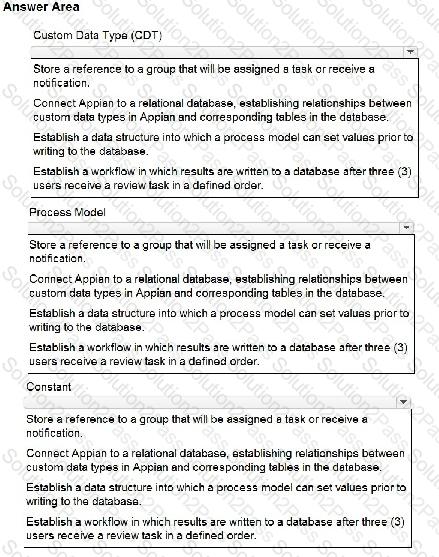
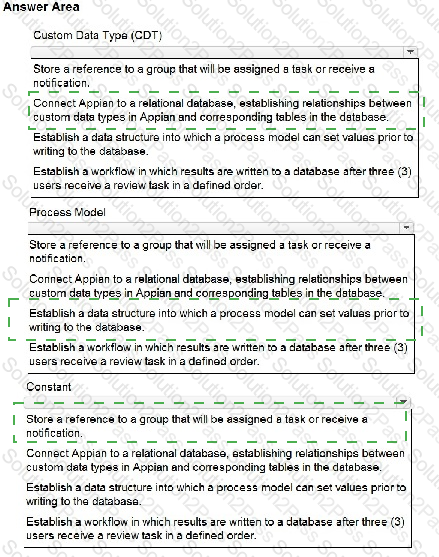
You want to calculate the deadline for a review, which is determined by applying a formula that takes the characteristics of the review into account. This formula for calculating a review deadline is standard across the organization according to policy.

An Appian object was used to apply the calculation on an existing interface 14 months ago.

What should you do to perform the same calculation on a new data collection form?

A.

Duplicate the existing Appian object and rename it to include the date of the release that will contain the new object.

This follows the best practice of not reusing objects that are more than one (1) year old.

B.

Reuse the existing Appian object to perform the calculation after validating it works properly for your use case.

Reusing the object helps to enforce consistency with application of the formula across the application.

C.

Duplicate the existing Appian object and reuse the same name.

This follows the best practice of maintaining traceability of object creation to developers while avoiding duplication of code.

Where can an Appian Developer connect with and share their expertise with other Appian Developers?

A.

Appian Learning Paths via Appian Academy

B.

Appian Knowledge Base

C.

Appian Community discussions

You are creating a new application with the prefix ACM.

Which four default folders are created by Appian when you select " Generate groups and folders to secure and organize objects " ? (Choose four.)

A.

ACM Users

B.

ACM Knowledge Center

C.

ACM Process Models

D.

ACM Rules & Constants

E.

ACM Application Documentation

Which statement reflects an Appian user interface design best practice?

A.

Create and use reusable interfaces.

B.

Use red text to highlight important information.

C.

Use a section layout within a section layout.

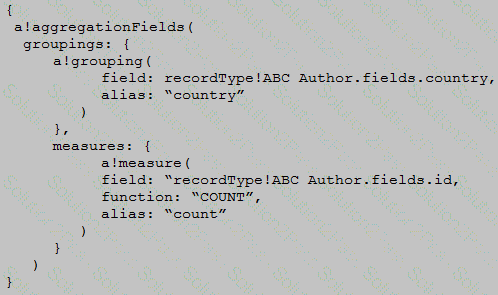
You have a record type, ABC_Author, backed by a database table.

You need to retrieve the number of authors for each country.

Review the following basic query expression:
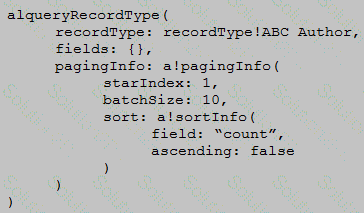
Which code snippet should be added to the fields parameter?

A)
B)
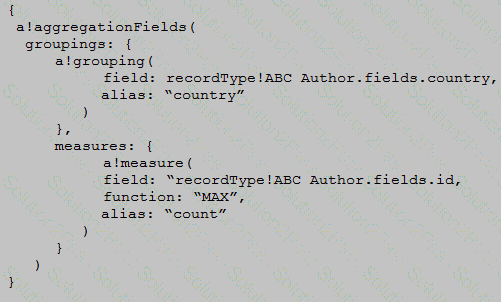
C)
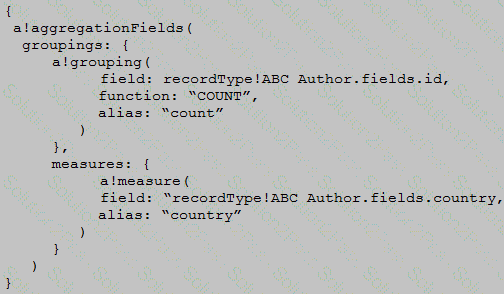
D)

A.

Option A

B.

Option B

C.

Option C

D.

Option D

You are using a local variable in an expression rule to describe the height of an applicant.

Which statement correctly describes the application of Appian best practices for naming your local variable?

A.

local!hoaa - This employs the naming convention of abbreviating " Height of an applicant " to minimize both the typing required by developers and the length of code Appian is required to parse.

B.

local!applicantHeight - This employs the naming convention of specifically describing the value contained by the variable.

C.

local!x - This employs the naming convention of using algebraic variables for a value that may either change over time or be used by future developers for other purposes.

What is an Appian best practice for calling a query on your interface?

A.

Call the query once on a local variable.

B.

Call the query everywhere you need it to show data.

C.

Call the query once on a rule input

How do you refer to metadata of a process model object within process model expressions? For example: the creator, name, or description.

A.

Process Properties, referred to in process model expressions using the pp! domain.

B.

Process Variables, referred to in process model expressions using the pv! domain.

C.

Process Model Properties, referred to in process model expressions using the pm! domain.

You have two record types: ACME_Student and ACME_Class.

You need to add a many-to-many relationship between these two record types.

What should you do?

A.

Create a new record type with data sync enabled, then add a one-to-many relationship from each record type (ACME_Student and ACME_Class) to the new mapping record type.

B.

This relationship cannot be modeled using record type relationships.

C.

Add the relationship from either ACME_Student or ACME_Class, then select Many-to-Many under Relationship Type, and add the corresponding keys.

You need to view a record type relationship diagram.

Where should you look in the record type?

A.

List

B.

Views

C.

Data model

Page: 1 / 2
Total 124 questions
Copyright © 2014-2026 Solution2Pass. All Rights Reserved