Spring Sale Special - Limited Time 70% Discount Offer - Ends in 0d 00h 00m 00s - Coupon code: xmaspas7

Easiest Solution 2 Pass Your Certification Exams

ACD201 Appian Senior Developer Free Practice Exam Questions (2026 Updated)

Prepare effectively for your Appian ACD201 Appian Senior Developer certification with our extensive collection of free, high-quality practice questions. Each question is designed to mirror the actual exam format and objectives, complete with comprehensive answers and detailed explanations. Our materials are regularly updated for 2026, ensuring you have the most current resources to build confidence and succeed on your first attempt.

Page: 1 / 2
Total 106 questions

You have a Case record type with data sync enabled to retrieve submitted support cases.

What is the best approach to limit who can see which records in the record type?

A.

Security rules

B.

Default filters

C.

Record-level security

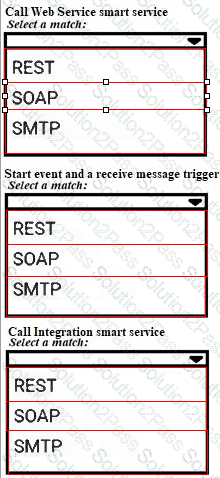
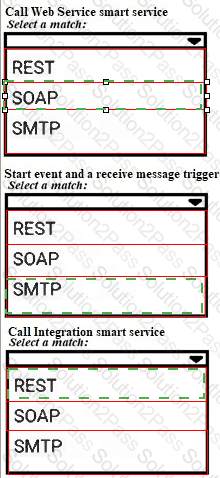
You're creating an application which has integrations with multiple systems using different protocols.

Match each process model component or node to the appropriate protocol.

Note: Each protocol will be used once. To change your responses, you may deselect your response by clicking the blank space at the top of the selection list.
You're refining a story for a centralized distribution center that extends the current application by allowing inventory managers to review orders.

These orders are created through a record action that various workshops access from a shared Appian site.

Which consideration best suits this use case?

A.

How will you handle errors resulting from a failed integration as a result of the workshops using an external system to place orders?

B.

What are the personas that will be utilizing this application so that an Appian group structure can be developed and maintained?

C.

What components have already been built relating to this piece of functionality so that you can reuse them and speed up development?

You're developing a functionality to manage transactions for an insurance company. Each transaction can have multiple items where respective item type and item amount can be entered. The amount entered can be either negative or positive, and is a decimal data type with a precision of 8 and a scale of 2.

A maximum of 10 items can be entered for a transaction. Once all the items are entered, you need to calculate and show the sum of all items' total amounts at the transaction level.

What is the best way to calculate and display the sum of all item amounts?

A.

text(sum(ri!items.amount),"00.00")

B.

fixed(sum(ri!items.amount),2,false())

C.

round(sum(ri!items.amount),2)

The synced record type Customer has a one-to-many relationship with the Case record type.

You need to calculate the number of open cases for each customer.

What are two valid methods to accomplish this? (Choose two.)

A.

Within the Case record type, edit the relationship to the Customer record and select the "Open” status as the grouping filter.

B.

Within the Customer record type, create a custom field that evaluates in real-time to aggregate related record fields and count the open cases.

C.

Create a query expression for the Customer record type. Utilize the a!measure() function within the aggregation fields to count the related cases in the “Open” status.

D.

Create a sync-time custom record field within the Customer record. Utilize the a!relatedRecordData() function to filter open cases and count the number of entries.

You’re establishing a Health Check schedule for your department.

Which two statements should you consider when implementing Health Checks? (Choose two.)

A.

Run a Health Check at least once a month in production as part of server and application monitoring.

B.

Run Health Checks during regular business hours in production to identify issues during heavy usage.

C.

Configure a weekly Health Check cadence for the development environment.

D.

Run Health Checks during regular non-business hours in production to avoid slowing down the environment.

You need to create a read-only grid that displays support case information. Data for the support cases is mapped to the "Case" record type with data sync enabled.

Within the record, there are fields named "createdDateTime" and "resolvedDateTime". These two fields store the timestamps for when a case is created and resolved, respectively.

The grid includes a column indicating the number of hours between when the case was created and when it was resolved. This column must be sortable within the grid.

How should you calculate the hour value that will display in the column?

A.

Create a custom record field that evaluates in real-time, and calculates the number of hours between when the case was created and when it was resolved.

B.

Within the grid column, utilize an Appian function to calculate the number of hours between when the case was created and when it was resolved.

C.

Create a custom record field that evaluates at sync-time, and calculates the number of hours between when the case was created and the current date and time.

Which two items are configured in the Admin Console when you create a web API? (Choose two.)

A.

API Key

B.

Access Control Policies

C.

Service Account

D.

LDAP Authentication

You need to connect to an external system using OAuth 2.0: SAML Bearer Assertion Flow authentication type, which requests access to an API on behalf of a signed in user.

This standard has the several steps involved with the SAML Bearer Assertion Flow.

Which two steps should you perform? (Choose two.)

A.

Add required users and groups to OAuth 2.0 SAML Bearer Assertion Users system group.

B.

Enable the checkbox labeled OAuth 2.0: SAML Bearer Assertion Flow in the Admin Console.

C.

Create a Bearer Assertion process flow to authenticate the user.

D.

Upload Client Certificate to Connected System.

What should you use to create a predefined query in a database for ease of use?

A.

Stored Procedure

B.

Expression Rule

C.

View

You run a report on different employee transactions by using a View.

You encounter the following error: "a!queryEntity: An error occurred while retrieving the data."

What is the most likely root cause of this error?

A.

The view doesn't have a column mapped as a primary key in its corresponding CDT.

B.

The view contains a large number of rows, requiring more time to fetch the data.

C.

The rule contains a missing syntax.

You need to configure your process model to store the result of an expression rule for every item in a list. Your design must have the smallest memory footprint.

What should you do?

A.

Invoke a sub-process for each item in the list.

B.

Configure a script task to use a!forEach() to iterate over each item in the list.

C.

Create a loop of smart service nodes in the process model and execute it for each item in the list.

D.

Execute MNI over a script task for each item in the list.

You're creating a new record type with data sync enabled. Users in the "ACME Employees" group must be able to access the record list and start the New Case action.

What are two valid steps that you should perform to grant users the appropriate access? (Choose two.)

A.

Add the “ACME Employees" group as a Viewer on the record type.

B.

Add the "ACME Employees" group as a Viewer to the data store mapped to the record.

C.

Grant Viewer permissions to the underlying interface object for the record list.

D.

Grant Initiator permissions to the underlying process model for the New Case action.

You're designing a report to show the total number of cases per month grouped by region. A synced record exists for the data source.

Which design pattern is most appropriate in this case?

A.

Configure a!columnChartFieid() using a!columnChartConfig() with the case creation date as the primaryGrouping and the region as the secondaryGrouping.

B.

Use a!queryRecordType() with a!aggregationFieids() to group the case creation date by region into a local variable. Pass the local variable value into the data input of a!columnChartField()

C.

Configure a!pieChartFieid() using a!pieChartConfig() with the case creation date as the primaryGrouping and the region as the secondaryGrouping.

You have a requirement to implement an audit trail for any modifications to a record.

You need to select the most efficient design option that has the least impact on your Appian application.

What should you do?

A.

Create a trigger on the database table to capture the audit trail to a table

B.

Create an Appian process to capture the change history and write the audit trail to the database

C.

Create a custom plug in that can write an audit trail to a log file.

Which two options are correct regarding record relationships when using synced records in your application? (Choose two.)

A.

Relationships can be established between any record types that have sync enabled, regardless of the source.

B.

Many-to-one relationships can be established using record relationships.

C.

Record type relationships enforce referential integrity.

D.

Up to 20 relationships can be added on a record type with data sync enabled.

Your client wants to configure user authentication using single sign-on (SSO) in their cloud environment.

Which two authentication types should you use to support this requirement? (Choose two.)

A.

PIEE user authentication

B.

LDAP authentication

C.

OpenID Connect authentication

D.

Appian authentication

You need to configure the security for the synced record type Case.

Your requirements are:

Only users in the "Archive Management" group can access cases in the "Archived" status.

Cases in the status "Deleted" are accessible to no one.

Users in the "All Users" group can already access the record.

What should you do?

A.

Create a new user filter to allow access if the user is in the "Archive Management" group while the case status is "Archived. "

Configure the record-level security to exclude all cases that are in the "Deleted" status

B.

Create a new user filter to allow access if the user is in the "Archive Management" group while the case status is "Archived. "

Configure a source filter to exclude all cases that are in the "Deleted" status.

C.

Create a new record-level security rule to allow access if the user is in the "Archive Management" group while the case status is "Archived."

Configure a source filter to exclude all cases that are in the "Deleted" status.

What are three ways to optimize the memory usage of a process model? (Choose three.)

A.

Pass data directly to activity nodes and smart services.

B.

Minimize the use of subprocesses in the model.

C.

Decrease the number of process variables.

D.

Configure process variables as parameters.

E.

Divide large nodes into multiple smaller nodes.

F.

Avoid storing large blocks of text in process variables.

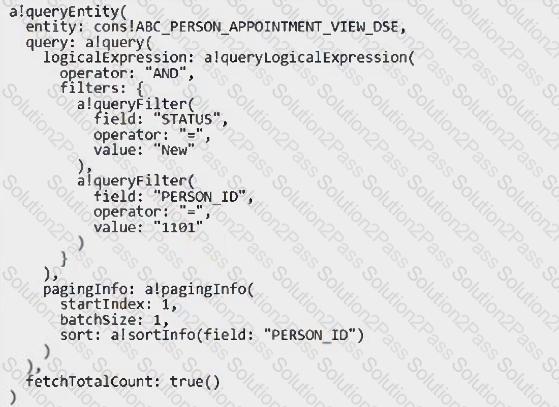
A view is created with the primary table PERSON and is joined using a left join with the APPOINTMENT table on the column "PERSON_ID". There is a one-to-many relationship between the PERSON and APPOINTMENT tables.

A Custom Data Type (CDT) and a data store entity have been created based on this view, with the primary key being "PERSON_ID".

Review the data presented in the PERSON and APPOINTMENT tables:
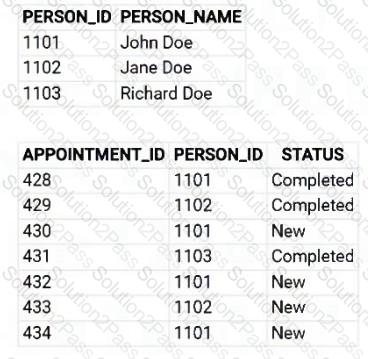
Which two statements are true when the following query entity is executed? (Choose two.)

A.

Appian makes one more query to the database(other than the actual query to fetch the data) to get the totalCount based on the applied filters.

B.

result totalCount is 3

C.

result totalCount is 1

D.

Appian makes one more query to the database(other than the actual query to fetch the data) to get the totalCount based on the applied filters and paging info.

Page: 1 / 2
Total 106 questions
Copyright © 2014-2026 Solution2Pass. All Rights Reserved