Pre-Summer Sale Special - Limited Time 70% Discount Offer - Ends in 0d 00h 00m 00s - Coupon code: xmaspas7

Easiest Solution 2 Pass Your Certification Exams

CIC CBIC Certified Infection Control Exam Free Practice Exam Questions (2026 Updated)

Prepare effectively for your CBIC CIC CBIC Certified Infection Control Exam certification with our extensive collection of free, high-quality practice questions. Each question is designed to mirror the actual exam format and objectives, complete with comprehensive answers and detailed explanations. Our materials are regularly updated for 2026, ensuring you have the most current resources to build confidence and succeed on your first attempt.

Page: 4 / 5
Total 299 questions

At a facility with 2,500 employees, 1,500 are at risk for bloodborne pathogen exposure. Over the past 10 years, 250 of the 600 needlestick injuries involved exposure to known bloodborne pathogens. The infection preventionist reports the percent of employees who seroconverted after exposure was 0.4%. How many employees became infected?

A.

1

B.

2

C.

6

D.

10

Which of the following statements describes the MOST important consideration of an infection preventionist when assessing the effectiveness of an infection control action plan?

A.

Re-evaluate the action plan every three years.

B.

Update the plan before the risk assessment is completed.

C.

Develop a timeline and assign responsibilities for the stated action.

D.

Monitor and validate the related outcome and process measures.

What inflammatory reaction may occur in the eye after cataract surgery due to a breach in disinfection and sterilization of intraocular surgical instruments?

A.

Endophthalmitis

B.

Bacterial conjunctivitis

C.

Toxic Anterior Segment Syndrome

D.

Toxic Posterior Segment Syndrome

Which of the following is the BEST strategy for reducing bloodstream infections associated with central venous catheters?

A.

Routine replacement of central lines every 7 days.

B.

Use of chlorhexidine-impregnated dressings.

C.

Daily blood cultures for patients with central lines.

D.

Use of povidone-iodine instead of chlorhexidine for skin antisepsis.

Which of the following processes is essential for endoscope reprocessing?

A.

Intermediate level disinfection and contact time

B.

Pre-cleaning, leak testing, and manual cleaning

C.

Inspection using a borescope and horizontal storage

D.

Leak testing, manual cleaning, and low level disinfection

The appropriate method to obtain cultures for the diagnosis of catheter-associated urinary tract infections (CAUTI) is:

A.

Aseptic technique via the collection port

B.

Removal with culture of the urinary catheter tip

C.

Disconnection of the catheter from the drainage tubing

D.

Aseptic technique via the drainage port of the collection bag

The infection preventionist (IP) is working with Environmental Services to evaluate a new disinfectant for purchase by the facility. With which of the following should the IP be MOST concerned?

A.

Safety of the product

B.

Vendor knowledge of product

C.

Vendor proximity to the facility

D.

Staff preference

What antimicrobial is associated with increased Clostridioides difficile infection?

A.

Amoxicillin

B.

Aztreonam

C.

Clindamycin

D.

Tobramycin

A 22-year-old male has a splenectomy secondary to trauma. Which of the following vaccines is MOST important for this patient?

A.

Haemophilus influenzae type B

B.

Pneumococcal

C.

Hepatitis B

D.

Varicella

Some pathogens live in the body and can be cultured, but do NOT elicit any response from the body’s defense mechanisms. This state is called:

A.

Colonization

B.

Infection

C.

Latency

D.

Contamination

Which of the following descriptions accurately describes a single-use medical device?

A.

A device which can be used on a single patient

B.

A device that is sterilized and can be used again on the same patient

C.

A device used on a patient and reprocessed prior to being used again

D.

A device used one time on a patient during a procedure and then discarded

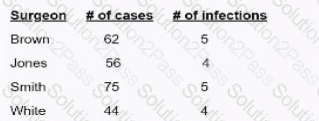
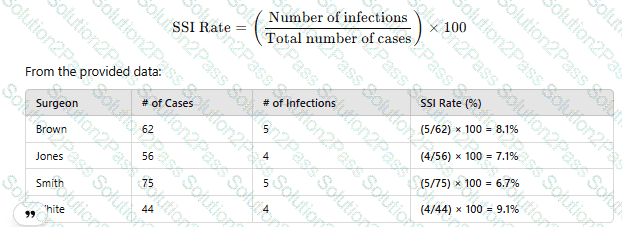
Surgical site infection (SSI) data for the previous quarter reveal the following numbers. The surgeon with the highest infection rate is Doctor
A.

Brown

B.

Jones.

C.

Smith

D.

White

During a COVID outbreak with hospital-associated transmission cases, the infection preventionist (IP) receives a news media call about what is being done to reduce the transmission. The IP's BEST response is to

A.

answer the questions truthfully.

B.

give vague answers to ensure patient privacy.

C.

refer the reporters to the hospital's media spokesperson.

D.

inform the reporter that the conversation must be recorded to ensure accuracy.

The infection preventionist recognizes that facility renovation projects are associated with risk for healthcare-associated infections (HAIs). What is the primary rationale for this risk?

A.

Increased numbers of construction staff resulting in congested workspaces

B.

Improper training regarding hand hygiene for contracted workers

C.

Trash removal using uncovered carts

D.

Environmental dispersal of microorganisms

An infection preventionist has been asked to consult on disinfectant products for use in a long term care home. What should their primary concern be?

A.

Patient care items are cleaned whenever visibly soiled.

B.

An appropriate disinfectant should be available whenever items are used on patients known to be colonized with multi drug resistant organisms.

C.

Disinfectant products should be compatible with the patient care devices used by the facility.

D.

Disinfectant products should have a mild odor to reduce allergy concerns.

Which of the following intravenous solutions will MOST likely promote the growth of microorganisms?

A.

50% hypertonic glucose

B.

5% dextrose

C.

Synthetic amino acids

D.

10% lipid emulsions

When evaluating environmental cleaning and disinfectant products as a part of the product evaluation committee, which of the following is responsible for providing information regarding clinical trials?

A.

Infection Preventionist

B.

Clinical representatives

C.

Environmental Services

D.

Manufacturer representatives

Which of the following is NOT valuable when using a graph to display data?

A.

Title with topic of data

B.

Facility and time frame for data

C.

Published trends for data comparison

D.

X and Y axes labels and annotation where indicated

What is the limitation of using liquid chemical sterilants to sterilize medical items?

A.

It does not kill the spores.

B.

The sterility is not maintained during storage.

C.

It requires a contact time of at least 12 hours.

D.

It can only be used for heat tolerant devices.

Following an outbreak of Hepatitis A, the water supply is sampled. A high count of which of the following isolates would indicate that the water was a potential source?

A.

Coliforms

B.

Pseudomonads

C.

Legionella

D.

Acinetobacter

Page: 4 / 5
Total 299 questions
Copyright © 2014-2026 Solution2Pass. All Rights Reserved