New Year Sale Special - Limited Time 70% Discount Offer - Ends in 0d 00h 00m 00s - Coupon code: xmaspas7

Easiest Solution 2 Pass Your Certification Exams

350-501 Cisco Implementing and Operating Cisco Service Provider Network Core Technologies (350-501 SPCOR) Free Practice Exam Questions (2025 Updated)

Prepare effectively for your Cisco 350-501 Implementing and Operating Cisco Service Provider Network Core Technologies (350-501 SPCOR) certification with our extensive collection of free, high-quality practice questions. Each question is designed to mirror the actual exam format and objectives, complete with comprehensive answers and detailed explanations. Our materials are regularly updated for 2025, ensuring you have the most current resources to build confidence and succeed on your first attempt.

Page: 6 / 6
Total 547 questions

What is one of the main functions of 6RD?

A.

It provides stateful session translation with the 2002::/16 prefix.

B.

It translates RFC 1918 IP addresses into public IP addresses.

C.

It provides native reachability between IPv4-only hosts and 6RD-enabled IPv6 hosts.

D.

It allows customers IPv6 traffic to be tunneled over IPv4 network infrastructure.

An engineer is developing a configuration script to enable dial-out telemetry streams using gRPC on several new devices. TLS must be disabled on the devices. Which configuration must the engineer apply on the network?

A)
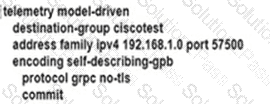
B)
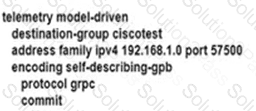
C)
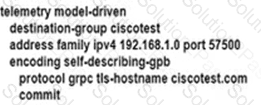
D)
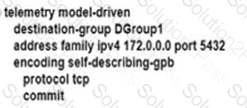
A.

Option A

B.

Option B

C.

Option C

D.

Option D

A network architect must implement CSC VPN services for a new backbone carrier. Which two benefits does the architecture provide? (Choose two.)

A.

It maintains.a single backbone, which simplifies the VPN implementation to customers.

B.

It eliminates the need to maintain a centralized network-maintenance and operations strategy.

C.

It leverages IPsec to establish connections within the backbone. which eliminates the need for BGP to distribute routes.

D.

It supports a scalable growth strategy that services multiple customers efficiently

E.

It relies on IP communications, which simplifies the network design.

A network operator needs to implement PIM-SSM multicast configuration on customer's network so that users in different domains are able to access and stream live traffic. Which two actions must the engineer perform on the network

to make the streaming work? (Choose two.)
A.

Configure at least one MSDP peer on the network

B.

Enable IGMP version 2 at the interface lever.

C.

Enable PIM sparse mode on the device.

D.

Enable IGMP version 3 at the interface level.

E.

Enable PM dense mode on the device.

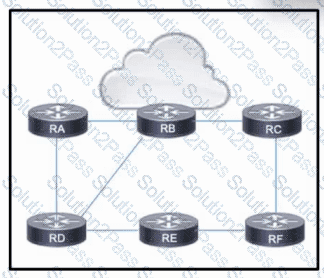
Refer to the exhibit. The network is running OSPF, and access to the internet is provided through router RB. Router RA connects to several servers that provide services to users connected to RC and RF. User traffic is growing, and the engineering team wants to mitigate the future potential for congestion when the servers are experiencing heavy use.

Which action must the team take to maintain better network performance?

A.

Implement MPLS and install a Cisco MPLS TE tunnel to route high-priority traffic via a preferred path.

B.

Implement ACLs to manage traffic flowing over individual links.

C.

Implement class maps to categorize traffic and apply them to policies to manage traffic flow.

D.

Implement OSPF point-to-point links to eliminate the need for DR election and the associated traffic.

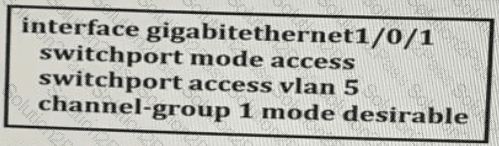
Refer to the exhibit:

An engineer is preparing to implement link aggregation configuration.

Which statement al about this configuration is true?

A.

The switch port actively sends packets to negotiate an EtherChannel using PAgP

B.

The switch port accepts LACP and PAgP packets from a connected peer and negotiate an EtherChannel using the common EtherChannel mode.

C.

The switch port passively negotiates an EtherChannel if it receives PAgP packets from a connected peer

D.

The switch port negotiates an EtherChannel if it receives LACP packets from a connected peer

After implement MPLS protocol for multiple VRFs on a single Cisco device, the engineer notices all VRFs on the router still do to not LDP session protection feature enabled. Which configuration must the engineer apply to enable the LDP session protection feature FOR LDP neighbors within each VRF?

A.

Configure LDP session protection globally on the device only.

B.

Configure LDP session protection globally on the device and on each neighbor that requires session protection.

C.

Configure LDP session authentication on the device to enable LDP session protection on each VRF automatically.

D.

Configure LDP session protection within the individual VRFs.

Which type of attack is a Protocol attack?

A.

HTTP flood

B.

TFTP flood

C.

SYN flood

D.

Slowlorls

According to RFC5305 on IS-IS extensions for traffic engineering, what is the 4-octet sub-TLV type 10 of extended IS-IS reachability TLV type 22?

A.

TE default metric

B.

maximum reservable link bandwidth

C.

administrative group (color)

D.

IPv4 neighbor address

Which protocol is used for communication between the PCE and PCC?

A.

ICMP

B.

PCEP

C.

CEF

D.

POP

When Cisco lOS XE REST API uses HTTP request methods what is the purpose of a PUT request?

A.

retrieves the specified resource or representation

B.

submits data to be processed to the specified resource

C.

updates the specified resource with new information

D.

creates a new resource

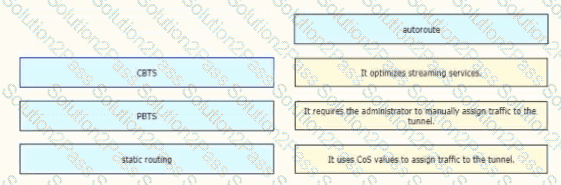
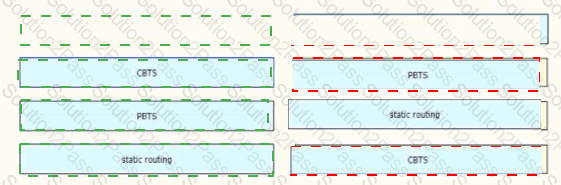
Drag and drop the methods of Cisco MPLS TE tunnel traffic assignment from the left onto their characteristics on the right.
Page: 6 / 6
Total 547 questions
Copyright © 2014-2025 Solution2Pass. All Rights Reserved