F5CAB2 F5 BIG-IP Administration Data Plane Concepts (F5CAB2) exam Free Practice Exam Questions (2026 Updated)
Prepare effectively for your F5 F5CAB2 BIG-IP Administration Data Plane Concepts (F5CAB2) exam certification with our extensive collection of free, high-quality practice questions. Each question is designed to mirror the actual exam format and objectives, complete with comprehensive answers and detailed explanations. Our materials are regularly updated for 2026, ensuring you have the most current resources to build confidence and succeed on your first attempt.
Refer to the exhibit above.
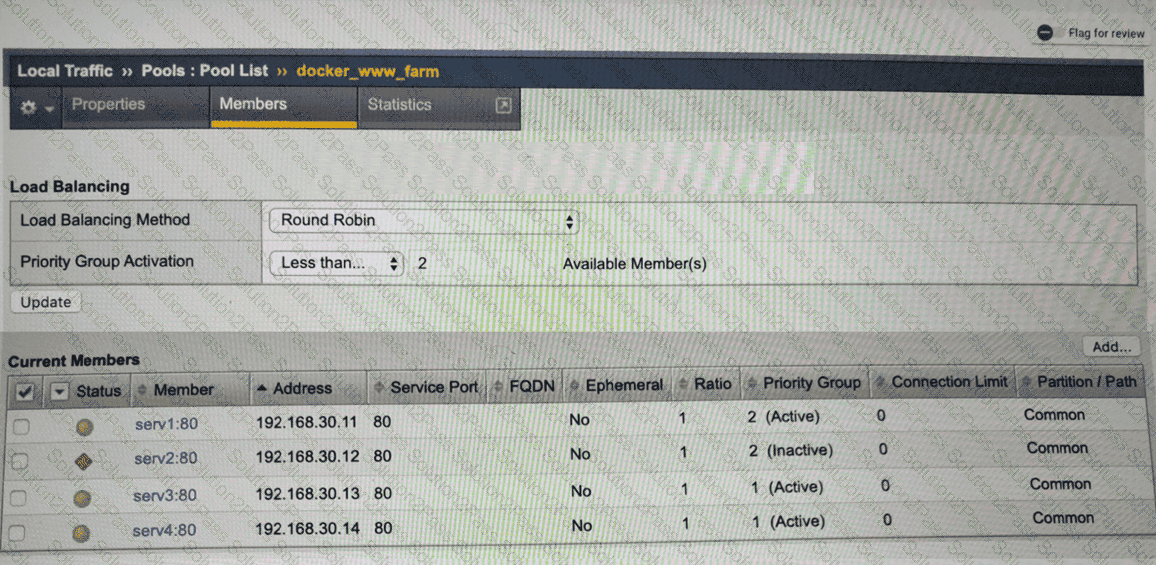
A BIG-IP pool is configured with Priority Group Activation = Less than 2 available members . The pool members have different priority groups and availability states. Which pool members are receiving traffic ? (Choose one answer)
To increase available bandwidth of an existing Trunk, the BIG-IP Administrator is adding additional interfaces. Which command should the BIG-IP Administrator run from within bash shell?
When using the setup utility to configure a redundant pair, you are asked to provide a " Failover Peer IP " . Which address is this?
Refer to the exhibit.
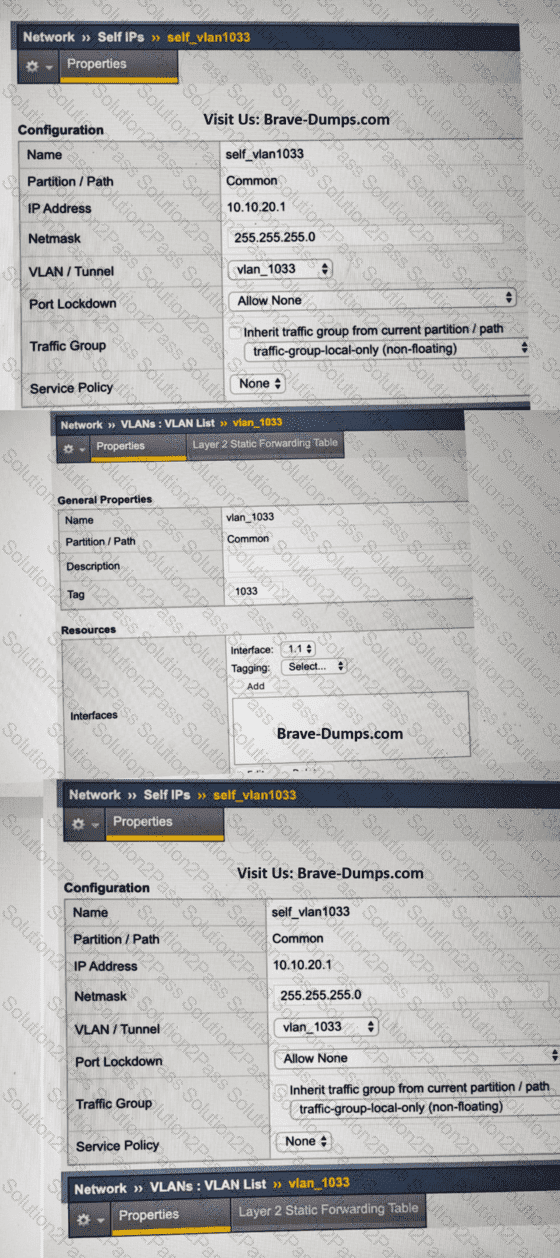
The network team creates a new VLAN on the switches. The BIG-IP Administrator creates a new VLAN and a Self IP on the BIG-IP device, but the servers on the new VLAN are NOT reachable from the BIG-IP device.
Which action should the BIG-IP Administrator take to resolve this issue? (Choose one answer)
Refer to the exhibit.
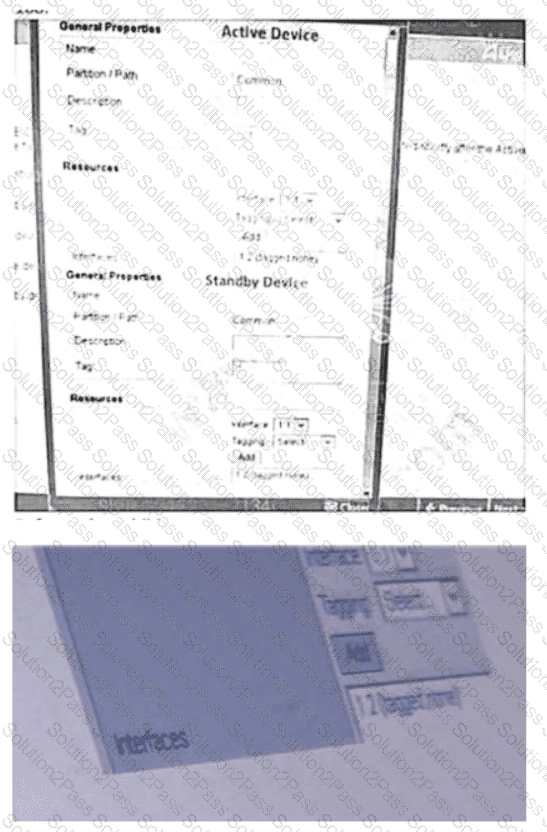
During a planned upgrade to a BIG-IP HA pair running Active/Standby, an outage to application traffic is reported shortly after the Active unit is forced to Standby. Reverting the failover resolves the outage. What should the BIG-IP Administrator modify to avoid an outage during the next failover event? (Choose one answer)
A standard virtual server has been associated with a pool with multiple members. Assuming all other settings are left at their defaults, which statement is always true concerning traffic processed by the virtual server?
Which of the virtual servers listed is selected when a packet is sourced from 10.10.1.1:34456 and destined to 10.16.2.100:445 arrives at the BIG-IP?
What should a BIG-IP Administrator configure to minimize impact during a failover ? (Choose one answer)
A BIG-IP Administrator needs to connect a BIG-IP system to two upstream switches to provide external network resilience . The network engineer instructs the administrator to configure interface binding with LACP . Which configuration should the administrator use? (Choose one answer)
The BIG-IP Administrator wants to provide quick failover between the F5 LTM devices that are configured as an HA pair with a single Self IP using the MAC Masquerade feature. The administrator configures MAC masquerade for traffic-group-1 using the following command:
`tmsh modify /cm traffic-group traffic-group-1 mac 02:12:34:56:00:00`
However, the Network Operations team identifies an issue with using the same MAC address across multiple VLANs. As a result, the administrator enables Per-VLAN MAC Masquerade to ensure a unique MAC address per VLAN by running:
`tmsh modify /sys db tm.macmasqaddr_per_vlan value true`
What would be the resulting MAC address on a tagged VLAN with ID 1501? (Choose one answer)
A BIG-IP Administrator is making adjustments to an iRule and needs to identify which of the 235 Virtual Servers configured on the BIG-IP device will be affected. How should the administrator obtain this information in an efficient way?
Which statement is true concerning cookie persistence?
A BIG-IP Administrator wants to add a new Self IP to the BIG-IP device. Which item should be assigned to the new Self IP being configured?
A development team needs to apply a software fix and troubleshoot one of its servers. The BIG-IP Administrator needs to immediately remove all connections from the BIG-IP system to the back-end server. The BIG-IP Administrator checks the virtual server configuration and finds that a persistence profile is assigned to it.
What should the BIG-IP Administrator do to meet this requirement? (Choose one answer)
What are two features of an application delivery controller (ADC)?
Pick the 2 correct responses below.
What type of virtual server should be used to load balance UDP traffic without considering previous connections?
The network architecture for a BIG-IP consists of an external VLAN and an internal VLAN with two interfaces connected to the upstream switch . The design requires fault tolerance in the case that one of the interfaces is down. Which deployment architecture meets these requirements? (Choose one answer)
What should a BIG-IP Administrator configure to minimize impact during a failover?
A BIG-IP Administrator is conducting maintenance on one BIG-IP appliance in an HA Pair. Why should the BIG-IP Administrator put the appliance into FORCED-OFFLINE state?
An application is configured so that the same pool member must be used for an entire session, as well as for HTTP and FTP traffic. A user reports that a session has terminated, and the user must restart the session. The BIG-IP Administrator determines that the active BIG-IP device failed over to the standby BIG-IP device. Which configuration settings should the BIG-IP Administrator verify to ensure proper behavior when BIG-IP failover occurs?