F5CAB4 F5 BIG-IP Administration Control Plane Administration (F5CAB4) exam Free Practice Exam Questions (2026 Updated)
Prepare effectively for your F5 F5CAB4 BIG-IP Administration Control Plane Administration (F5CAB4) exam certification with our extensive collection of free, high-quality practice questions. Each question is designed to mirror the actual exam format and objectives, complete with comprehensive answers and detailed explanations. Our materials are regularly updated for 2026, ensuring you have the most current resources to build confidence and succeed on your first attempt.
A BIG-IP Administrator is setting up a new BIG-IP device. The network administrator reports that the interface has an incompatible media speed. The BIG-IP Administrator needs to change this setting manually. From which location should the BIG-IP Administrator perform this task?14
The BIG-IP Administrator has modified an iRule on one device of an HA pair. The BIG-IP Administrator notices there is NO traffic on the BIG-IP device in which they are logged into. What should the BIG-IP Administrator do to verify if the iRule works correctly?
Refer to the exhibit.
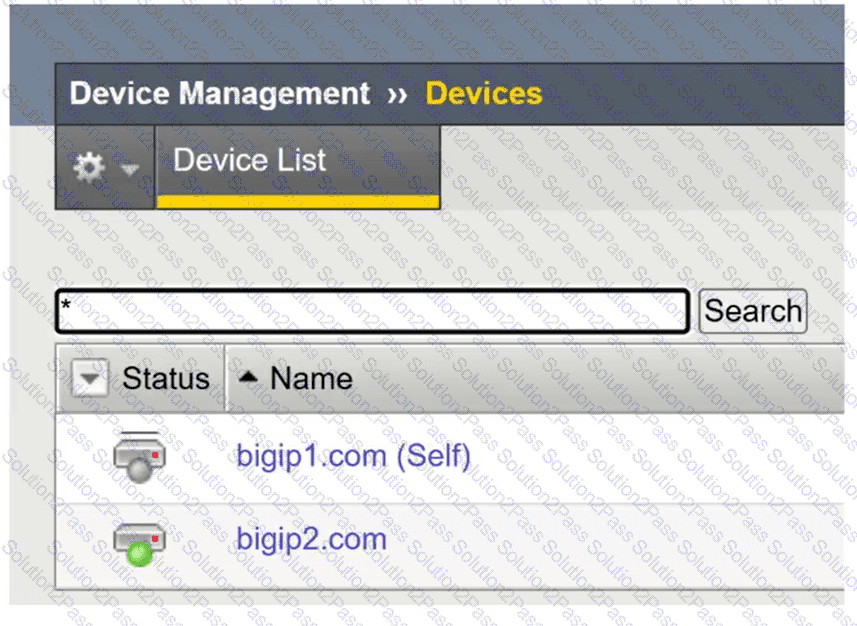
What is the status of bigip1.com ?
A BIG-IP Administrator needs to check the memory utilization on a BIG-IP system. Which two methods can the BIG-IP Administrator use? (Choose two.)
A local user account (Users) on the BIG-IP device is assigned the User Manager role. User1 attempts to modify the properties of another account (User2), but the action fails. The BIG-IP Administrator can successfully modify the User2 account. Assuming the principle of least privilege, what is the correct way to allow User1 to modify User2 properties?
An LTM device has a virtual server mapped to www.f5.com. Users report that when they connect to /resources/201.1.2h.l_l.com they are unable to receive content. What is the likely cause of the issue?
What are the recommended methods for forcing a BIG-IP system to standby mode ? (Choose two answers)
Which log file should the BIG-IP Administrator check to determine if a specific user tried to log in to the BIG-IP Configuration Utility ? (Choose one answer)
A BIG-IP Administrator needs to update the list of configured NTP servers. In which area of the Configuration Utility should the BIG-IP Administrator perform this update?
A BIG-IP Administrator plans to resolve a non-critical issue with a BIG-IP device in 2 weeks. What Severity level should be assigned to this type of F5 support ticket?
A BIG-IP Administrator makes a configuration change to the BIG-IP device. Which file logs the message regarding the configuration change?
New Syslog servers have been deployed in an organization. The BIG-IP Administrator must reconfigure the BIG-IP system to send log messages to these servers.
In which location in the Configuration Utility can the BIG-IP Administrator make the needed configuration changes to accomplish this? (Choose one answer)
Which file should the BIG-IP Administrator check to determine when a Virtual Server changed its status?
A BIG-IP device sends out the following SNMP trap: big-ipo.f5.com - bigipExternalLinkChange Link: 1.0 is DOWN. Where in the BIG-IP Configuration utility should the BIG-IP Administrator verify the current status of Link 1.0?
A BIG-IP Administrator needs to find which modules have been licensed for use on the BIG-IP system. In which section of the Configuration Utility can the BIG-IP Administrator find this information?
Refer to the output.
Color green
Status In Sync
Summary
Details
/Common/host1.company.com: connected (for 2548 seconds)
/Common/sync-fail-test (In Sync):
- all 2 devices consistent
/Common/device_trust_group (In Sync):
- all 2 devices consistent
Which TMSH command generated this output?
Administrative user accounts have been defined on the remote LDAP server and are unable to log in to the BIG-IP device.
Which log file should the BIG-IP Administrator check to find the related messages? (Choose one answer)
An organization is performing a major release upgrade to its BIG-IP system. The system is under medium load and has enough disk space to perform the upgrade.
Which pre-upgrade task is disruptive to regular system performance and should be performed during a maintenance window? (Choose one answer)
A node is a member of various pools and hosts different web applications. If a web application is unavailable, the BIG-IP appliance needs to mark the pool member down for that application pool. What should a BIG-IP Administrator deploy at the pool level to accomplish this?
In which of the following log files would log events pertaining to pool members being marked “UP” or “DOWN” by their Health Monitors be written? (Choose one answer)