F5CAB5 F5 BIG-IP Administration Support and Troubleshooting (F5CAB5) exam Free Practice Exam Questions (2026 Updated)
Prepare effectively for your F5 F5CAB5 BIG-IP Administration Support and Troubleshooting (F5CAB5) exam certification with our extensive collection of free, high-quality practice questions. Each question is designed to mirror the actual exam format and objectives, complete with comprehensive answers and detailed explanations. Our materials are regularly updated for 2026, ensuring you have the most current resources to build confidence and succeed on your first attempt.
Refer to Exhibit:
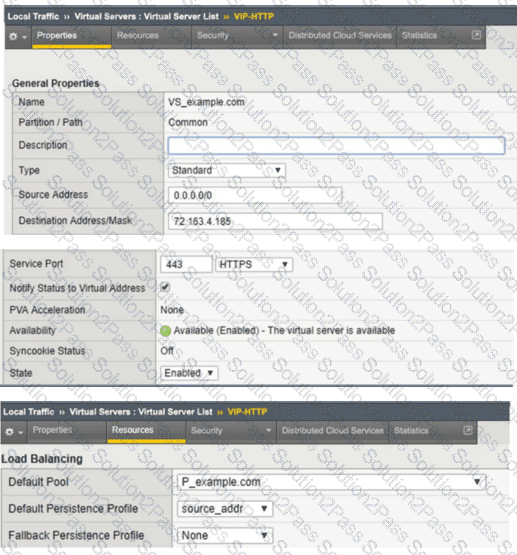
An organization is reporting slow performance accessing their Intranet website, hosted in a public cloud. All employees use a single Proxy Server with the public IP of 104.219.110.168 to connect to the Internet. What should the BIG-IP Administrator of the Intranet website do to fix this issue?
A Standard Virtual Server for a web application is configured with Automap for the Source Address Translation option. The original source address of the client must be known by the backend servers. What should the BIG-IP Administrator configure to meet this requirement?
In the BIG-IP Configuration Utility, a user requests a single screen view to determine the status of all Virtual Servers and associated pool members, as well as any iRules in use. Where should the BIG-IP Administrator instruct the user to find this view?32
A BIG-IP Administrator observes the following messages in the /var/log/ltm log:
warning tmm[pid]: 011e0002: sweeper_segment_cb_any: Aggressive mode /Common/default-eviction-policy activated (0) (global memory) (345209/690176 pages)
warning tmm[pid]: 011e0003: Aggressive mode sweeper /Common/default-eviction-policy (0) (global memory) 1 connections killed
warning tmm[pid]: 011e0003: Aggressive mode sweeper /Common/default-eviction-policy (0) (global memory) 1 connections killed
warning tmm[pid]: 011e0003: Aggressive mode sweeper /Common/default-eviction-policy (0) (global memory) 1 connections killed
What is happening when the BIG-IP Administrator sees the messages displayed above? (Choose two answers)
A BIG-IP Administrator notices that one of the servers that runs an application isNOTreceiving any traffic. The BIG-IP Administrator examines the configuration status of the application and observes the displayed monitor configuration and affected pool member status.
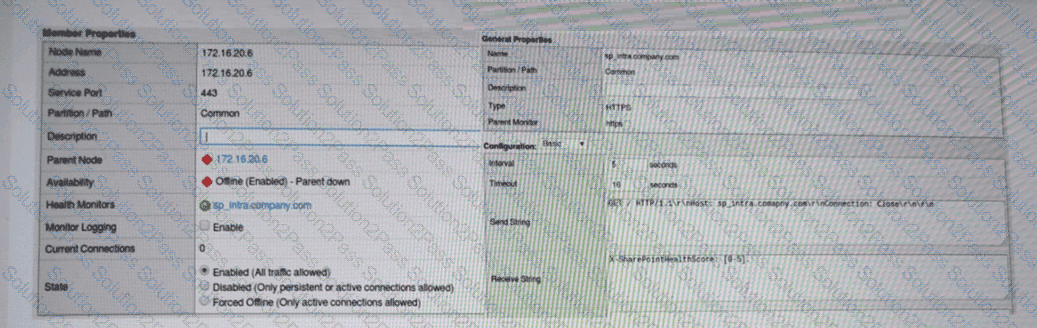
What is the possible cause of this issue? (Choose one answer)
A BIG-IP Administrator configured the following virtual server to pass traffic on all addresses and ports. After configuration is completed, the BIG-IP Administrator notices that the virtual server is unable to pass traffic.
ltm virtual forwarding_any_vs {
destination 0.0.0.0:any
ip-forward
mask 255.255.255.255
profiles {
fastL4 { }
}
serverssl-use-sni disabled
source 0.0.0.0/0
translate-address disabled
translate-port disabled
}
Which part of the configuration is the cause of the issue? (Choose one answer)
A BIG-IP Administrator creates a new Virtual Server. The end user is unable to access the page. During troubleshooting, the administrator learns that the connection between the BIG-IP system and server is NOT set up correctly. What should the administrator do to solve this issue?
A BIG-IP Administrator needs to view the CPU utilization of a particular Virtual Server. Which section of the Configuration Utility should the administrator use for this purpose?
Refer to the exhibit. A BIG-IP Administrator creates a new Virtual Server to load balance SSH traffic. Users are unable to log on to the servers. What should the BIG-IP Administrator do to resolve the issue? (Exhibit shows a Standard Virtual Server with an HTTP profile applied).
Which file should the BIG-IP Administrator check to determine when a Virtual Server changed its status from RED to GREEN?
A BIG-IP Administrator needs to view the CPU utilization of a particular Virtual Server. Which section of the Configuration Utility should the administrator use for this purpose?
Exhibit:
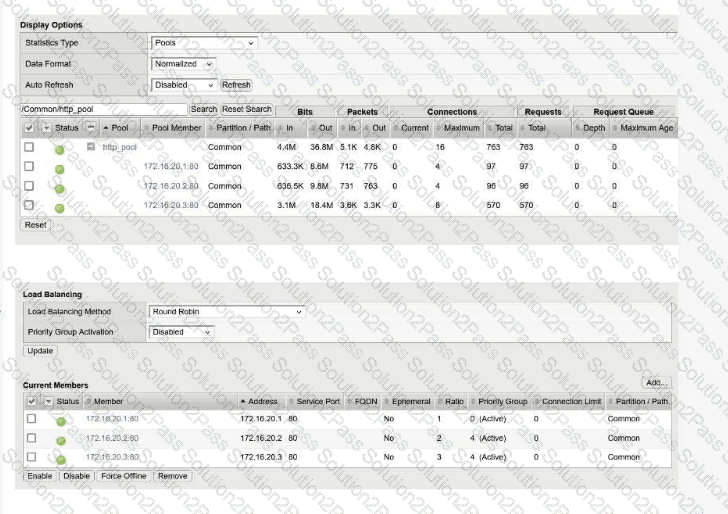
A BIG-IP Administrator configured a virtual server with a pool of 3 members and selected the Round Robin load balancing method to evenly distribute traffic across the pool members. During initial testing, traffic was not evenly distributed and the pool member 172.16.20.3 received more traffic than the other pool members.
Refer to the exhibit and the virtual server configuration provided below:
Plaintext
ltm virtual http.vs {
destination 10.10.1.100:http
ip-protocol tcp
mask 255.255.255.255
persist {
source_addr { default yes }
}
pool http.pool
profiles {
tcp{}
}
serverssl-use-sni disabled
source 0.0.0.0/0
source-address-translation {
type automap
}
translate-address enabled
}
What is the most likely cause of this behavior?
Users are unable to reach an application. The BIG-IP Administrator checks the Configuration Utility and observes that the Virtual Server has a red diamond in front of the status. What is causing this issue?
Refer to the exhibit.
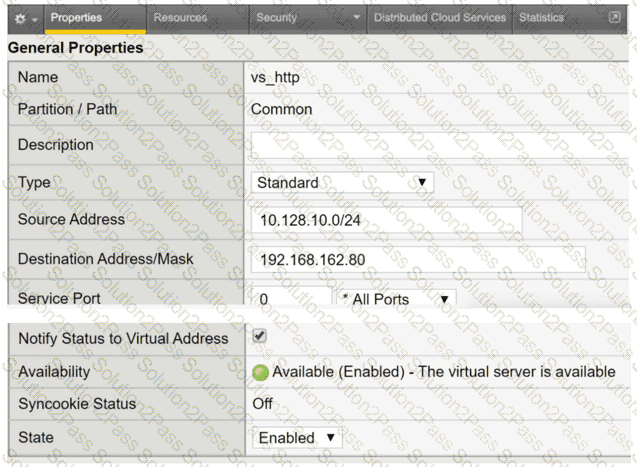
A user with IP address 192.168.162.70 is unable to connect to an HTTP application. What is a possible cause within the Virtual Server configuration?
Clients report that they cannot reach the virtual server vs-production on port 80, but are able to ping the virtual server address. The configuration is shown below:
Plaintext
ltm virtual vs-production {
destination 10.99.20.50:http
ip-protocol tcp
mask 255.255.255.255
profiles {
http {}
tcp {}
}
source 192.168.0.0/16
translate-address enabled
translate-port enabled
vlans {
external
}
vlans-enabled
}
What is the cause?
A gateway_icmp health monitor is configured on a pool. The BIG-IP Administrator is investigating why the pool is reported as down while the server is online. Other pools with servers in the same subnet are correctly monitored.
What can cause this behavior? (Choose one answer)
What information is required for a BIG-IP Administrator to open an F5 Support ticket?
A BIG-IP device sends out the following SNMP trap: big-ipo.f5.com - bigipExternalLinkChange Link: 1.0 is DOWN. Where in the BIG-IP Configuration utility should the BIG-IP Administrator verify the current status of Link 1.0?
A BIG-IP Administrator adds new Pool Members into an existing, highly utilized pool. Soon after, there are reports that the application is failing to load for some users. What pool level setting should the BIG-IP Administrator check?