Summer Sale Special - Limited Time 70% Discount Offer - Ends in 0d 00h 00m 00s - Coupon code: xmaspas7

Easiest Solution 2 Pass Your Certification Exams

NSE4_FGT_AD-7.6 Fortinet NSE 4 - FortiOS 7.6 Administrator Free Practice Exam Questions (2026 Updated)

Prepare effectively for your Fortinet NSE4_FGT_AD-7.6 Fortinet NSE 4 - FortiOS 7.6 Administrator certification with our extensive collection of free, high-quality practice questions. Each question is designed to mirror the actual exam format and objectives, complete with comprehensive answers and detailed explanations. Our materials are regularly updated for 2026, ensuring you have the most current resources to build confidence and succeed on your first attempt.

Page: 1 / 2
Total 95 questions

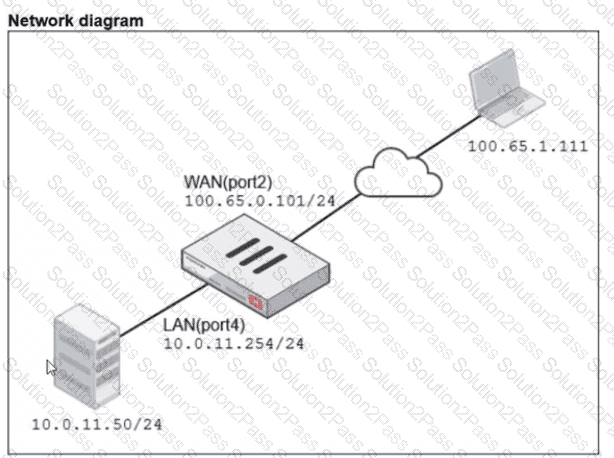
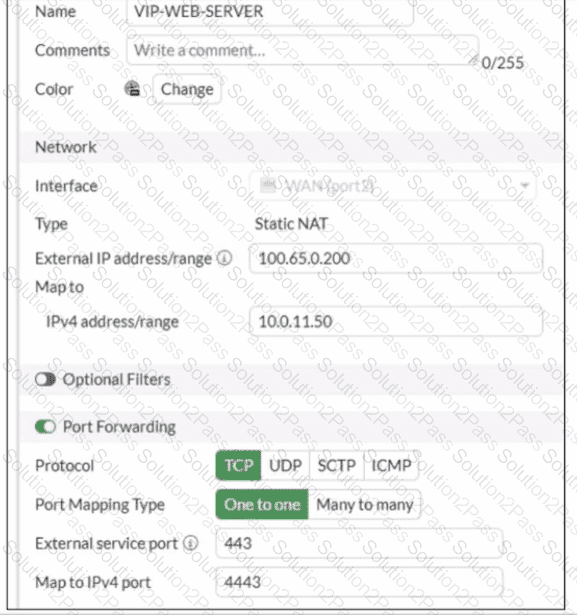
Refer to the exhibits.

A diagram of a FortiGate device connected to the network VIP object and firewall policy configurations are shown.

The WAN (port2) interface has the IP address

100.65.0.101/24.

The LAN (port4) interface has the IP address

10.0.11.254/24.

If the host 100.65.1.111 sends a TCP SYN packet on port 443 to 100.65.0.200. what will the source address, destination address, and destination port of the packet be at the time FortiGate forwards the packet to the destination?

A.

10.0.11.254, 100.65.0.200. and 443, respectively

B.

10.0.11.254, 10.0.15.50, and 4443. respectively

C.

100.65.1. 111, 10.0.11.50, and 4443. respectively

D.

100.65.1.111, 10.0.11.50. and 443. respectively

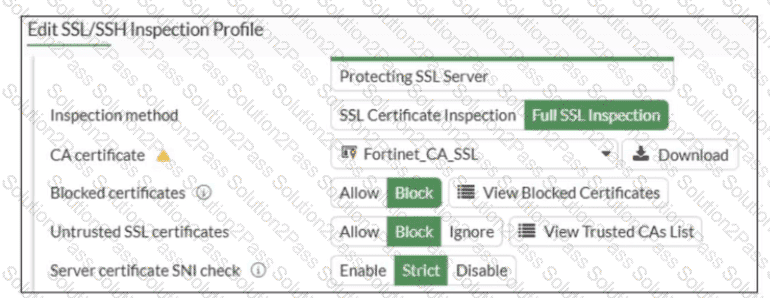
Refer to the exhibit.

What would be the impact of these settings on the Server certificate SNI check configuration on FortiGate?

A.

FortiGate will accept and use the CN in the server certificate for URL filtering if the SNI does not match the CN or SAN fields.

B.

FortiGate will accept the connection with a warning if the SNI does not match the CN or SAN fields.

C.

FortiGate will close the connection if the SNI does not match the CN or SAN fields.

D.

FortiGate will close the connection if the SNI does not match the CN and SAN fields

How does FortiExtender connect to FortiSASE in a site-based, remote internet access method?

A.

FortiExtender uses a Virtual Extensible LAN (VXLAN)-over-IPsec connection.

B.

FortiExtender establishes a secure SSL connection using FortiClient.

C.

FortiExtender first connects to a FortiGate LAN extension through a secure web gateway (SWG).

D.

FortiExtender uses the proxy auto-configuration < PAC) file and an explicit web proxy to connect.

A network administrator enabled antivirus and selected an SSL inspection profile on a firewall policy. When downloading an EICAR test file through HTTP, FortiGate detects the virus and blocks the file. When downloading the same file through HTTPS, FortiGate does not detect the virus and does not block the file, allowing it to be downloaded. The administrator confirms that the traffic matches the configured firewall policy. What are two reasons for the failed virus detection by FortiGate? (Choose two answers)

A.

The selected SSL inspection profile has certificate inspection enabled.

B.

The website is exempted from SSL inspection.

C.

The EICAR test file exceeds the protocol options oversize limit.

D.

The browser does not trust the FortiGate self-signed CA certificate.

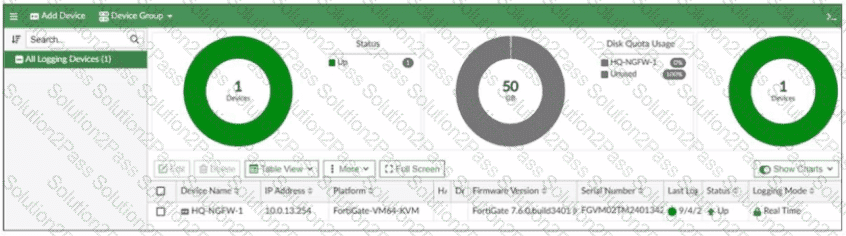
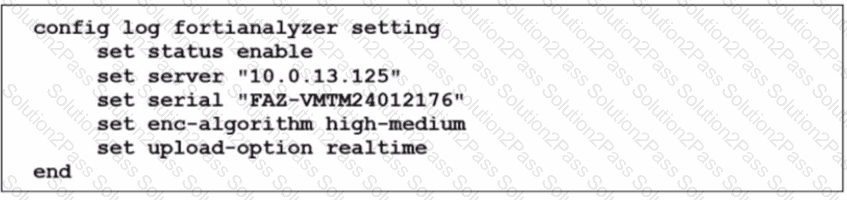
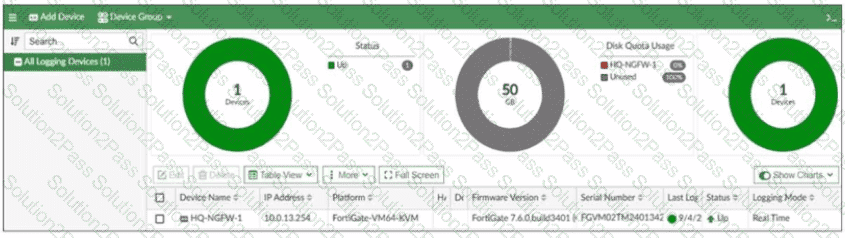
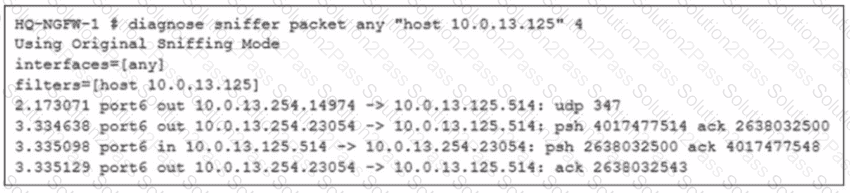
The FortiGate device HQ-NGFW-1 with the IP address 10.0.13.254 sends logs to the FortiAnalyzer device with the IP address 10.0.13.125. The administrator wants to verify that reliable logging is enabled on HQ-NGFW-1.

Which exhibit helps with the verification?

A)
B)
C)
D)
A.

Option A

B.

Option B

C.

Option C

D.

Option D

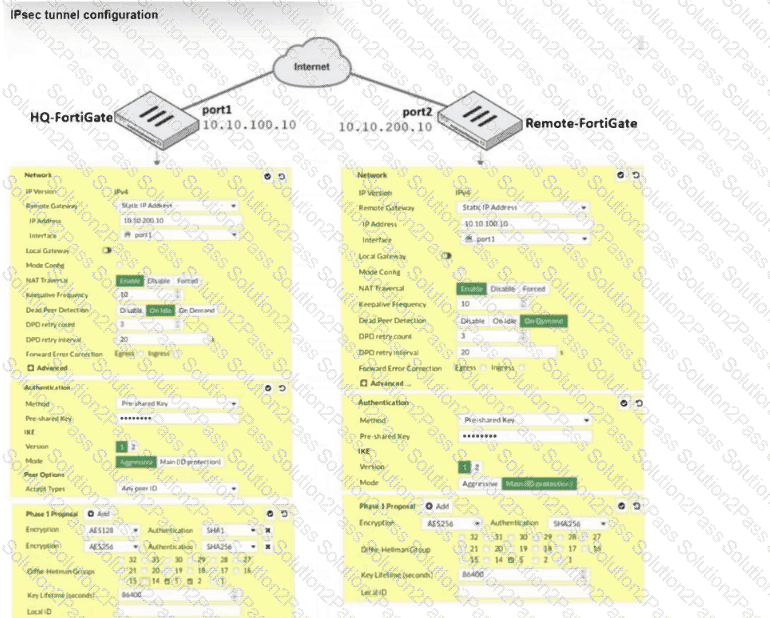
Refer to the exhibit.

A network administrator is troubleshooting an IPsec tunnel between two FortiGate devices. The administrator has determined that phase 1 failed to come up. The administrator has also re-entered the pre-shared key on both FortiGate devices to make sure they match.

Based on the phase 1 configuration and the diagram shown in the exhibit, which two configuration changes can the administrator make to bring phase 1 up? (Choose two.)

A.

On HQ-NGFW, disable Diffie-Hellman group 2.

B.

On HQ-NGFW, set IKE mode to Main (ID protection).

C.

On BR1-FGT, set port2 to Interface.

D.

On both FortiGate devices, set Dead Peer Detection to On Demand.

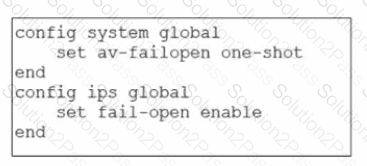
Which two statements are correct when FortiGate enters conserve mode? (Choose two answers)

A.

FortiGate continues to run critical security actions, such as quarantine.

B.

FortiGate refuses to accept configuration changes.

C.

FortiGate halts complete system operation and requires a reboot to regain available resources.

D.

FortiGate continues to transmit packets without IPS inspection when the fail-open global setting in IPS is enabled.

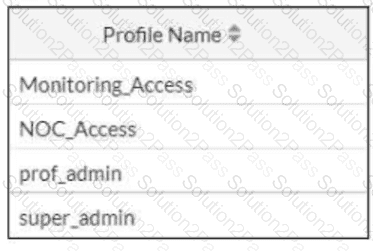
Refer to the exhibit.

The NOC team connects to the FortiGate GUI with the NOC_Access admin profile. They request that their GUI sessions do not disconnect too early during inactivity. What must the administrator configure to answer this specific request from the NOC team? (Choose one answer)

A.

Move NOC_Access to the top of the list to ensure all profile settings take effect.

B.

Increase the offline value of the Override Idle Timeout parameter in the NOC_Access admin profile.

C.

Ensure that all NOC_Access users are assigned the super_admin role to guarantee access.

D.

Increase the admintimeout value under config system accprofile NOC_Access.

Refer to the exhibit to view the firewall policy.
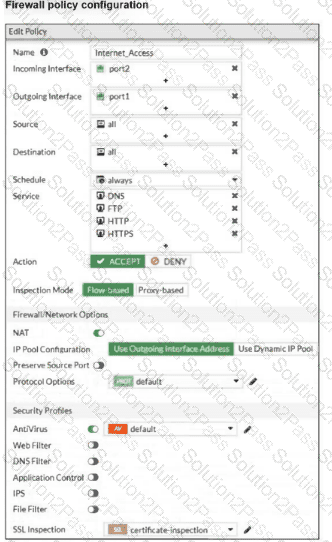
Why would the firewall policy not block a well-known virus, for example EICAR? (Choose one answer)

A.

The action on the firewall policy is not set to DENY.

B.

Web filter is not enabled, so the firewall policy does not complement the antivirus profile.

C.

The firewall policy is not configured in proxy-based inspection mode.

D.

The firewall policy does not apply deep content inspection.

A network administrator has enabled full SSL inspection and web filtering on FortiGate. When visiting any HTTPS websites, the browser reports certificate warning errors. When visiting HTTP websites, the browser does not report errors.

What is the reason for the certificate warning errors?

A.

The option invalid SSL certificates is set to allow on the SSL/SSH inspection profile.

B.

The matching firewall policy is set to proxy inspection mode.

C.

The browser does not trust the certificate used by FortiGate for SSL inspection.

D.

The certificate used by FortiGate for SSL inspection does not contain the required certificate extensions.

Which two features of IPsec IKEv1 authentication are supported by FortiGate? (Choose two.)

A.

No certificate is required on the remote peer when you set the certificate signature as the authentication method

B.

Extended authentication (XAuth) for faster authentication because fewer packets are exchanged

C.

Extended authentication (XAuth) to request the remote peer to provide a username and password

D.

Pre-shared key and certificate signature as authentication methods

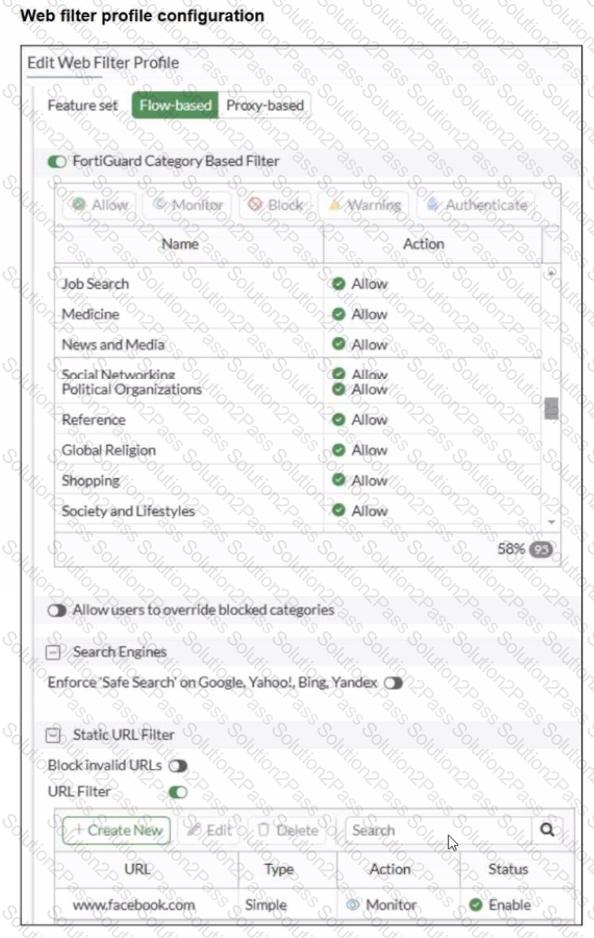
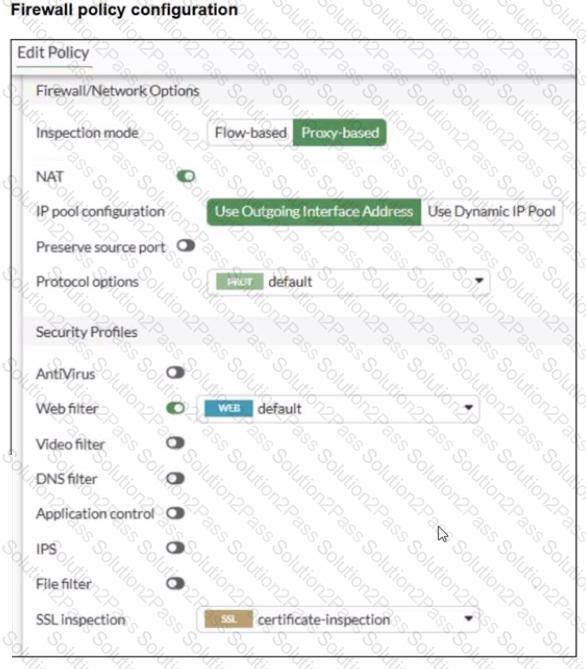
Refer to the exhibits.

A web filter profile configuration and firewall policy configuration are shown.

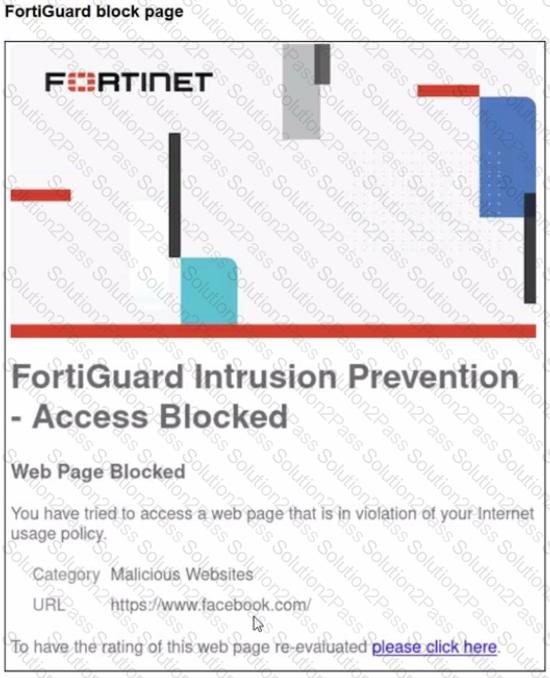
You are trying to access www. facebook.com, but you are redirected to a FortiGuard web filtering block page.

Based on the exhibits, what is the possible cause of the issue?

A.

The web rating override configuration is incorrect.

B.

The web filter profile feature set is configured incorrectly.

C.

The firewall policy inspection mode is incorrect.

D.

For www. facebook. com. the URL filter action is incorrect.

You have implemented the application sensor and the corresponding firewall policy as shown in the exhibits.
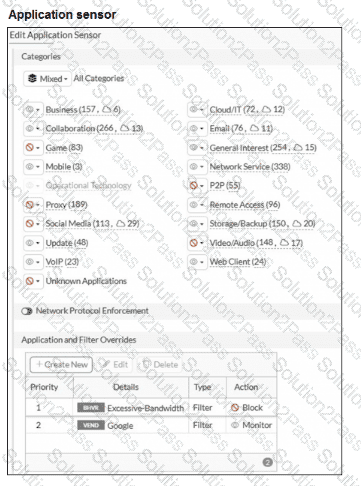
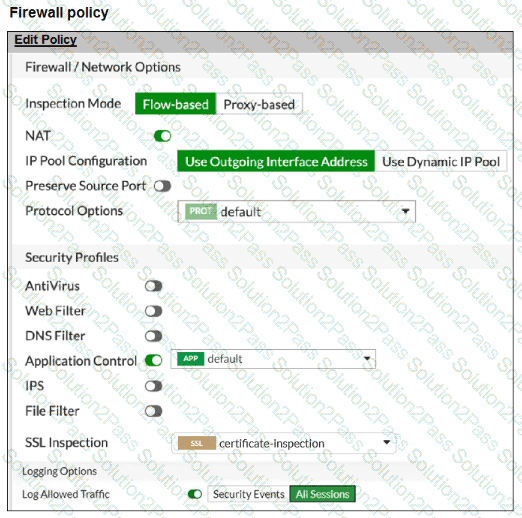
You cannot access any of the Google applications, but you are able to access www.fortinet.com .

What would you do to resolve this issue?

A.

Change the Inspection mode to Proxy-based.

B.

Set SSL inspection to deep-content-inspection.

C.

Move up Google in the Application and Filter Overrides section to set its priority to 1.

D.

Add Google .com to the URL category in the security profile.

Refer to the exhibit.

A partial cloud topology is shown.
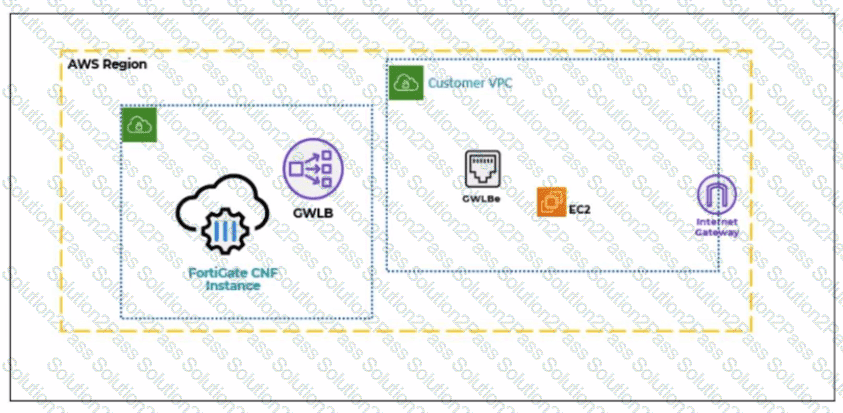
You deployed a FortiGate Cloud-Native Firewall (CNF) in AWS.

During the deployment, which components must the FortiGate CNF create to handle traffic from the EC2 instance?

A.

The customer VPC and GWLBe

B.

The gateway load balancer endpoint (GWLBe) in the customer virtual private cloud (VPC)

C.

The CNF VPC. customer VPC. and GWLB

D.

The GWLB. GWLBe, and the internet gateway (IGW) in the customer VPC

An administrator manages a FortiGate model that supports NTurbo

How does NTurbo acceleration enhance antivirus performance?

A.

For flow-based inspection. NTurbo establishes a dedicated data path to redirect traffic between the IPS engine and FortiGate ingress and egress interfaces.

B.

For flow-based inspection. NTurbo creates two inspection sessions on the FortiGate device.

C.

For proxy-based inspection. NTurbo offloads traffic to the content processor.

D.

For proxy-based inspection. NTurbo buffers the whole file and then sends it to the antivirus engine.

An administrator wants to configure dead peer detection (DPD) on IPsec VPN for detecting dead tunnels. The requirement is that FortiGate sends DPD probes only when there is no inbound traffic.

Which DPD mode on FortiGate meets this requirement?

A.

On Demand

B.

Enabled

C.

On Idle

D.

Usabled

Refer to the exhibit.

Based on this partial configuration, what are the two possible outcomes when FortiGate enters conserve mode? (Choose two.)

A.

FortiGate drops new sessions requiring inspection.

B.

Administrators must restart FortiGate to allow new sessions.

C.

Administrators cannot change the configuration.

D.

FortiGate skips quarantine actions.

Refer to the exhibit.

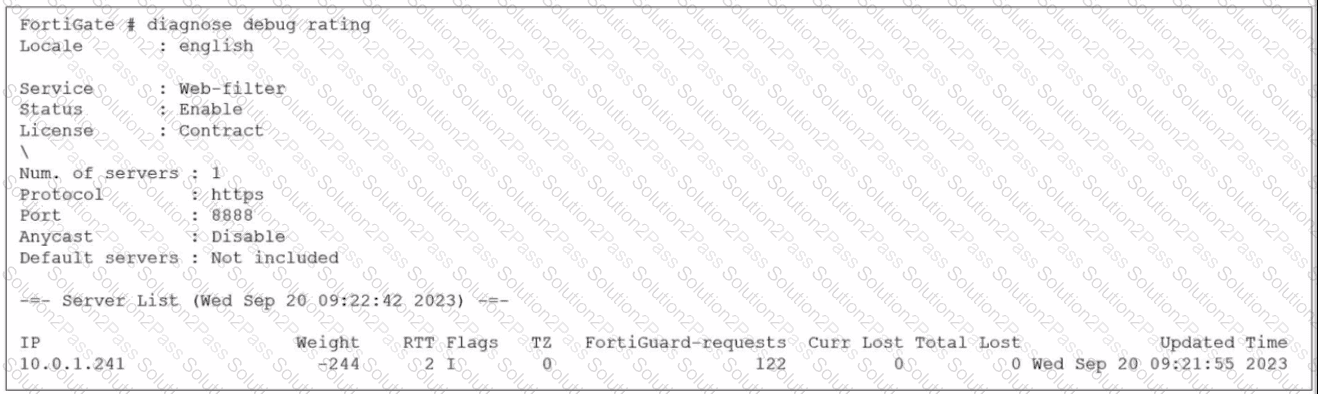
Which two statements about the FortiGuard connection are true? (Choose two.)

A.

The weight increases as the number of failed packets rises

B.

You can configure unreliable protocols to communicate with FortiGuard Server.

C.

FortiGate identified the FortiGuard Server using DNS lookup.

D.

FortiGate is using the default port for FortiGuard communication.

Which three methods are used by the collector agent for AD polling? (Choose three answers)

A.

NetAPI

B.

WMI

C.

WinSecLog

D.

DNS reverse lookup

E.

FSSO REST API

An administrator creates a new address object on the root FortiGate (HQ-NGFW-1) in the Security Fabric. After synchronization, this object is not available on the downstream FortiGate (HQ-ISFW).
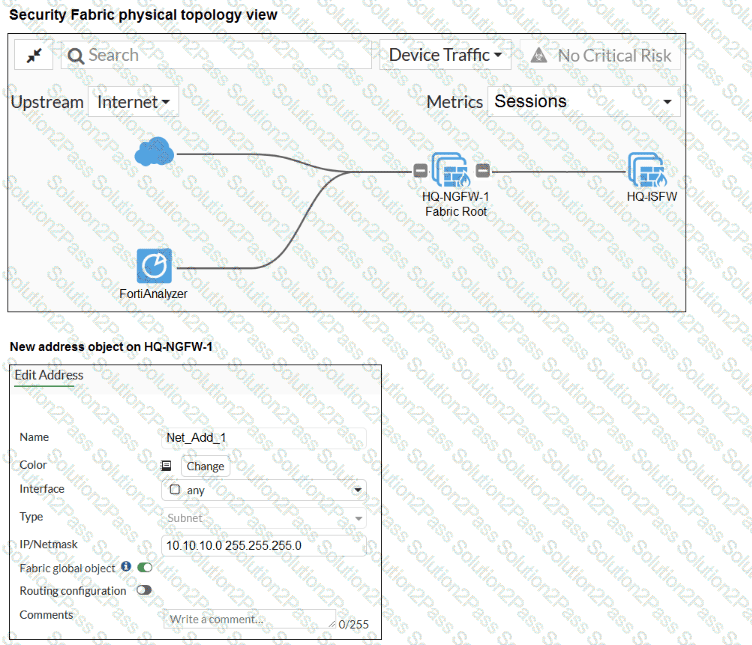
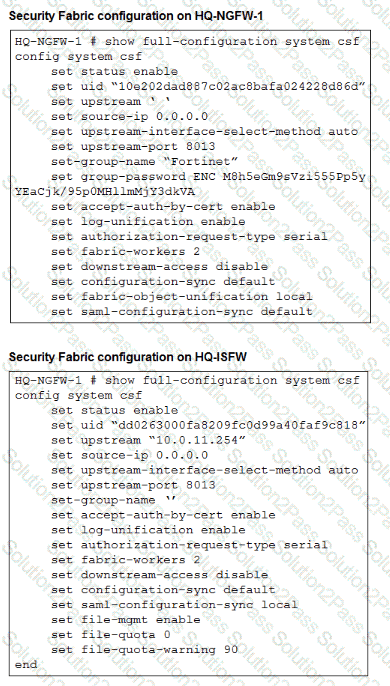
What must the administrator do to synchronize the address object?

A.

Change the csf setting on HQ-ISFW (downstream) to set configuration-sync local.

B.

Change the csf setting on HQ-ISFW (downstream) to set saml-configuration-sync default.

C.

Change the csf setting on HQ-NGFW-1 (root) to set fabric-object-unification default.

D.

Change the csf setting on both devices to set downstream-access enable.

Page: 1 / 2
Total 95 questions
Copyright © 2014-2026 Solution2Pass. All Rights Reserved