Winter Sale Limited Time 65% Discount Offer - Ends in 0d 00h 00m 00s - Coupon code: s2p65

Easiest Solution 2 Pass Your Certification Exams

NSE7_SSE_AD-25 Fortinet NSE 7 - FortiSASE 25 Enterprise Administrator Free Practice Exam Questions (2026 Updated)

Prepare effectively for your Fortinet NSE7_SSE_AD-25 Fortinet NSE 7 - FortiSASE 25 Enterprise Administrator certification with our extensive collection of free, high-quality practice questions. Each question is designed to mirror the actual exam format and objectives, complete with comprehensive answers and detailed explanations. Our materials are regularly updated for 2026, ensuring you have the most current resources to build confidence and succeed on your first attempt.

Page: 1 / 2
Total 81 questions

Which two statements about FortiSASE Geofencing with regional compliance are true? (Choose two answers)

A.

You can configure regional compliance on the security POP or the on-premises device, not both.1

B.

If no regional compliance rule is configured, the connection is made to the closest security POP.

C.

A regional compliance rule can connect only to an on-premises device or only to a security POP.2

D.

The connection order for a regional compliance rule is always the security POP first, followed by the on-premises device.

Which two settings are automatically pushed from FortiSASE to FortiClient in a new FortiSASE deployment with default settings? (Choose two answers)

A.

FortiSASE certificate authority (CA) certificate

B.

Tunnel profile

C.

Real-time protection

D.

Zero trust network access (ZTNA) tags1

A Fortinet customer is considering integrating FortiManager with FortiSASE. What are two prerequisites they should consider? (Choose two answers)

A.

Adding a FortiManager connection add-on license to FortiSASE.

B.

Placing FortiManager in the same FortiCloud account as FortiSASE.

C.

Reducing the number of FortiSASE PoPs that support FortiManager.

D.

Running a FortiManager version that is supported by FortiSASE.

Which information does FortiSASE use to bring network lockdown into effect on an endpoint? (Choose one answer)

A.

Zero-day malware detection on endpoint

B.

The number of critical vulnerabilities detected on the endpoint

C.

The connection status of the tunnel to FortiSASE

D.

The security posture of the endpoint based on ZTNA tags

What is the purpose of security posture tagging in ZTNA? (Choose one answer)

A.

To assign usernames to different devices for security logs

B.

To ensure that all devices and users are monitored continuously

C.

To provide granular access control based on the compliance status of devices and users1

D.

To categorize devices and users based on their role in the organization

When viewing the daily summary report generated by FortiSASE. the administrator notices that the report contains very little data. What is a possible explanation for this almost empty report?

A.

Digital experience monitoring is not configured.

B.

Log allowed traffic is set to Security Events for all policies.

C.

The web filter security profile is not set to Monitor

D.

There are no security profile group applied to all policies.

What are two benefits of deploying secure private access (SPA) with SD-WAN? (Choose two answers)

A.

ZTNA posture check performed by the hub FortiGate

B.

Support of both TCP and UDP applications

C.

A direct access proxy tunnel from FortiClient to the on-premises FortiGate

D.

Inline security inspection by FortiSASE

How does FortiSASE hide user information when viewing and analyzing logs?

A.

By hashing data using Blowfish

B.

By hashing data using salt

C.

By encrypting data using Secure Hash Algorithm 256-bit (SHA-256)

D.

By encrypting data using advanced encryption standard (AES)

During FortiSASE provisioning, how many security points of presence (POPs) need to be configured by the FortiSASE administrator?

A.

3

B.

4

C.

2

D.

1

What can be configured on FortiSASE as an additional layer of security for FortiClient registration? (Choose one answer)

A.

Security posture tags

B.

User verification

C.

Device identification1

D.

Application inventory

Which two statements about the Hub Selection Method in FortiSASE Secure Private Access (SPA) are correct? (Choose two answers)

A.

When using Hub Health and Priority, FortiSASE selects the highest priority hub that meets the configured SLA thresholds.

B.

When using BGP MED, FortiSASE selects the hub with the lowest MED value only if it also meets the configured SLA thresholds.

C.

When using SLA thresholds, administrators can customize latency, jitter, and packet loss for each security POP.

D.

When using Hub Health and Priority, all hubs with the same priority are always selected regardless of SLA results.

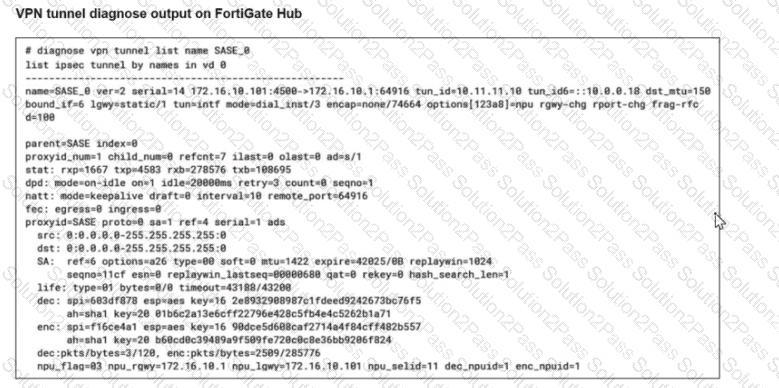
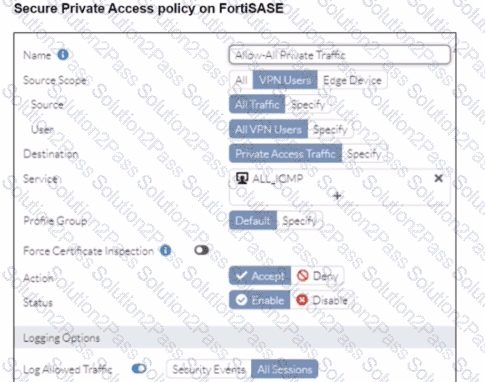
Refer to the exhibits.

A FortiSASE administrator has configured FortiSASE as a spoke to a FortiGate hub. The tunnel is up to the FortiGate hub. However, the remote FortiClient is not able to access the web server hosted behind the FortiGate hub. What is the reason for the access failure? (Choose one answer)

A.

The hub is not advertising the required routes.

B.

A private access policy has denied the traffic because of failed compliance.

C.

The hub firewall policy does not include the FortiClient address range.

D.

The server subnet BGP route was not received on FortiSASE.

An administrator must restrict endpoints from certain countries from connecting to FortiSASE. Which configuration can achieve this? (Choose one answer)

A.

A network lockdown policy on the endpoint profiles

B.

Source IP anchoring to restrict access from the specified countries

C.

A geography address object as the source for a deny policy

D.

Geofencing to restrict access from the required countries

You are designing a new network for Company X and one of the new cybersecurity policy requirements is that all remote user endpoints must always be connected and protected Which FortiSASE component facilitates this always-on security measure?

A.

site-based deployment

B.

thin-branch SASE extension

C.

unified FortiClient

D.

inline-CASB

To complete their day-to-day operations, remote users require access to a TCP-based application that is hosted on a private web server. Which FortiSASE deployment use case provides the most efficient and secure method for meeting the remote users' requirements?

A.

SD-WAN private access

B.

inline-CASB

C.

zero trust network access (ZTNA) private access

D.

next generation firewall (NGFW)

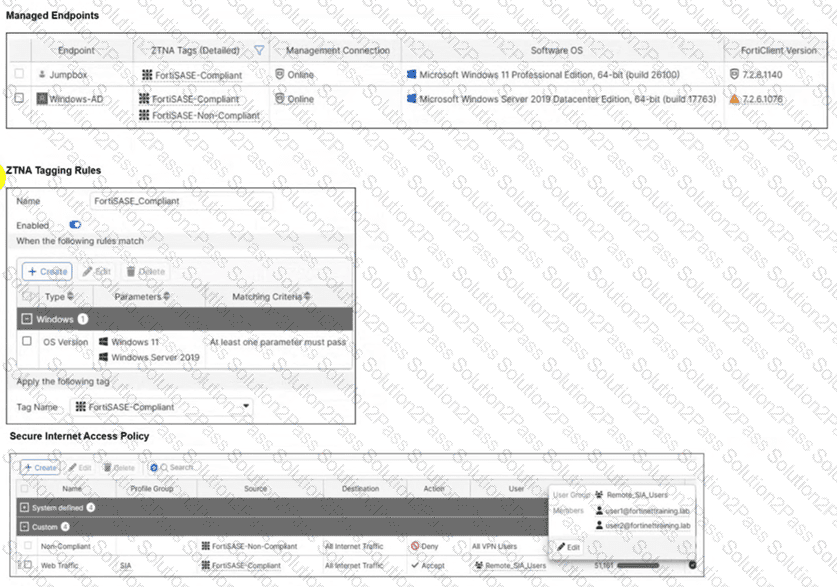
Refer to the exhibits.

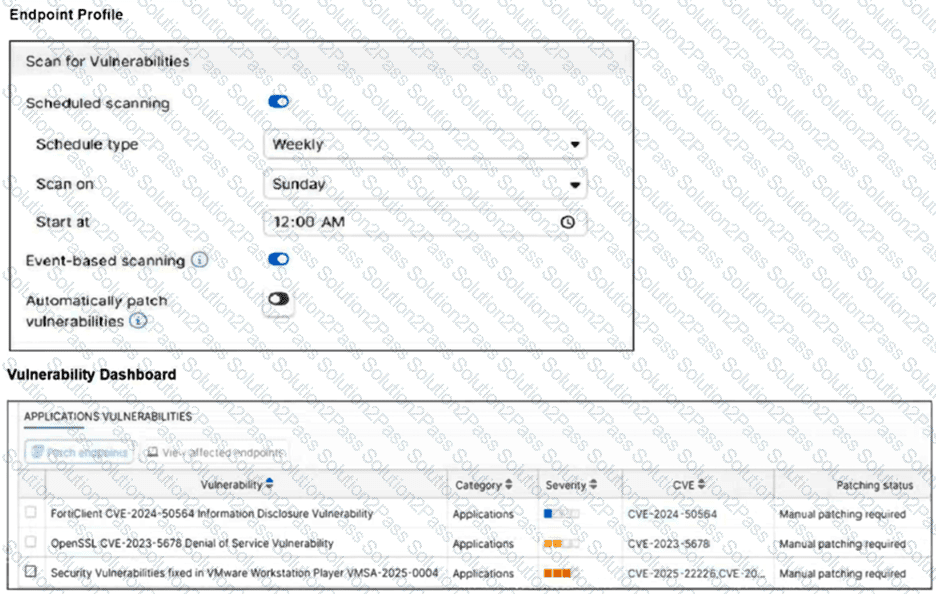
Jumpbox and Windows-AD are endpoints from the same remote location. Jumpbox can access the internet through FortiSASE, while Windows-AD can no longer access the internet. Based on the information in the exhibits, which reason explains the outage on Windows-AD? (Choose one answer)

A.

The device security posture for Windows-AD has changed.

B.

The FortiClient version installed on Windows-AD does not match the expected version on FortiSASE.

C.

Windows-AD is excluded from FortiSASE management.

D.

The remote VPN user on Windows-AD no longer matches any VPN policy.

Which secure internet access (SIA) use case minimizes individual workstation or device setup, because you do not need to install FortiClient on endpoints or configure explicit web proxy settings on web browser-based end points?

A.

SIA for inline-CASB users

B.

SIA for agentless remote users

C.

SIA for SSLVPN remote users

D.

SIA for site-based remote users

A FortiSASE administrator is configuring a Secure Private Access (SPA) solution to share endpoint information with a corporate FortiGate.

Which three configuration actions will achieve this solution? (Choose three.)

A.

Add the FortiGate IP address in the secure private access configuration on FortiSASE.

B.

Use the FortiClient EMS cloud connector on the corporate FortiGate to connect to FortiSASE

C.

Register FortiGate and FortiSASE under the same FortiCloud account.

D.

Authorize the corporate FortiGate on FortiSASE as a ZTNA access proxy.

E.

Apply the FortiSASE zero trust network access (ZTNA) license on the corporate FortiGate.

Refer to the exhibit.

An organization must inspect all the endpoint internet traffic on FortiSASE, and exclude Google Maps traffic from the FortiSASE tunnel and redirect it to the endpoint physical interface.

Which configuration must you apply to achieve this requirement? (Choose one answer)

A.

Add the Google Maps URL in the zero trust network access (ZTNA) TCP access proxy forwarding rule.

B.

Configure a steering bypass tunnel firewall policy using Google Maps FQDN to exclude and redirect the traffic.

C.

Exempt Google Maps in URL filtering in the web filter profile.

D.

Add the Google Maps URL as a steering bypass destination in the endpoint profile.

What are two advantages of using zero-trust tags? (Choose two.)

A.

Zero-trust tags can be used to allow or deny access to network resources

B.

Zero-trust tags can determine the security posture of an endpoint.

C.

Zero-trust tags can be used to create multiple endpoint profiles which can be applied to different endpoints

D.

Zero-trust tags can be used to allow secure web gateway (SWG) access

Page: 1 / 2
Total 81 questions
Copyright © 2014-2026 Solution2Pass. All Rights Reserved