HCVA0-003 HashiCorp Certified: Vault Associate (003) Exam Free Practice Exam Questions (2026 Updated)
Prepare effectively for your HashiCorp HCVA0-003 HashiCorp Certified: Vault Associate (003) Exam certification with our extensive collection of free, high-quality practice questions. Each question is designed to mirror the actual exam format and objectives, complete with comprehensive answers and detailed explanations. Our materials are regularly updated for 2026, ensuring you have the most current resources to build confidence and succeed on your first attempt.
You have a CI/CD pipeline using Terraform to provision AWS resources with static privileged credentials. Your security team requests that you use Vault to limit AWS access when needed. How can you enhance this process and increase pipeline security?
What is the primary role of the Vault Security Operator (VSO) in a Kubernetes environment?
A large organization uses Vault for various use cases with multiple auth methods enabled. A user can authenticate via LDAP, OIDC, or a local userpass account, but they receive different policies for each method and often need to log out and back in for different actions. What can be configured in Vault to ensure users have consistent policies regardless of their authentication method?
Frapps, Inc. is a coffee startup specializing in frozen caffeinated beverages. Their new customer loyalty web app uses Vault to store sensitive information, choosing Integrated Storage for its benefits. Select the benefits the organization would see by using Integrated Storage over other storage backends (Select four)
You are the primary Vault operator. During a routine audit, an auditor requested the ability to display all secrets under a specific path in Vault without seeing the actual stored data. Which policy permits the auditor to display the stored secrets without revealing their contents?
Your organization recently suffered a security breach on a specific application, and the security response team believes that MySQL database credentials were likely obtained during the event. The application generated the credentials using the database secrets engine in Vault mounted at the path database/. How can you quickly revoke all of the secrets generated by this secrets engine?
Your Azure Subscription ID is stored in Vault and you need to retrieve it via Vault API for an automated job. The Subscription ID is stored at secret/cloud/azure/subscription. The secret is stored on a KV Version 2 secrets engine. What curl command below would successfully retrieve the latest version of the secret?
What of the following features are true about batch tokens in Vault? (Select two)
To secure your applications, your organization uses certificates generated by a public CA. However, this strategy has proven expensive and you have to revoke certificates even though they have additional time left. What Vault plugin can be used to quickly generate X.509 certificates to secure your internal applications?
A new application is being provisioned in your environment. The application requires the generation of dynamic credentials against the Oracle database in order to read reporting data. Which is the best auth method to use to permit the application to authenticate to Vault?
By default, what methods of authentication does Vault support? (Select four)
There are a few ways in Vault that can be used to obtain a root token. Select the valid methods from the answers below. (Select three)
You are planning to deploy a new Vault cluster for your organization and notice that Vault supports a wide variety of storage backends. You need high availability since you will have multiple applications relying on the Vault service. When building your cluster, can you choose any of the available storage backends?
You have a new team member on the Vault operations team. Their first task is to rotate the encryption key in Vault as part of the organization’s security policy. However, when they log in, they get an access denied error when attempting to rotate the key. The policy being used is below. Why can’t the user rotate the encryption key?
path " auth/* " {
capabilities = [ " create " , " read " , " update " , " delete " , " list " ]
}
path " sys/rotate " {
capabilities = [ " read " , " update " ]
}
Your organization uses a CI/CD pipeline to deploy its applications on Azure. During testing, you generate new credentials to validate Vault can create new credentials. The result of this command is below:
text
CollapseWrapCopy
$ vault read azure/creds/bryan-krausen
Key Value
--- -----
lease_id azure/creds/bryan-krausen/9eed0373-ca92-99b6-b914-779b7bb0e1d9
lease_duration 60m
lease_renewable true
client_id 532bf678-ee4e-6be1-116b-4e4221e445dd
client_secret be60395b-4e6b-2b7e-a4b3-c449a5c00973
What commands can be used to revoke this secret after you have finished testing? (Select three)
A developer has requested access to manage secrets at the path kv/apps/webapp01. You create the policy below which gives them the proper access:
path " kv/apps/webapp01 " {
capabilities = [ " read " , " create " , " update " , " list " ]
}
However, when the developer logs in to the Vault UI, they see the following screenshot and cannot access the desired secret. Why can’t the developer see the secrets they need?
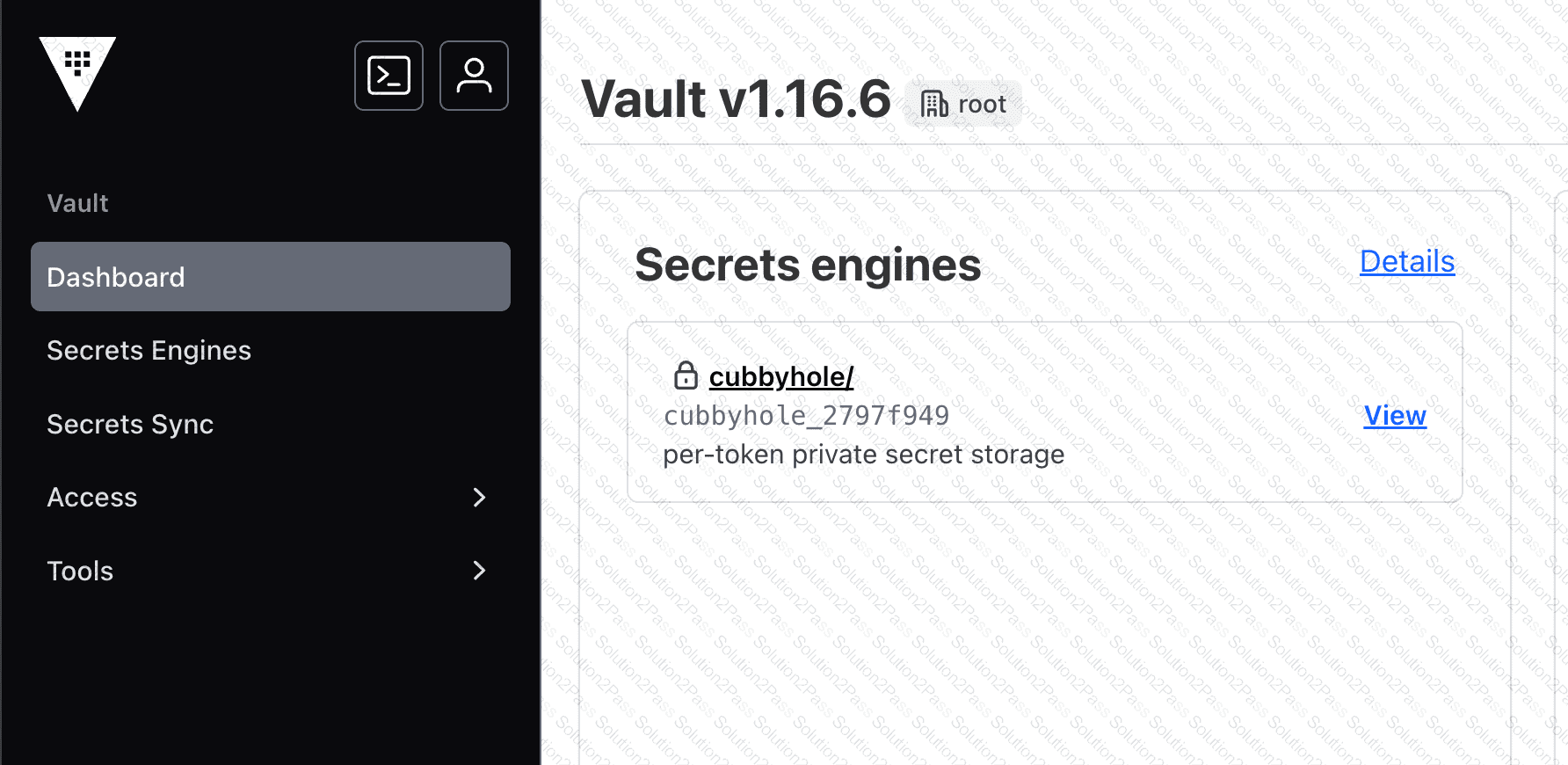
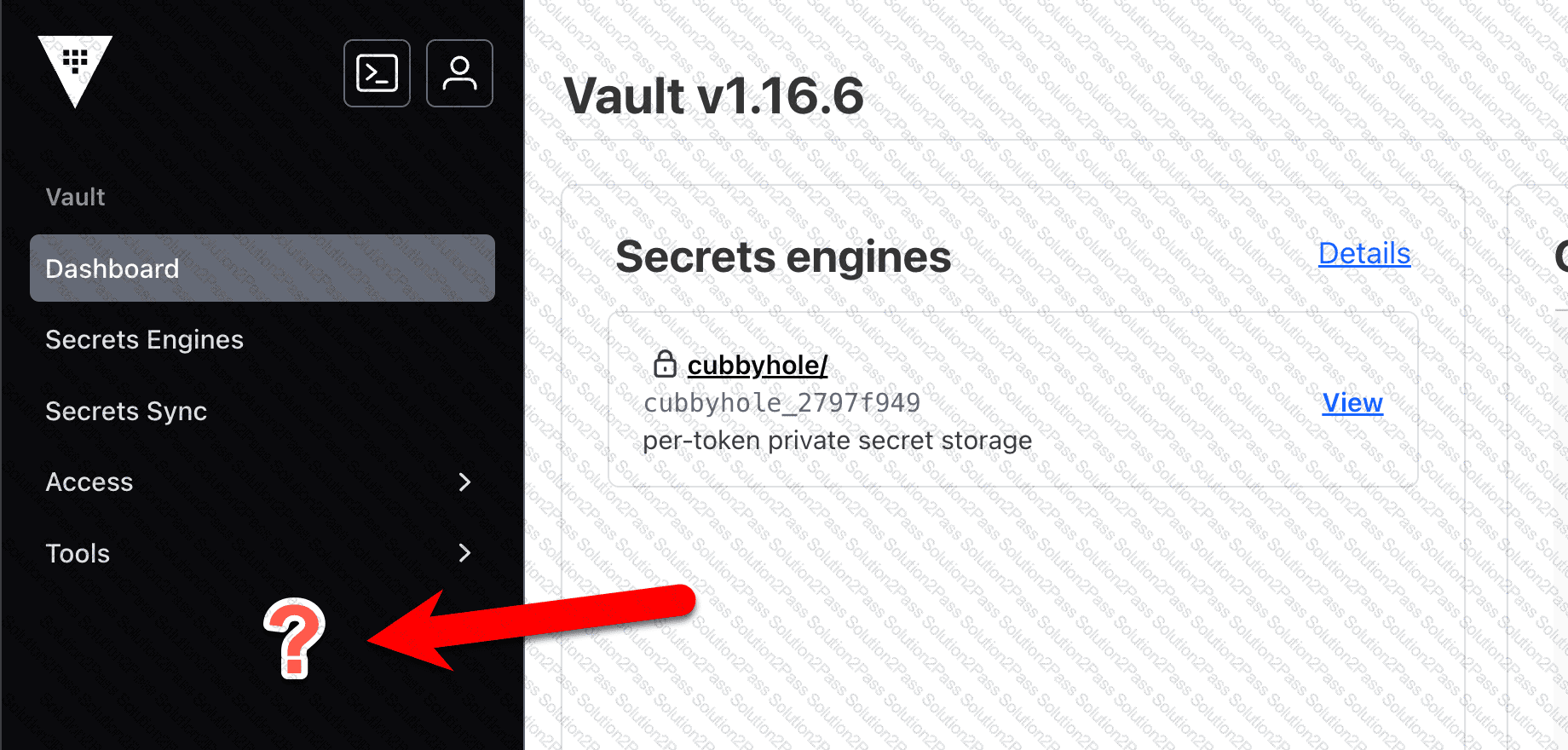
Your supervisor has requested that you log into Vault and update a policy for one of the development teams. You successfully authenticated to Vault via OIDC but do not see a way to manage the Vault policies. Why are you unable to manage policies in the Vault UI?
A security architect is designing a solution to address the " Secret Zero " problem for a Kubernetes-based application that needs to authenticate to HashiCorp Vault. Which approach correctly leverages Vault features to solve this challenge?
You are planning the deployment of your first Vault cluster and have decided to use Integrated Storage as the storage backend. Where do you configure the storage backend to be used by Vault?
What command is used to extend the TTL of a token, if permitted?