H12-841_V1.5 Huawei HCIP-Datacom-Campus Network Planning and Deployment V1.5 Free Practice Exam Questions (2026 Updated)
Prepare effectively for your Huawei H12-841_V1.5 HCIP-Datacom-Campus Network Planning and Deployment V1.5 certification with our extensive collection of free, high-quality practice questions. Each question is designed to mirror the actual exam format and objectives, complete with comprehensive answers and detailed explanations. Our materials are regularly updated for 2026, ensuring you have the most current resources to build confidence and succeed on your first attempt.
(Which of the following information types are transmitted through enhanced BGP EVPN in Huawei SD-WAN Interconnection Solution?)
(One particular WLAN architecture supported on a campus network has the following networking characteristics: The AP can work independently, or manage a small number of other APs to implement basic roaming functions; the cost is low, and network maintenance personnel only need limited skills. What is this WLAN architecture?)
(Which of the following commands needs to be run in the BGP view to enable a VPN instance to advertise IP routes to the BGP-EVPN address family?)
(Refer to the following route queried using a command on the VTEP. Which of the following statements about the route are true?)
[VTEP] display bgp evpn all routing-table mac-route 0:48:b0d5-9dc7-3c41:32:172.16.1.173
BGP local router ID : 1.1.1.1
Local AS number : 100
Total routes of Route Distinguisher(1:3): 1
BGP routing table entry information of 0:48:b0d5-9dc7-3c41:32:172.16.1.173:
Imported route.
Label information (Received/Applied): 3 2/NULL
From: 0.0.0.0 (0.0.0.0)
Route Duration: 1d00h15m21s
Direct Out-interface:
Original nexthop: 1.1.1.1
Qos information : 0x0
Ext-Community: RT <0:2>, RT <0:3>, Tunnel Type
AS-path Nil, origin incomplete, pref-val 0, valid, local, best, select, pre 0
Route Type: 2 (MAC Advertisement Route)
Ethernet Tag ID: 0
MAC Address/Len: b0d5-9dc7-3c41/48, IP Address/Len: 172.16.1.173/32, ESI: 0000.0000.0000.0000.0000
Advertised to such peers:
1.1.1.2
(Which of the following advantages are provided by Telemetry compared with SNMP?Choose all that apply.)
(In the Huawei CloudCampus Solution, which of the following provisioning modes isnot supportedby firewalls?)
(Huawei switches support VLAN assignment based on interface, MAC address, protocol, and IP address.)
(Refer to the following routing entries queried using a command on the VTEP. Which of the following statements about these routes are true?)
Network(EthTagId/IpAddrLen/OriginalIp) NextHop
*>i 0:32:1.1.1.0 1.1.1.0
Route Distinguisher: 2:5
Network(EthTagId/IpAddrLen/OriginalIp) NextHop
*>i 0:32:1.1.1.0 1.1.1.0
Route Distinguisher: 2:7
Network(EthTagId/IpAddrLen/OriginalIp) NextHop
*>i 0:32:1.1.1.0 1.1.1.0
(iMaster NCE-Campus provides independent working interfaces on different planes: management plane and service plane. You can log in to each plane through a specific IP address and port number. The port number of the service plane is _____.)
(Which of the following functions isnot supportedby AH?)
(Which of the following is not one of the three roles defined in policy association?)
(Which of the following are the typical deployment scenarios when iMaster NCE-Campus is used to deploy a network?)
(To isolate communication between wired terminals, you can enable port isolation on the access switches. However, APs cannot implement wireless user isolation.)
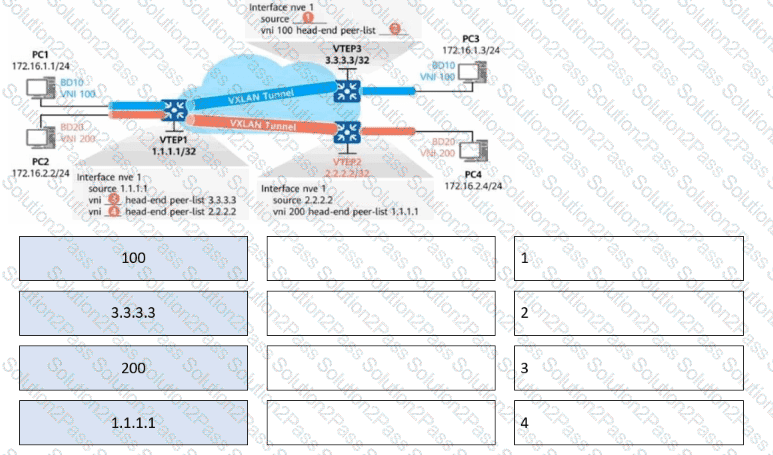
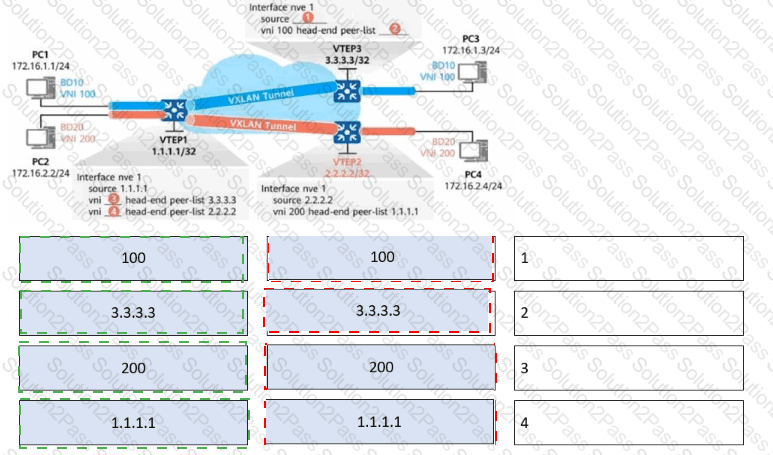
Complete the following static VXLAN tunnel configurations by dragging the configurations to the corresponding areas.
(Which of the following fields in the ESP protocol is used to prevent replay attacks?)
(Refer to the following routing entries queried using a command on the VTEP. Which of the following statements about these routes are true?)
Network(EthTagId/IpAddrLen/OriginalIp) NextHop
*>i 0:32:1.1.1.0 1.1.1.0
Route Distinguisher: 2:5
Network(EthTagId/IpAddrLen/OriginalIp) NextHop
*>i 0:32:1.1.1.0 1.1.1.0
Route Distinguisher: 2:7
Network(EthTagId/IpAddrLen/OriginalIp) NextHop
*>i 0:32:1.1.1.0 1.1.1.0
(When you configure a virtualized campus network on iMaster NCE-Campus, Fit APs can immediately go online after you add them to iMaster NCE-Campus.)
(Which of the following statements about BGP EVPN are true?)
(Which of the following statements about VXLAN isfalse?)
(When you configure a virtualized campus network on iMaster NCE-Campus, creating a virtual network is equivalent to creating a VPN instance to isolate different services.)