Weekend Sale Special - 75% Discount Offer - Ends in 0d 00h 00m 00s - Coupon code: stp75

Easiest Solution 2 Pass Your Certification Exams

93-Tall-Mass-Timber-Buildings International Code Council 93-Tall-Mass-Timber-Buildings Free Practice Exam Questions (2026 Updated)

Prepare effectively for your International Code Council 93-Tall-Mass-Timber-Buildings 93-Tall-Mass-Timber-Buildings certification with our extensive collection of free, high-quality practice questions. Each question is designed to mirror the actual exam format and objectives, complete with comprehensive answers and detailed explanations. Our materials are regularly updated for 2026, ensuring you have the most current resources to build confidence and succeed on your first attempt.

In mass timber construction of Type IV-C, the fire-resistance ratings of bearing walls are permitted to be reduced by _____ where supporting a roof only.

A.

30-minutes

B.

45-minutes

C.

1-hour

D.

2-hours

In Type IV-C construction, the fire-resistance rating provided by protection over a connection can be determined by which of the following?

A.

Testing the fasteners used in the assembly.

B.

Testing the protection covering the connection.

C.

Calculating the temperature rise of the structural element being protected.

D.

Calculating the temperature rise of the supported member used in the connection.

Combustible construction forming concealed spaces shall be protected with noncombustible protection with an assigned time of 40 minutes in which construction type?

A.

Type IV-A

B.

Type IV-B

C.

Type IV-C

D.

Type IV-HT

Which of the following is the best definition of Type IV-B construction?

A.

100% noncombustible protection on all mass timber surfaces

B.

50% noncombustible protection on the exterior and interior mass timber elements

C.

100% exposed mass timber except: shafts, concealed spaces, and outside of exterior walls

D.

Noncombustible protection on all surfaces of mass timber except for limited exposed mass timber elements

The building owner shall be responsible for each of the following for fire safety during construction except:

A.

completion of a daily fire safety inspection at the project site by the site safety director.

B.

documentation and maintenance on-site of each inspection’s results until a certificate of occupancy has been issued.

C.

securing documentation in a fire- and water-resistant safe until a certificate of occupancy has been issued.

D.

making documentation immediately available on-site for presentation to the fire code official upon request.

Are mass timber elements permitted to serve as a fire barrier to an adjacent occupancy if they are separated from the interior of the building with an approved thermal barrier consisting of a minimum of 1/2 in. gypsum board or a noncombustible equivalent?

A.

No

B.

Yes, for Type IV-B only

C.

Yes, for Type IV-HT

D.

Yes for Type IV-B and IV-C

The fire-resistance of a protected mass timber assembly is equivalent to the fire resistance time of the:

A.

mass timber itself.

B.

noncombustible protection.

C.

mass timber itself plus the finish rating time of the noncombustible protection.

D.

mass timber itself plus the added contribution time attributable to the noncombustible protection.

Given: Sealants or adhesives need not be provided where they are not a required component of a tested fire resistance rated assembly.

If a sealant is required, it must meet the requirement of ASTM:

A.

E114

B.

E119

C.

C920

D.

D3498

A proprietary field-glued mass timber beam splice will require which of the following:

A.

Special inspection

B.

Approval from the permit applicant

C.

Field verification by the building official

D.

Field verification by the registered design professional

One code-recognized method for calculating the fire-resistance rating of exposed wood members and decking is:

A.

ACI 216.1

B.

TMS 0216

C.

ASCE 29 Chapter 5

D.

AWS NDS Chapter 16

In mass timber construction of Type IV-B, each of the following is suitable for use as fireblocking except:

A.

mineral wool.

B.

one-half-inch gypsum board.

C.

7/16-inch wood structural panels.

D.

mass timber complying with IBC Section 2304.11.

According to UL Fire Resistance Directory, a “finish rating” is the time:

A.

assigned for gypsum board membranes in IBC Table 722.6.2(1)

B.

assigned for noncombustible protection in IBC Table 722.7.1(2)

C.

it takes the surface of wood nearest the fire but beneath the protective cover to reach a temperature rise of 250°F

D.

it takes the surface of wood nearest the fire but beneath the protective cover to reach a temperature rise of 325°F

Which of the following best describes circumstances for which a separate inspection by a building official would be required for the fire protection of structural connections in buildings of Type IV-B construction?

A.

When connections do not integrate full mass timber member bearing on other mass timber elements

B.

When connection fire resistance is provided by a fire resistance rated joint system in accordance with Section 715

C.

When connection fire resistance is provided by wood cover calculated to meet the requirements of Section 2304.10.1

D.

When connections are made without additional noncombustible protection beyond what is required for the connected elements

Which of the following requires continuous special inspection?

A.

Bolted connections

B.

Concealed connections

C.

Anchorage of mass timber construction to deep foundation systems

D.

Adhesive anchors installed horizontally resisting sustained tension loads

Sealants used to resist passage of air in construction Type IV-A, shall be in accordance with which of the following standards?

A.

ASTM A36

B.

ASTM E119

C.

ASTM C920

D.

ASTM F1667

Which of the following is an acceptable alternative for protecting structural connections from fire in Type IV-A, IV-B or IV-C construction?

A.

Testing of connections in accordance with ASTM E136

B.

Limiting connections to those incorporating wood-on-wood bearing

C.

Using connectors that are rated by the manufacturer for fire performance

D.

Engineering analysis showing limited temperature rise at the connector for the required fire-resistance time of connected members

Refer to the figure by clicking on the EXHIBIT button above.
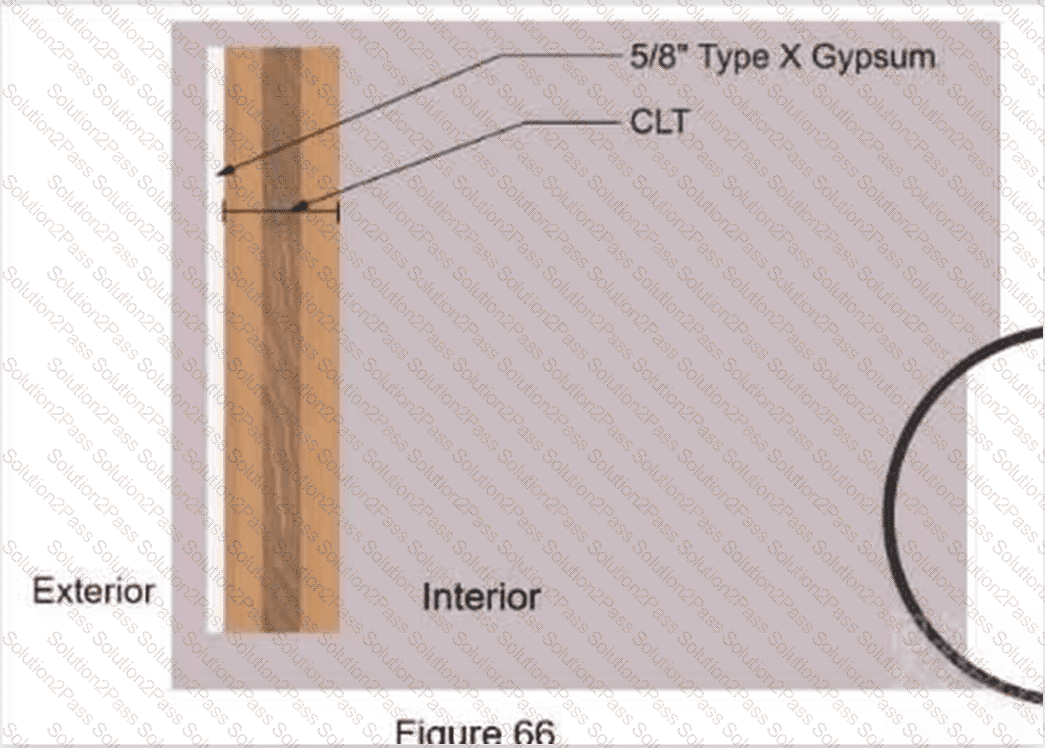
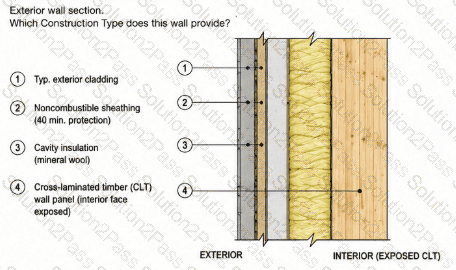
The exterior wall section shown in the Figure provides the prescribed noncombustible protection required by which Construction Type?

A.

Type IV-A

B.

Type IV-B

C.

Type IV-C

D.

Type IV-HT

Which of the following construction Types permit concealed spaces to be protected by completely filling the concealed space with noncombustible insulation?

A.

Type IV-A

B.

Type IV-B

C.

Type IV-C

D.

Type IV-HT

Which of the following provisions for mass timber used for interior exit and elevator hoistway enclosures is true?

A.

Type IV-A construction requires at least 80 minutes of the 120-minute fire-resistance rating to be provided by noncombustible protection.

B.

Type IV-B construction requires at least 40 minutes of the 120-minute fire-resistance rating to be provided by noncombustible protection.

C.

Type IV-C construction requires at least 40 minutes of the 60-minute fire-resistance rating to be provided by noncombustible protection.

D.

Type IV-HT construction requires at least 40 minutes of the 60-minute fire-resistance rating to be provided by noncombustible protection.

Which of the following best describes the required protection for mass timber hoistway enclosure walls in Type IV-C construction?

A.

Noncombustible protection of at least 40 minutes fire resistance

B.

No requirement, but walls must achieve the required fire-resistance rating

C.

Noncombustible protection of at least 1/2 in. gypsum board or equivalent

D.

fire-retardant-treated-wood sheathing, 1/2-inch gypsum board, or a noncombustible material

Copyright © 2014-2026 Solution2Pass. All Rights Reserved