JN0-352 Juniper Enterprise Routing and Switching, Specialist (JNCIS-ENT) Free Practice Exam Questions (2026 Updated)
Prepare effectively for your Juniper JN0-352 Enterprise Routing and Switching, Specialist (JNCIS-ENT) certification with our extensive collection of free, high-quality practice questions. Each question is designed to mirror the actual exam format and objectives, complete with comprehensive answers and detailed explanations. Our materials are regularly updated for 2026, ensuring you have the most current resources to build confidence and succeed on your first attempt.
Which sequence correctly describes the basic message flow that leads to a successful BGP peering session?
You have configured an aggregate route for prefix 10.20.0.0/22 with three contributing routes: 10.20.0.0/24, 10.20.1.0/24, and 10.20.2.0/24. A packet arrives destined to 10.20.3.100.
In this scenario, which action does the router take?
Which two statements describe OSPF DR and BDR behavior? (Choose two.)
[Exhibit]
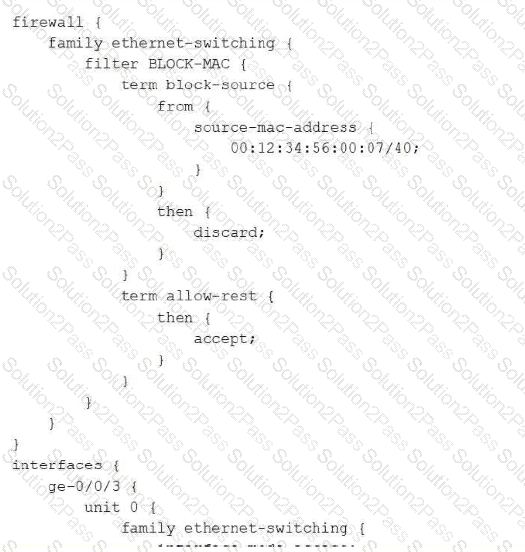
You need to apply a Layer 2 firewall filter on a Juniper Networks EX Series Switch to block traffic from the source MAC address 00:12:34:56:00:07 entering the switch on ge-0/0/3. After committing the configuration, traffic from the MAC address still passes through.
Referring to the exhibit, which statement is correct in this scenario?
You enable the point-to-point parameter on your OSPF interface configuration.
In this scenario, what are two benefits of this action? (Choose two.)
Which statement describes the purpose of an integrated routing and bridging (IRB) interface on a Juniper Networks EX Series Switch?
Which two statements are correct about BGP local preference? (Choose two.)
[Exhibit]
Click the Exhibit button.
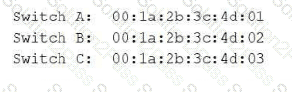
A network has three Juniper Networks EX Series Switches connected together. No changes have been made to the default spanning-tree configuration.
Referring to the exhibit, which statement is correct about the root bridge?
Which two characteristics describe the default behavior of aggregate routes? (Choose two.)
[Exhibit]
Click the Exhibit button.
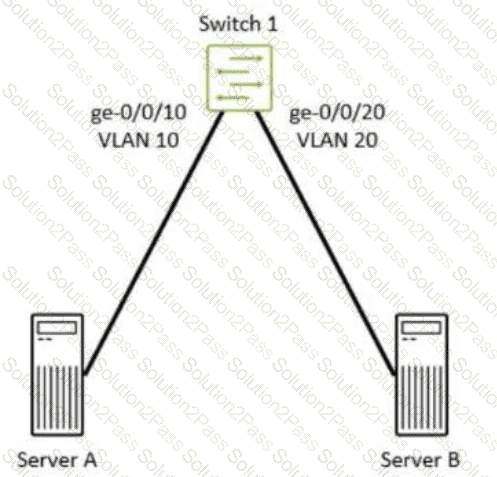
Referring to the exhibit, all possible firewall filters are configured along the path from Server A to Server B.
In which order will Switch 1 process transmit (Tx) and receive (Rx) firewall filters?
You implement FBF on router R1 so that traffic from subnet 172.25.0.0/24 uses ISP-A and traffic from subnet 172.25.1.0/24 uses ISP-B. You create forwarding instances for ISP-A and ISP-B. You also configure static default routes inside each instance. However, the static default routes remain inactive.
In this scenario, which action would complete the FBF implementation?
Your router receives two BGP routes for the same prefix. One route is learned from an IBGP neighbor, and the other route is learned from an EBGP neighbor.
By default, which route will be selected as active in this scenario?
Which statement describes the additional overhead added when a packet is encapsulated in a GRE tunnel?
Two Juniper Networks EX Series Switches are connected with four 1-GbE links configured as a single link aggregation group (LAG). One of the physical member links experiences a failure.
By default, what impact will this failure have on traffic forwarding between the switches?
What are three valid OSPF adjacency states? (Choose three.)
You need to configure a Juniper Networks EX Series Switch to be able to accept both tagged and untagged traffic on the same access port.
Which feature will allow you to accomplish this task?
You have configured a GRE tunnel from your local router with tunnel source 10.0.0.1 to a remote router at destination 192.168.0.1. The tunnel is functioning until you commit set routing-options static route 0.0.0.0/0 next-hop gr-0/0/0. This configuration causes the tunnel to go down.
Which statement is correct in this scenario?
[Exhibit]
Click the Exhibit button.
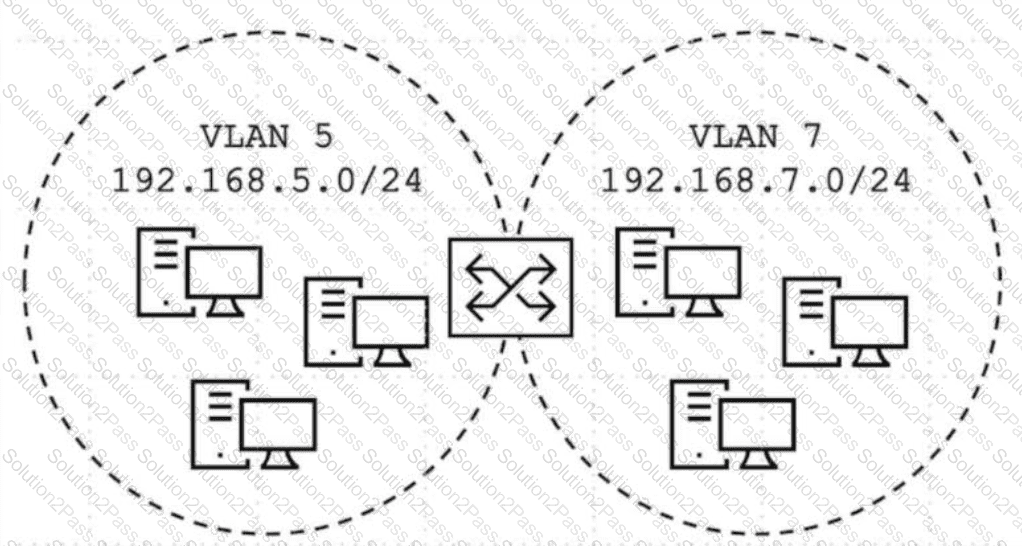
Devices on VLAN 5 and VLAN 7 need to communicate with each other.
Referring to the exhibit, what will satisfy this requirement?
Which statement describes how a generated route determines its next hop?