AI-300 Microsoft Operationalizing Machine Learning and Generative AI Solutions Free Practice Exam Questions (2026 Updated)
Prepare effectively for your Microsoft AI-300 Operationalizing Machine Learning and Generative AI Solutions certification with our extensive collection of free, high-quality practice questions. Each question is designed to mirror the actual exam format and objectives, complete with comprehensive answers and detailed explanations. Our materials are regularly updated for 2026, ensuring you have the most current resources to build confidence and succeed on your first attempt.
You use an Azure Machine Learning workspace.
You must monitor cost at the endpoint and deployment level.
You have a trained model that must be deployed as an online endpoint. Users must authenticate by using Microsoft Entra ID.
What should you do?
Note: This question is part of a series of questions that present the same scenario. Each question in the series contains a unique solution that might meet the stated goals.
You have an Azure Machine Learning workspace. You connect to a terminal session from the Notebooks page in Azure Machine Learning studio.
You plan to add a new Jupyter kernel that will be accessible from the same terminal session.
You need to perform the task that must be completed before you can add the new kernel.
Solution: Delete the Python 3.8 - AzureML kernel.
Does the solution meet the goal?
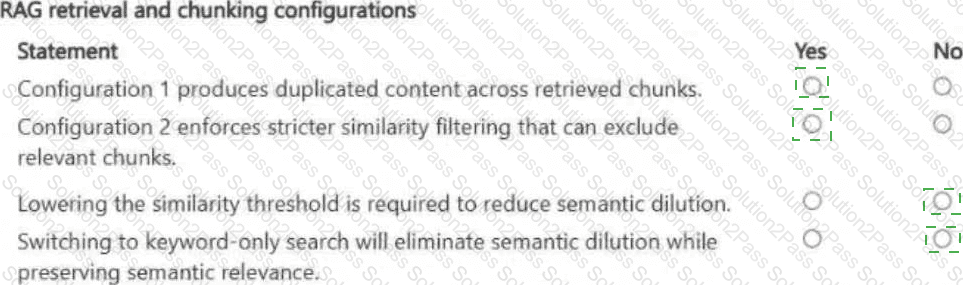
You manage a Retrieval-Augmented Generation (RAG) system that retrieves internal policy documents from a vector index.
Recent analysis shows that:
Retrieved results frequently include duplicated content from the same document.
Retrieved chunks sometimes span unrelated policy sections.
You review the following retrieval and ingestion configurations:
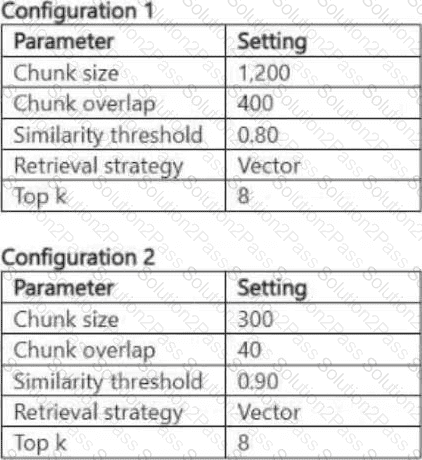
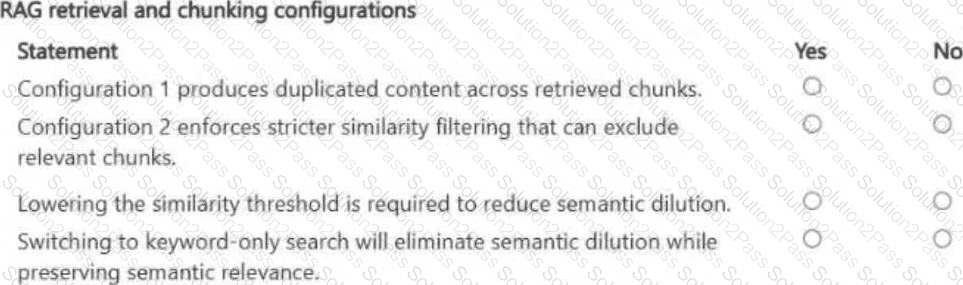
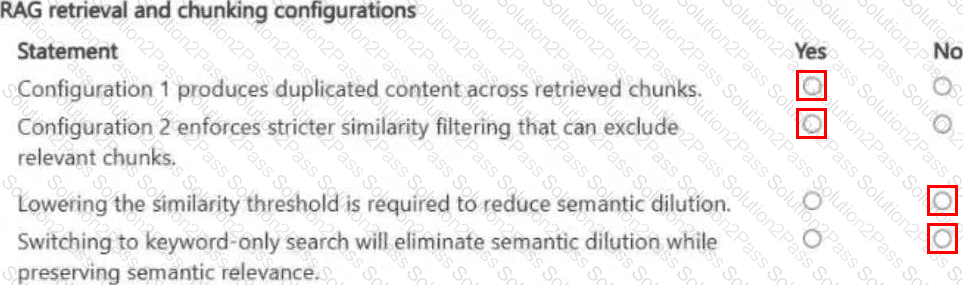
You need to reduce duplicated retrieval results and improve chunk relevance across policy sections.
For each of the following statements, select Yes if the statement is true. Otherwise, select No. NOTE: Each correct selection is worth one point.
A Retrieval-Augmented Generation (RAG) solution returns incomplete answers because relevant content is inconsistently retrieved from the knowledge source.
You need to improve RAG accuracy without changing the embedding model currently in use. You need to achieve this goal while minimizing operational costs.
Which two actions should you perform? Each correct answer presents part of the solution. NOTE: Each correct selection is worth one point. Choose two.
You manage an Azure Machine Learning workspace named workspace!.
You plan to author custom pipeline components by using Azure Machine Learning Python SDK v2.
You must transform the Python code into a YAML specification that can be processed by the pipeline service.
You need to import the Python library that provides the transformation functionality.
Which Python library should you import?
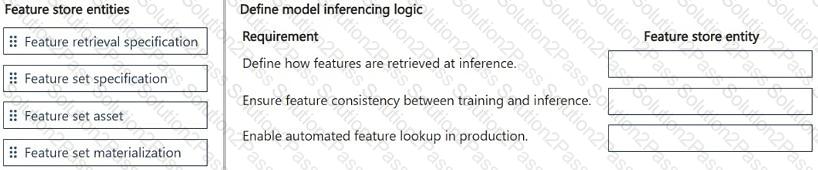
A data science team trains a model that depends on features that are stored in a managed feature store.
The model is registered in Azure Machine Learning and will be deployed to a real-time endpoint.
After deployment, the model must:
• Retrieve feature values dynamically at inference time.
• Use the same feature definitions that were used during training.
• Run without manual configuration changes across environments.
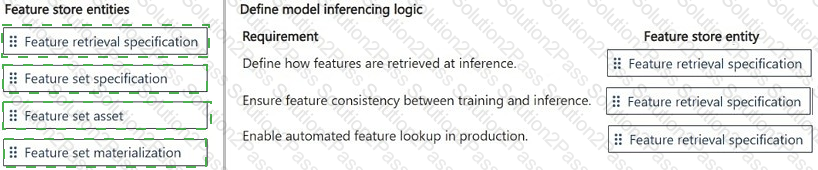
You need to define feature store entities so that feature retrieval behaves as expected when the model is deployed.
Which feature store entity should you select for each requirement? To answer, move the appropriate feature store entities to the correct requirements. You may use each feature store entity once, more than once, or not at all. You may need to move the split bar between panes or scroll to view content.
NOTE: Each correct selection is worth one point.
A team uses a hosted Git repository to store training code and pipeline definitions of a machine learning experiment.
The team must ensure that access to the repository is granted without requiring each developer to store personal access tokens on their machines.
Repository access must be secure and centrally managed to reduce credential spread.
You need to enable secure access between an Azure Machine Learning workspace and the repository.
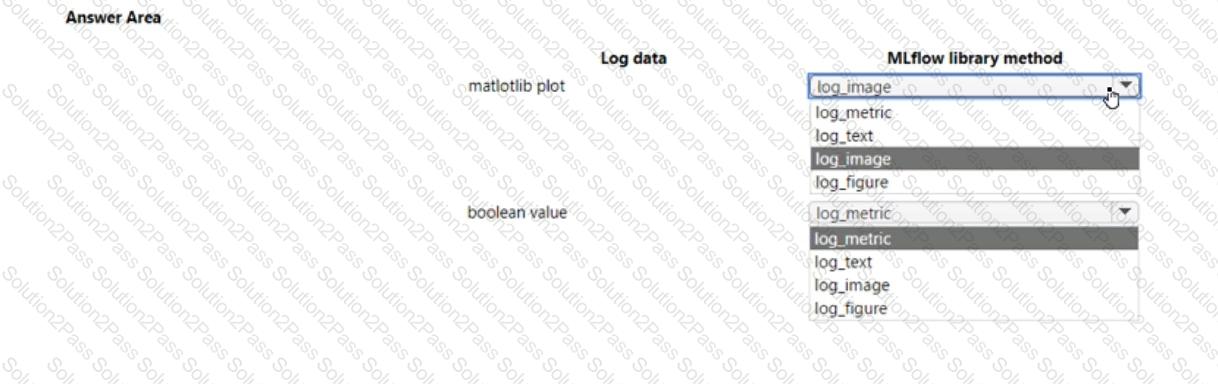
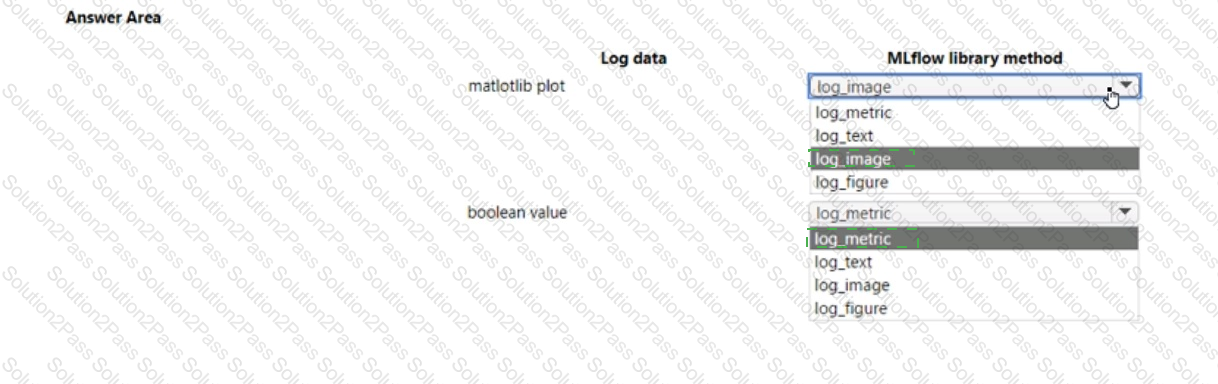
You create an Azure Machine Learning workspace and install the MLflow library.
You need to tog different types of data by using the MLflow library.
Which method should you use? To answer, select the appropriate options in the answer area.
NOTE: Each correct selection is worth one point.
A product team is building a customer support assistant that must respond consistently across multiple channels.
Early testing shows that small wording changes in prompts cause large differences in tone and factual accuracy.
The team needs prompts that are reliable, reusable, and adaptable across multiple use cases without retraining the underlying model.
You need to design prompts that improve response quality while remaining flexible for future changes.
Which two actions should you perform? Each correct answer presents part of the solution. (Choose two.)
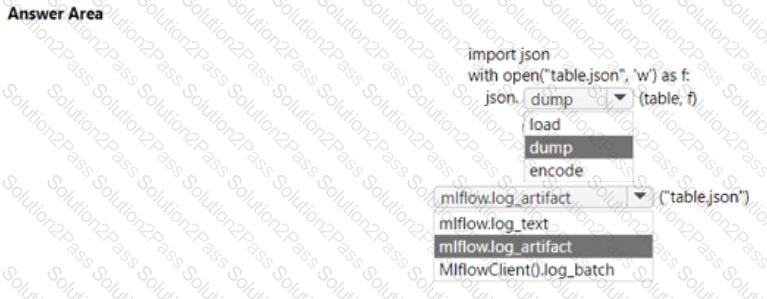
You create an Azure Machine Learning workspace.
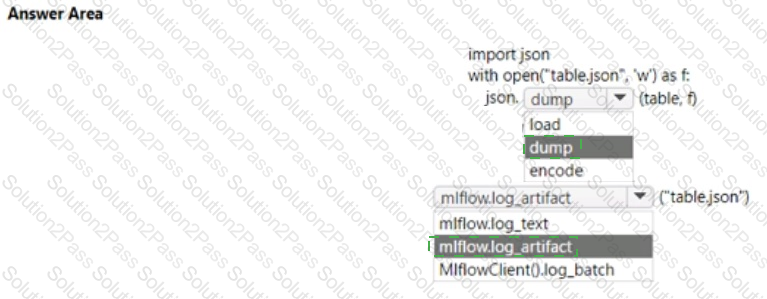
You must use the Python SDK v2 to implement an experiment from a Jupyter notebook in the workspace. The experiment must log a table in the following format:
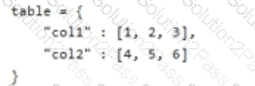
You need to complete the Python code to log the table.
How should you complete the code? To answer, select the appropriate options in the answer area.
NOTE: Each correct selection is worth one point.
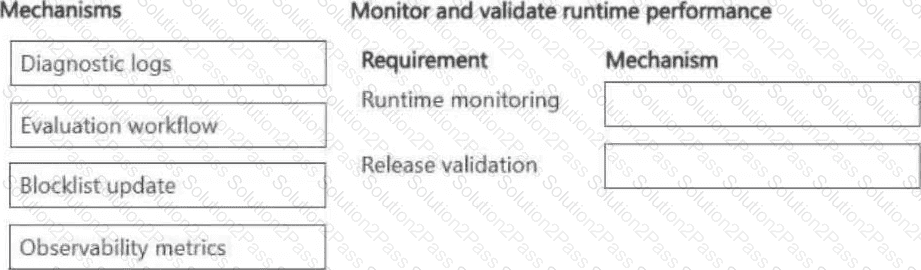
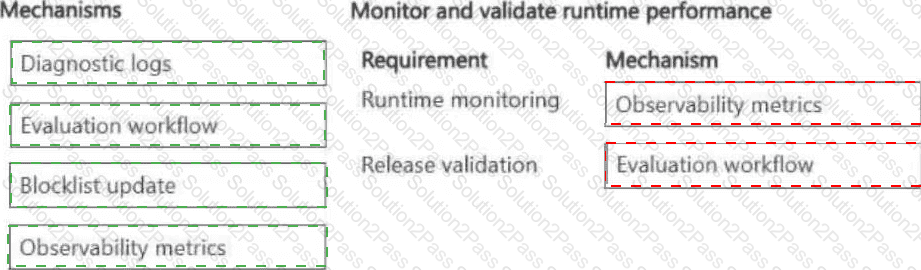
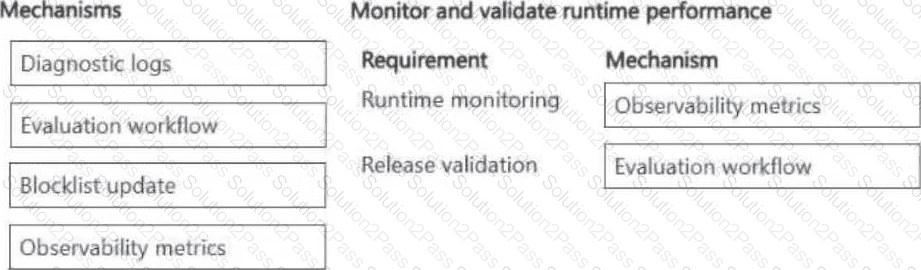
An organization operates a generative AI application in production by using Microsoft Foundry. The application serves live user traffic and is updated by a data scientist team regularly as prompts and models evolve.
The application intermittently times out during production use, which requires ongoing visibility into runtime behavior.
The team must also validate model quality and safety before releasing new updates to avoid introducing regressions.
You need to apply the correct mechanisms for continuous runtime monitoring and for release time validation.
Which mechanisms should you use for each requirement? To answer, move the appropriate mechanisms to the correct requirements. You may use each mechanism once, more than once, or not at all. You may need to move the split bar between panes or scroll to view content. NOTE: Each correct selection is worth one point.
A team develops and manages a conversational assistant by using Microsoft Foundry.
The team must be able to validate that the assistant does not produce hateful responses before the application is exposed to any users.
You need to evaluate the model output for hateful responses as part of a repeatable validation process.
Which evaluator should you configure first?
Note: This question is part of a series of questions that present the same scenario. Each question in the series contains a unique solution that might meet the stated goals. Some question sets might have more than one correct solution, while others might not have a correct solution.
After you answer a question in this section, you will NOT be able to return to it. As a result, these questions will not appear on the review screen.
You manage an Azure Machine Learning workspace. The Python script named script.py reads an argument named training_data.
The training_data argument specifies the path to the training data in a file named dataset1.csv.
You plan to run the script.py Python script as a command job that trains a machine learning model.
You need to provide the command to pass the path for the dataset as a parameter value when you submit the script as a training job.
Solution: python script.py --trainingdata ${{inputs.training_data}}
Does the solution meet the goal?
-
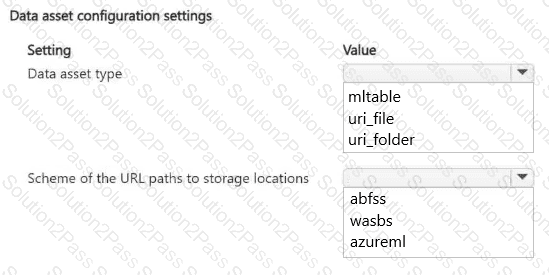
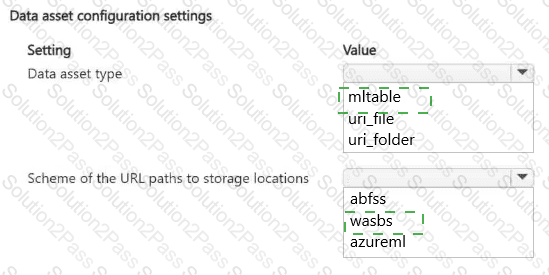
You have an Azure Machine Learning workspace and a collection of image files stored in two Azure Blob Storage accounts.
You need to configure data asset properties.
Which values should you use in your configuration? To answer, select the appropriate options in the answer area.
NOTE: Each correct selection is worth one point.