CPHQ NAHQ Certified Professional in Healthcare Quality Examination Free Practice Exam Questions (2026 Updated)
Prepare effectively for your NAHQ CPHQ Certified Professional in Healthcare Quality Examination certification with our extensive collection of free, high-quality practice questions. Each question is designed to mirror the actual exam format and objectives, complete with comprehensive answers and detailed explanations. Our materials are regularly updated for 2026, ensuring you have the most current resources to build confidence and succeed on your first attempt.
Patient-centered care is best measured by the percentage of patients:
To evaluate outcomes, an ambulatory/outpatient care unit should analyze:
The primary objective of the project charter is to
Which of the following demonstrates interrater reliability and construct validity for an instrument designed to capture data for a publicly reported measure set?
Option
Interrater Reliability
Construct Validity
A
Two or more abstractors enter identical responses when reviewing the same record.
The tool measures the quality of care which the measure developers intended to measure.
B
Trained data collectors can reliably predict results after reviewing a random sample of records.
The tool includes data elements that measure the aspects of quality which are important to the public.
C
Concordance between process and outcome measures can be accurately estimated by the measure developers.
The instrument enables statistically valid inferences to be drawn about the quality of care delivered.
D
The design of the instrument minimizes falsified answers and other data entry errors.
The instrument captures variations in care processes across the population.
Which of the following actions target social determinants of health in an improvement project on asthma control?
Patient complaints have been received regarding appointment time delays. Which of the following should be completed first?
The chart shown below is created for a project schedule.
What is the minimum number of days required to complete the project?
A goal of measurement is to collect valid and reliable data that reflects
Which tool Is used to Identify resources needed to complete a project?
Which of the following conclusions might be drawn from failure mode and effects analysis (FMEA)?
Providers in a clinic can earn incentives based on performance measure results. Based on the incentive structure and current performance below, which measure should providers focus on to maximize their incentive?
Measure
Weight
Target
Current
Breast Cancer Screening
30%
70%
70%
Colorectal Cancer Screening
10%
65%
62%
Controlling High Blood Pressure
40%
82%
83%
Childhood Immunization Status
20%
48%
44%
Quality measures must be relevant, scientifically sound, and
A 300-bed healthcare organization has decided to apply for accreditation with a new accreditation body. The accreditation readiness coordinator should first
At what step in the DMAIC process should a healthcare quality professional complete a gap analysis?
Where could a quality professional find data on causes ofinfant mortality?
A local health center is launching a community health assessment. What data is recommended to identify the potential needs of the population?
While auditing a medical chart for breast cancer screening compliance using HEDIS, a quality professional questioned whether a patient’s last screening fell within the lookback period. Where should the quality professional look to ensure compliance?
Which of the following statements most accurately describes health literacy?
Which organization should be consulted when an organization wishes to expand diagnostic testing?
An organization is adopting Lean Six Sigma as their new performance improvement model. The best approach for providing training on the model is to
A healthcare quality professional is organizing a team to address accuracy of the admission source data collection element. Accuracy of this data element impacts exclusions for various quality scores. The following teams have been proposed:
Team
Sponsor
Leader
Members
A
Chief Financial Officer
Director of Quality
Case Manager, Registration Staff, Coding Manager
B
Chief Executive Officer
Director of Finance
Staff Nurse, Hospitalist, Coding Manager
C
Chief Nursing Officer
Director of Health Information Management
Coding Manager, Emergency Dept. Nurse, Intensivist
D
Chief Medical Officer
Director of Case Management
Clinical Documentation Specialist, Case Manager, Emergency Dept. Intensivist
Which team is most appropriate to address this issue?
An electronic medical records system was implemented in a department. Which of the following is the next step?
A healthcare organization implemented an initiative to decrease hospital admissions for chronic heart failure. The baseline rate was 16%, and the current rate is 12%. Based on this performance, which of the following is most applicable?
A multidisciplinary team completed a quality improvement project and wants to evaluate the team’s performance. Which of the following is most helpful?
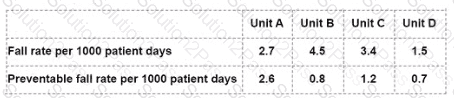
Based on the data below, which unit should the quality Improvement coordinator focus on?
Which of the following should a healthcare plan use to collect satisfaction data from its health plan members?
A quality professional is conducting a root cause analysis related to a sentinel event. Which tool would be most useful to identify potential causes of the event?
A hospital received 50 Incident reports describing falls that occurred within aone-month period. Which of the following actions should be taken?
Which of the following should be used to determine how data changes over time?
Annual evaluation of a quality Improvement process must