EMT NREMT Emergency Medical Technicians (EMT002) Exam Free Practice Exam Questions (2026 Updated)
Prepare effectively for your NREMT EMT Emergency Medical Technicians (EMT002) Exam certification with our extensive collection of free, high-quality practice questions. Each question is designed to mirror the actual exam format and objectives, complete with comprehensive answers and detailed explanations. Our materials are regularly updated for 2026, ensuring you have the most current resources to build confidence and succeed on your first attempt.
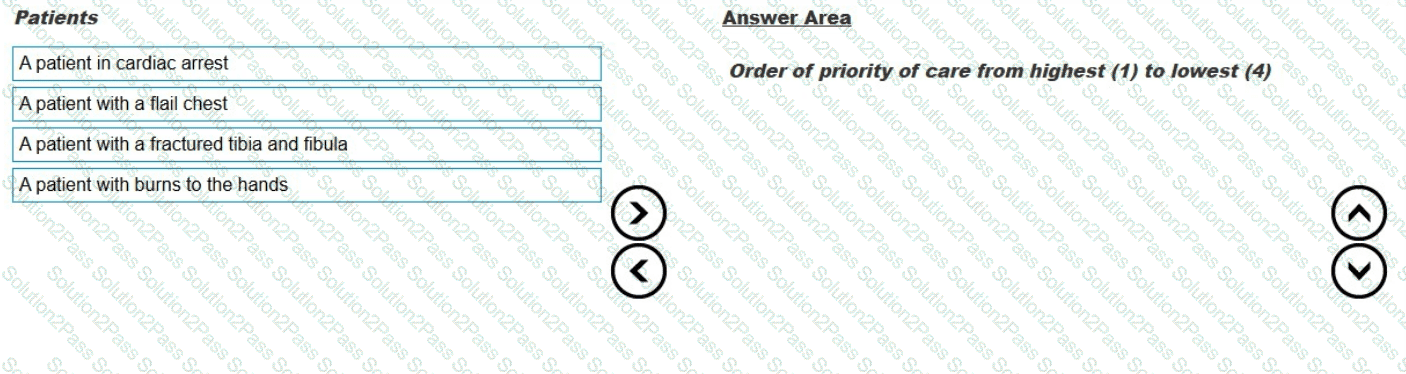
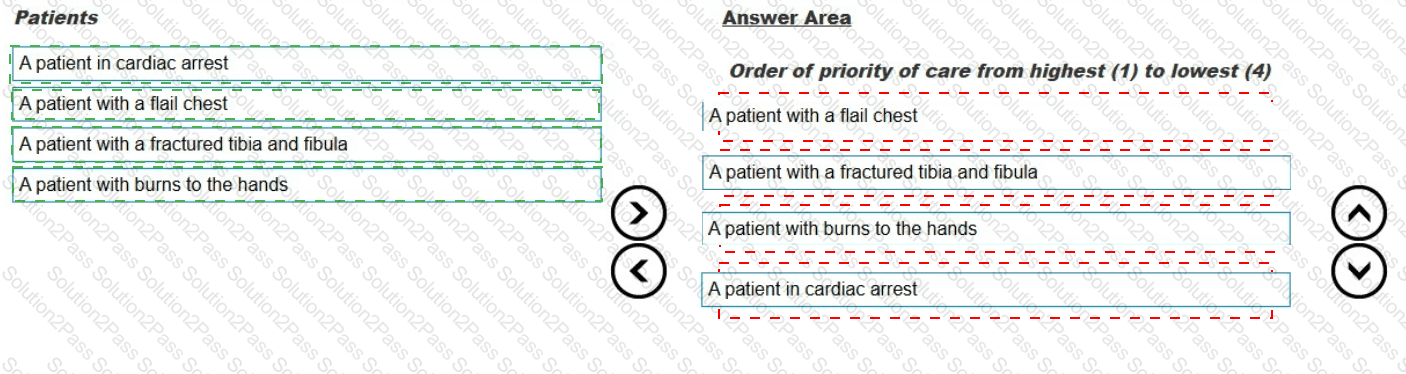
Which patient is the highest priority, and which patient is the lowest priority during a mass casualty event? Move each patient into the Answer Area to correctly order the patients from the highest priority to the lowest priority.
In which of the following positions should a patient with an altered level of consciousness be transported?
Following insertion of an oropharyngeal airway in an unresponsive 1-year-old male, he develops cyanosis and bradycardia. You should
A patient who was involved in a car crash removes the cervical collar you placed on his neck and refuses to allow you to replace it. You should
Which of the following is categorized as a personal injury prevention supply?
What patient conditions have an indication for the use of a CPAP device? Select the three answer options that are correct.
A 76-year-old patient has behavioral changes that began this morning. The patient is also having trouble ambulating and speaking. Which of the following conditions should the EMT suspect? Select the two answer options that are correct.
A 7-year-old patient is confused and disoriented. What should the EMT assess to rapidly determine the patient ' s condition? Select the three answer options that are correct.
A 45-year-old male is lying unresponsive on the floor. He is cyanotic with shallow respirations. After opening his airway, you should
Who is ultimately responsible for maintaining certification requirements and ensuring continuing education requirements are met?
Which of the following is spread through the fecal-oral route?
Which of the following would directly increase public safety in the community?
A 45-year-old male complains of a sudden onset of right flank pain that radiates to his right groin. He is pale, diaphoretic, and restless. You should suspect
Which of the following are signs of a complete airway obstruction? Select the two answer options that are correct.
Sectors under the Incident Management System are designed to:
A 43-year-old patient is experiencing a sudden onset of coughing, nausea, and shortness of breath. The patient has a history of alcohol use disorder and major depressive disorder. The patient spent the day cleaning. The kitchen has food in various forms of decay. The patient ' s condition improves slightly once oxygen has been administered. Which of the following environmental factors is the most likely cause of the patient ' s presentation?
Defusing sessions should do which of the following in order to be successful? Select the two correct options.
Which of the following adverse conditions typically occurs during hemodialysis treatment?
Reassessment of a patient begins with repeating the
In order for a plaintiff to recover damages in a lawsuit against an EMT, there must be a duty to perform, breach of duty, damage, and