Summer Sale Special - Limited Time 70% Discount Offer - Ends in 0d 00h 00m 00s - Coupon code: xmaspas7

Easiest Solution 2 Pass Your Certification Exams

4A0-D03 Nokia SR Linux EVPN and Data Center Interconnect Free Practice Exam Questions (2026 Updated)

Prepare effectively for your Nokia 4A0-D03 Nokia SR Linux EVPN and Data Center Interconnect certification with our extensive collection of free, high-quality practice questions. Each question is designed to mirror the actual exam format and objectives, complete with comprehensive answers and detailed explanations. Our materials are regularly updated for 2026, ensuring you have the most current resources to build confidence and succeed on your first attempt.

Page: 1 / 1
Total 56 questions

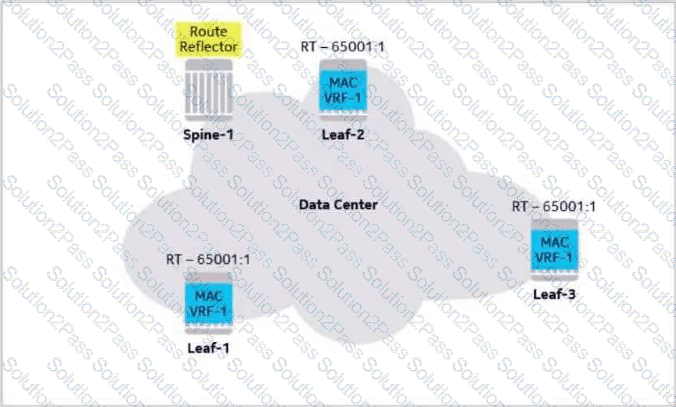
Consider the exhibit.

All three leafs have an EVPN MP-BGP session with the route reflector in Spine-1. Leaf-2 and Leaf-3 have existing instances of an L2 EVPN named MAC VRF-1. Leaf-1 has just enabled a new instance of MAC VRF-1.

Which of the following steps is NOT taken when this new instance is enabled?

A.

Leaf-1 generates an IMET route.

B.

Leaf-1 advertises the IMET route in a BGP EVPN update directly to Leaf-2 and Leaf-3.

C.

Leaf-2 and Leaf-3 auto-discover the new peer based on the route target in the received IMET route.

D.

Leaf-2 and Leaf-3 add Leaf-1 to their existing flooding list for BUM traffic.

Consider the exhibit.

The network is configured for interface-less symmetric routing with an ECMP of 4 enabled on all leaf routers.

Which of the following statements is FALSE?

A.

Anycast gateway is an optional configuration on the Leaf1 and Leaf2 IRB interfaces.

B.

The IRB interfaces on Leaf1 and Leaf2 must be configured to advertise learned local host-routes.

C.

MAC-VRF100 on Leaf1 and Leaf2 must have BGP EVPN and BGP VPN configured.

D.

IP-VRF1 on Leaf1, Leaf2 and Leaf3 must be configured with a VXLAN-routed interface.

Consider the exhibit.

Leaf1 and Leaf2 have the Ethernet segment configured to use the default election algorithm while Leaf3 and Leaf4 are configured to use the preference-based algorithm with Leaf3 having the higher preference value. The DF candidate list is the same on all leaf routers.

Which of the following leafs is the DF for mac-vrf103?

A.

Leaf1

B.

Leaf2

C.

Leaf3

D.

Leaf4

Which of the following statements about a BGP route target is FALSE?

A.

The route-target is a BGP extended community.

B.

It is defined in MP-BGP to allow for overlapping MAC addresses from multiple tenants.

C.

It is advertised with every EVPN route update.

D.

It identifies the EVPN instance in the control plane.

Consider the exhibit.

The network is going to be designed to use interface-less symmetric routing.

Which of the following statements is TRUE?

A.

An instance of each mac-vrf is required on each leaf.

B.

The ingress PE will perform layer 2 and layer 3 lookups while the egress PE will perform layer 2 lookup.

C.

The IRB configuration does not require anycast gateway configuration on the ip-vrf.

D.

Forwarding information will be exchanged between the PEs using EVPN route-type 2 updates.

Which of the following statements about a L3 EVPN network using symmetric routing is FALSE?

A.

Each participating PE must support the use of EVPN route-type 5.

B.

Ingress and egress PEs perform MAC and IP forwarding.

C.

A routed-VXLAN interface is required on a per IP-VRF basis.

D.

Each MAC-VRF used in the L3 EVPN network must exist on each PE.

Consider the exhibit.

Host-2 is sending data to Host-1. The network is designed to use asymmetric routing.

Which of the following statements about the operation of the data plane is TRUE?

A.

Leaf-1 forwards the data for mac-vrf-2 towards Leaf-2 with a VNI of 2.

B.

Leaf-2 forwards the data for mac-vrf-2 towards the IP-VRF using its IRB interface.

C.

Leaf-2 IP-VRF consults the ARP table to learn Host-1 MAC address.

D.

Leaf-2 does a MAC look-up using mac-vrf-1 and forwards the data towards Host-1.

Consider the exhibit.

All three of the leafs have a MP-BGP EVPN session to the route-reflector Spine-1. Leaf-1, Leaf-2 and Leaf-3 have existing instances of an L2 EVPN named MAC VRF-1. Host-1 has just sent its first Ethernet frame into MAC VRF-1 on Leaf-1.

Which of the following steps is FALSE?

A.

Leaf-1 populates Host-1's MAC address learnt on the local interface to its MAC table.

B.

Leaf-1 generates an EVPN route-type 5 update with Host-1's MAC address and sends it to the route reflector.

C.

The route-reflector forwards the EVPN update to Leaf-2 and Leaf-3.

D.

Leaf-2 and Leaf-3 import the EVPN update based upon the route target.

Which of the following four symmetric routing options does NOT require the use of an EVPN route-type 2?

A.

Host routing

B.

Prefix routing interface-less

C.

Prefix routing interface-ful numbered

D.

Prefix routing interface-ful unnumbered

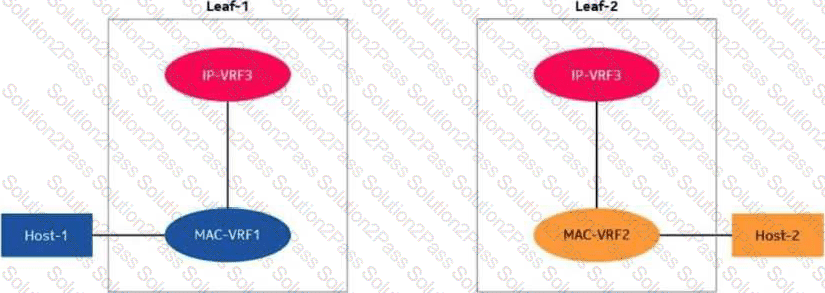
Consider the exhibit.

The two MAC-VRFs are inter-connected using IP-VRF3 which is to be deployed using asymmetric routing.

Which of the following statements is FALSE?

A.

Leaf-1 and Leaf-2 will advertise the IP prefixes to each other using EVPN route-type 5.

B.

Leaf-1 and Leaf-2 must both have instances of MAC-VRF1 and MAC-VRF2.

C.

Leaf-1 and Leaf-2 will advertise host MAC/IP address information using EVPN route-type 2.

D.

MAC-VRF1 and MAC-VRF2 will connect to IP-VRF3 using an IRB interface.

Which of the following GARP functions is FALSE?

A.

A host sends a GARP to update its own IP/MAC mapping to the other hosts in the subnet.

B.

All other hosts within the subnet will update their ARP tables.

C.

The GARP is sent as a broadcast.

D.

The other hosts in the subnet will acknowledge the receipt with a reply.

Which of the following statements about EVPN PE-CE routing, using BGP as the routing protocol, is FALSE?

A.

The PE advertises IPv4/IPv6 BGP updates to the CE based on the EVPN routes received from other PEs.

B.

The PE advertises updates received from the CE as EVPN route type 5 updates to the other PEs.

C.

iBGP is preferred between the CE and PE so that they will be in the same autonomous system.

D.

The PE and CE can utilize import and export policies to control the updates that are sent and received.

Consider the exhibit.

Based upon the information in the screen captures, which of the following statements is FALSE?

A.

Leaf-1 will not generate any EVPN route-type 5 updates for IP-VRF-100.

B.

The IRB interface will snoop all ARP and GARP messages received on IRB sub-interface 100.100.

C.

Leaf-1 will advertise EVPN route-type 2 updates with host IP and MAC information for MAC-VRF100.

D.

The ARP cache for ip-vrf 100 is only required to contain host prefixes for the local subnets.

Which of the following statements about configuring and using an integrated routing and bridging (IRB) interface is TRUE?

A.

The IRB sub-interface must be configured as either type bridge or routed.

B.

A MAC-VRF can be configured with multiple IRB sub-interfaces to support multi-homing.

C.

When the IRB sub-interface is configured with multiple IP addresses, one of them can be configured as the primary.

D.

When using an IRB interface to interconnect a MAC-VRF to an IP-VRF, one sub-interface is configured for the MAC-VRF and another one for the IP-VRF.

When configuring the EVPN MP-BGP route reflector sessions between the leaf and spine routers, which of the following statements is TRUE?

A.

The local-AS number configured within the BGP group will override the AS number configured directly under the BGP protocol.

B.

The cluster-id that uniquely identifies this route reflector session is configured on the route reflector and participating clients.

C.

When redundant route reflectors are deployed, one route reflector will be the primary while the other one will assume a backup role.

D.

Route reflectors can be used instead of a full mesh of eBGP sessions between the leaf and spine routers.

Which of the following statements about the decoupled gateway-based data center interconnect solution is TRUE?

A.

The IP addresses of all the leaf routers and route-reflectors must be reachable by the routers in the WAN.

B.

There is a clear demarcation for security and QoS between the data center border leaf and the WAN PE.

C.

The WAN PE maintains a peering session with the data center route reflector.

D.

VXLAN tunnels are established between the leaf routers in the different data centers.

Page: 1 / 1
Total 56 questions
Copyright © 2014-2026 Solution2Pass. All Rights Reserved