Winter Sale Limited Time 65% Discount Offer - Ends in 0d 00h 00m 00s - Coupon code: s2p65

Easiest Solution 2 Pass Your Certification Exams

ARA-R01 Snowflake SnowPro Advanced: Architect Recertification Exam Free Practice Exam Questions (2025 Updated)

Prepare effectively for your Snowflake ARA-R01 SnowPro Advanced: Architect Recertification Exam certification with our extensive collection of free, high-quality practice questions. Each question is designed to mirror the actual exam format and objectives, complete with comprehensive answers and detailed explanations. Our materials are regularly updated for 2025, ensuring you have the most current resources to build confidence and succeed on your first attempt.

Page: 2 / 3
Total 162 questions

A new user user_01 is created within Snowflake. The following two commands are executed:

Command 1-> show grants to user user_01;

Command 2 ~> show grants on user user 01;

What inferences can be made about these commands?

A.

Command 1 defines which user owns user_01

Command 2 defines all the grants which have been given to user_01

B.

Command 1 defines all the grants which are given to user_01 Command 2 defines which user owns user_01

C.

Command 1 defines which role owns user_01

Command 2 defines all the grants which have been given to user_01

D.

Command 1 defines all the grants which are given to user_01

Command 2 defines which role owns user 01

An Architect is troubleshooting a query with poor performance using the QUERY_HIST0RY function. The Architect observes that the COMPILATIONJHME is greater than the EXECUTIONJTIME.

What is the reason for this?

A.

The query is processing a very large dataset.

B.

The query has overly complex logic.

C.

The query is queued for execution.

D.

The query is reading from remote storage.

A company has an inbound share set up with eight tables and five secure views. The company plans to make the share part of its production data pipelines.

Which actions can the company take with the inbound share? (Choose two.)

A.

Clone a table from a share.

B.

Grant modify permissions on the share.

C.

Create a table from the shared database.

D.

Create additional views inside the shared database.

E.

Create a table stream on the shared table.

A retail company has over 3000 stores all using the same Point of Sale (POS) system. The company wants to deliver near real-time sales results to category managers. The stores operate in a variety of time zones and exhibit a dynamic range of transactions each minute, with some stores having higher sales volumes than others.

Sales results are provided in a uniform fashion using data engineered fields that will be calculated in a complex data pipeline. Calculations include exceptions, aggregations, and scoring using external functions interfaced to scoring algorithms. The source data for aggregations has over 100M rows.

Every minute, the POS sends all sales transactions files to a cloud storage location with a naming convention that includes store numbers and timestamps to identify the set of transactions contained in the files. The files are typically less than 10MB in size.

How can the near real-time results be provided to the category managers? (Select TWO).

A.

All files should be concatenated before ingestion into Snowflake to avoid micro-ingestion.

B.

A Snowpipe should be created and configured with AUTO_INGEST = true. A stream should be created to process INSERTS into a single target table using the stream metadata to inform the store number and timestamps.

C.

A stream should be created to accumulate the near real-time data and a task should be created that runs at a frequency that matches the real-time analytics needs.

D.

An external scheduler should examine the contents of the cloud storage location and issue SnowSQL commands to process the data at a frequency that matches the real-time analytics needs.

E.

The copy into command with a task scheduled to run every second should be used to achieve the near-real time requirement.

Which of the following are characteristics of how row access policies can be applied to external tables? (Choose three.)

A.

An external table can be created with a row access policy, and the policy can be applied to the VALUE column.

B.

A row access policy can be applied to the VALUE column of an existing external table.

C.

A row access policy cannot be directly added to a virtual column of an external table.

D.

External tables are supported as mapping tables in a row access policy.

E.

While cloning a database, both the row access policy and the external table will be cloned.

F.

A row access policy cannot be applied to a view created on top of an external table.

What is a characteristic of loading data into Snowflake using the Snowflake Connector for Kafka?

A.

The Connector only works in Snowflake regions that use AWS infrastructure.

B.

The Connector works with all file formats, including text, JSON, Avro, Ore, Parquet, and XML.

C.

The Connector creates and manages its own stage, file format, and pipe objects.

D.

Loads using the Connector will have lower latency than Snowpipe and will ingest data in real time.

A company is using a Snowflake account in Azure. The account has SAML SSO set up using ADFS as a SCIM identity provider. To validate Private Link connectivity, an Architect performed the following steps:

* Confirmed Private Link URLs are working by logging in with a username/password account

* Verified DNS resolution by running nslookups against Private Link URLs

* Validated connectivity using SnowCD

* Disabled public access using a network policy set to use the company’s IP address range

However, the following error message is received when using SSO to log into the company account:

IP XX.XXX.XX.XX is not allowed to access snowflake. Contact your local security administrator.

What steps should the Architect take to resolve this error and ensure that the account is accessed using only Private Link? (Choose two.)

A.

Alter the Azure security integration to use the Private Link URLs.

B.

Add the IP address in the error message to the allowed list in the network policy.

C.

Generate a new SCIM access token using system$generate_scim_access_token and save it to Azure AD.

D.

Update the configuration of the Azure AD SSO to use the Private Link URLs.

E.

Open a case with Snowflake Support to authorize the Private Link URLs’ access to the account.

Company A has recently acquired company B. The Snowflake deployment for company B is located in the Azure West Europe region.

As part of the integration process, an Architect has been asked to consolidate company B's sales data into company A's Snowflake account which is located in the AWS us-east-1 region.

How can this requirement be met?

A.

Replicate the sales data from company B's Snowflake account into company A's Snowflake account using cross-region data replication within Snowflake. Configure a direct share from company B's account to company A's account.

B.

Export the sales data from company B's Snowflake account as CSV files, and transfer the files to company A's Snowflake account. Import the data using Snowflake's data loading capabilities.

C.

Migrate company B's Snowflake deployment to the same region as company A's Snowflake deployment, ensuring data locality. Then perform a direct database-to-database merge of the sales data.

D.

Build a custom data pipeline using Azure Data Factory or a similar tool to extract the sales data from company B's Snowflake account. Transform the data, then load it into company A's Snowflake account.

What is a valid object hierarchy when building a Snowflake environment?

A.

Account --> Database --> Schema --> Warehouse

B.

Organization --> Account --> Database --> Schema --> Stage

C.

Account --> Schema > Table --> Stage

D.

Organization --> Account --> Stage --> Table --> View

A company’s client application supports multiple authentication methods, and is using Okta.

What is the best practice recommendation for the order of priority when applications authenticate to Snowflake?

A.

1) OAuth (either Snowflake OAuth or External OAuth)

2) External browser

3) Okta native authentication

4) Key Pair Authentication, mostly used for service account users

5) Password

B.

1) External browser, SSO

2) Key Pair Authentication, mostly used for development environment users

3) Okta native authentication

4) OAuth (ether Snowflake OAuth or External OAuth)

5) Password

C.

1) Okta native authentication

2) Key Pair Authentication, mostly used for production environment users

3) Password

4) OAuth (either Snowflake OAuth or External OAuth)

5) External browser, SSO

D.

1) Password

2) Key Pair Authentication, mostly used for production environment users

3) Okta native authentication

4) OAuth (either Snowflake OAuth or External OAuth)

5) External browser, SSO

An Architect is integrating an application that needs to read and write data to Snowflake without installing any additional software on the application server.

How can this requirement be met?

A.

Use SnowSQL.

B.

Use the Snowpipe REST API.

C.

Use the Snowflake SQL REST API.

D.

Use the Snowflake ODBC driver.

An Architect runs the following SQL query:
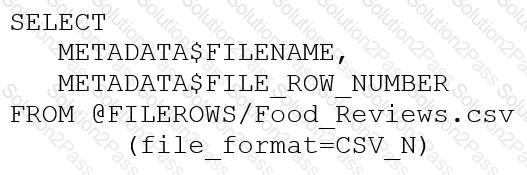
How can this query be interpreted?

A.

FILEROWS is a stage. FILE_ROW_NUMBER is line number in file.

B.

FILEROWS is the table. FILE_ROW_NUMBER is the line number in the table.

C.

FILEROWS is a file. FILE_ROW_NUMBER is the file format location.

D.

FILERONS is the file format location. FILE_ROW_NUMBER is a stage.

An Architect is implementing a CI/CD process. When attempting to clone a table from a production to a development environment, the cloning operation fails.

What could be causing this to happen?

A.

The table is transient.

B.

The table has a masking policy.

C.

The retention time for the table is set to zero.

D.

Tables cannot be cloned from a higher environment to a lower environment.

A retailer's enterprise data organization is exploring the use of Data Vault 2.0 to model its data lake solution. A Snowflake Architect has been asked to provide recommendations for using Data Vault 2.0 on Snowflake.

What should the Architect tell the data organization? (Select TWO).

A.

Change data capture can be performed using the Data Vault 2.0 HASH_DIFF concept.

B.

Change data capture can be performed using the Data Vault 2.0 HASH_DELTA concept.

C.

Using the multi-table insert feature in Snowflake, multiple Point-in-Time (PIT) tables can be loaded in parallel from a single join query from the data vault.

D.

Using the multi-table insert feature, multiple Point-in-Time (PIT) tables can be loaded sequentially from a single join query from the data vault.

E.

There are performance challenges when using Snowflake to load multiple Point-in-Time (PIT) tables in parallel from a single join query from the data vault.

A user, analyst_user has been granted the analyst_role, and is deploying a SnowSQL script to run as a background service to extract data from Snowflake.

What steps should be taken to allow the IP addresses to be accessed? (Select TWO).

A.

ALTERROLEANALYST_ROLESETNETWORK_POLICY='ANALYST_POLICY';

B.

ALTERUSERANALYSTJJSERSETNETWORK_POLICY='ANALYST_POLICY';

C.

ALTERUSERANALYST_USERSETNETWORK_POLICY='10.1.1.20';

D.

USE ROLE SECURITYADMIN;

CREATE OR REPLACE NETWORK POLICY ANALYST_POLICY ALLOWED_IP_LIST = ('10.1.1.20');

E.

USE ROLE USERADMIN;

CREATE OR REPLACE NETWORK POLICY ANALYST_POLICY

ALLOWED_IP_LIST = ('10.1.1.20');

A media company needs a data pipeline that will ingest customer review data into a Snowflake table, and apply some transformations. The company also needs to use Amazon Comprehend to do sentiment analysis and make the de-identified final data set available publicly for advertising companies who use different cloud providers in different regions.

The data pipeline needs to run continuously ang efficiently as new records arrive in the object storage leveraging event notifications. Also, the operational complexity, maintenance of the infrastructure, including platform upgrades and security, and the development effort should be minimal.

Which design will meet these requirements?

A.

Ingest the data using COPY INTO and use streams and tasks to orchestrate transformations. Export the data into Amazon S3 to do model inference with Amazon Comprehend and ingest the data back into a Snowflake table. Then create a listing in the Snowflake Marketplace to make the data available to other companies.

B.

Ingest the data using Snowpipe and use streams and tasks to orchestrate transformations. Create an external function to do model inference with Amazon Comprehend and write the final records to a Snowflake table. Then create a listing in the Snowflake Marketplace to make the data available to other companies.

C.

Ingest the data into Snowflake using Amazon EMR and PySpark using the Snowflake Spark connector. Apply transformations using another Spark job. Develop a python program to do model inference by leveraging the Amazon Comprehend text analysis API. Then write the results to a Snowflake table and create a listing in the Snowflake Marketplace to make the data available to other companies.

D.

Ingest the data using Snowpipe and use streams and tasks to orchestrate transformations. Export the data into Amazon S3 to do model inference with Amazon Comprehend and ingest the data back into a Snowflake table. Then create a listing in the Snowflake Marketplace to make the data available to other companies.

A company is following the Data Mesh principles, including domain separation, and chose one Snowflake account for its data platform.

An Architect created two data domains to produce two data products. The Architect needs a third data domain that will use both of the data products to create an aggregate data product. The read access to the data products will be granted through a separate role.

Based on the Data Mesh principles, how should the third domain be configured to create the aggregate product if it has been granted the two read roles?

A.

Use secondary roles for all users.

B.

Create a hierarchy between the two read roles.

C.

Request a technical ETL user with the sysadmin role.

D.

Request that the two data domains share data using the Data Exchange.

How can the Snowpipe REST API be used to keep a log of data load history?

A.

Call insertReport every 20 minutes, fetching the last 10,000 entries.

B.

Call loadHistoryScan every minute for the maximum time range.

C.

Call insertReport every 8 minutes for a 10-minute time range.

D.

Call loadHistoryScan every 10 minutes for a 15-minute time range.

An Architect has a VPN_ACCESS_LOGS table in the SECURITY_LOGS schema containing timestamps of the connection and disconnection, username of the user, and summary statistics.

What should the Architect do to enable the Snowflake search optimization service on this table?

A.

Assume role with OWNERSHIP on future tables and ADD SEARCH OPTIMIZATION on the SECURITY_LOGS schema.

B.

Assume role with ALL PRIVILEGES including ADD SEARCH OPTIMIZATION in the SECURITY LOGS schema.

C.

Assume role with OWNERSHIP on VPN_ACCESS_LOGS and ADD SEARCH OPTIMIZATION in the SECURITY_LOGS schema.

D.

Assume role with ALL PRIVILEGES on VPN_ACCESS_LOGS and ADD SEARCH OPTIMIZATION in the SECURITY_LOGS schema.

How does a standard virtual warehouse policy work in Snowflake?
A.

It conserves credits by keeping running clusters fully loaded rather than starting additional clusters.

B.

It starts only if the system estimates that there is a query load that will keep the cluster busy for at least 6 minutes.

C.

It starts only f the system estimates that there is a query load that will keep the cluster busy for at least 2 minutes.

D.

It prevents or minimizes queuing by starting additional clusters instead of conserving credits.

Page: 2 / 3
Total 162 questions
Copyright © 2014-2025 Solution2Pass. All Rights Reserved