OGEA-101 The Open Group TOGAF Enterprise Architecture Part 1 Exam (English) Free Practice Exam Questions (2026 Updated)
Prepare effectively for your The Open Group OGEA-101 TOGAF Enterprise Architecture Part 1 Exam (English) certification with our extensive collection of free, high-quality practice questions. Each question is designed to mirror the actual exam format and objectives, complete with comprehensive answers and detailed explanations. Our materials are regularly updated for 2026, ensuring you have the most current resources to build confidence and succeed on your first attempt.
Which of the following are interests important to the stakeholders in a system?
Complete the following sentence:
Presenting different_________and_________to stakeholders helps architects to extract hidden agendas principles and requirements that could impact the final Target Architecture
According to the TOGAF Standard, what are the two levels of risk that should be monitored?
Complete the sentence The Enterprise Continuum provides methods for classifying architecture artifacts as they evolve from________________________.
Which ADM Phase provides architectural oversight of the implementation?
Complete the sentence. Risks are identified as part of:
Full Question:
Consider the following description of the purpose of an ADM Phase:
To develop a domain architecture approved by the stakeholders for the problem being addressed, together with a set of gaps, and work to clear the gaps understood by the stakeholders.
Which ADM Phase does this describe?
Consider the following descriptions of deliverables consumed and produced across the TOGAF ADM cycle.
General rules and guidelines, intended to be enduring and seldom amended, that inform and support the way in which an organization sets about fulfilling its mission.
The joint agreements between development partners and sponsors on the deliverables, quality, and fitness-for-purpose of an architecture.
A document that is sent from the sponsoring organization to the architecture organization to trigger the start of an architecture development cycle.
A set of quantitative statements that outline what an implementation project must do in order to comply with the architecture.
Complete the sentence.
Deliverable 3 is an output of ________, and deliverable 4 can form ________.
What structural framework does the TOGAF Standard define to support the management, leverage, and storage of architectural work products?
Complete the sentence. The “Statement” part of the recommended TOGAF template for Architecture Principles
What are the four dimensions used to scope an architecture?
Consider the following descriptions of deliverables consumed and produced across the TOGAF ADM cycle.
2) A set of quantitative statements that outline what an implementation project must do in order to comply with the architecture.
4) The scope and approach that will be used to complete an architecture development cycle.
Complete the sentence. Deliverable 2 is the ___, deliverable 4 is a deliverable from ___.
Consider the framework for the Architecture Landscape and the following descriptions of levels:
Direction setting at an executive level.
Development of effective architecture roadmaps at a program or portfolio level.
Match the levels marked A, B, or C to the descriptions marked 1 and 2.
Consider the following statement.
Projects may cycle between ADM phases, in planned cycles covering multiple phases.
What does it illustrate?
What information does the Architecture Requirements Repository within the Architecture Repository hold?
What is present in all phases within the ADM and should be identified, classified and mitigated before starting a transformation effort?
Consider the following ADM phases objectives.
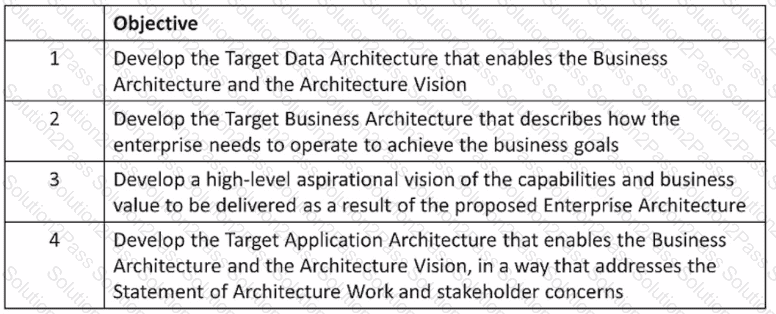
Which phase does each objective match?
Which of the following best describes the purpose of the Architecture Roadmap?
Complete the sentence. Architecture effort at the Logical abstraction level is about:
Exhibit:
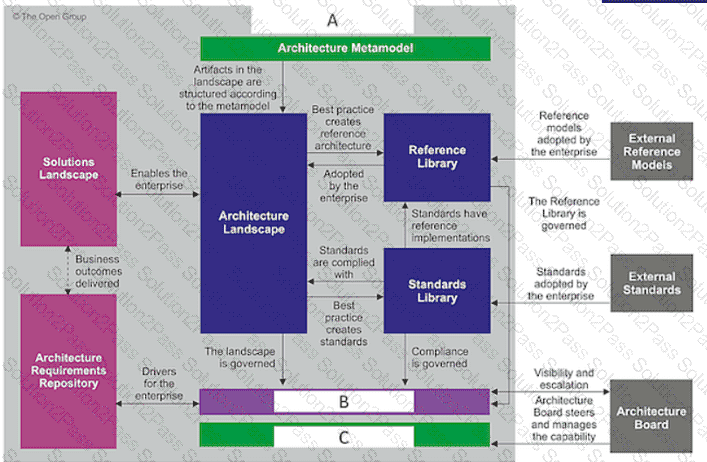
Consider the illustration. What are the items labelled A, B, and C?