OGEA-101 The Open Group TOGAF Enterprise Architecture Part 1 Exam (English) Free Practice Exam Questions (2026 Updated)
Prepare effectively for your The Open Group OGEA-101 TOGAF Enterprise Architecture Part 1 Exam (English) certification with our extensive collection of free, high-quality practice questions. Each question is designed to mirror the actual exam format and objectives, complete with comprehensive answers and detailed explanations. Our materials are regularly updated for 2026, ensuring you have the most current resources to build confidence and succeed on your first attempt.
Consider the following descriptions of deliverables consumed and produced across the TOGAF ADM cycle.
General rules and guidelines, intended to be enduring and seldom amended, that inform and support the way in which an organization sets about fulfilling its mission
A set of quantitative statements that outline what an implementation project must do in order to comply with the architecture.
A document that is sent from the sponsoring organization to the architecture organization to trigger the start of an architecture development cycle
The scope and approach that will be used to complete an architecture development cycle
Complete the sentence. Deliverable 3 is the, deliverable 4 is a deliverable from
In which section of the TOGAF template for Architecture Principles would a reader find the answer to the question of “How does this affect me?”
Complete the sentence. The purpose of the Preliminary Phase is to develop the:
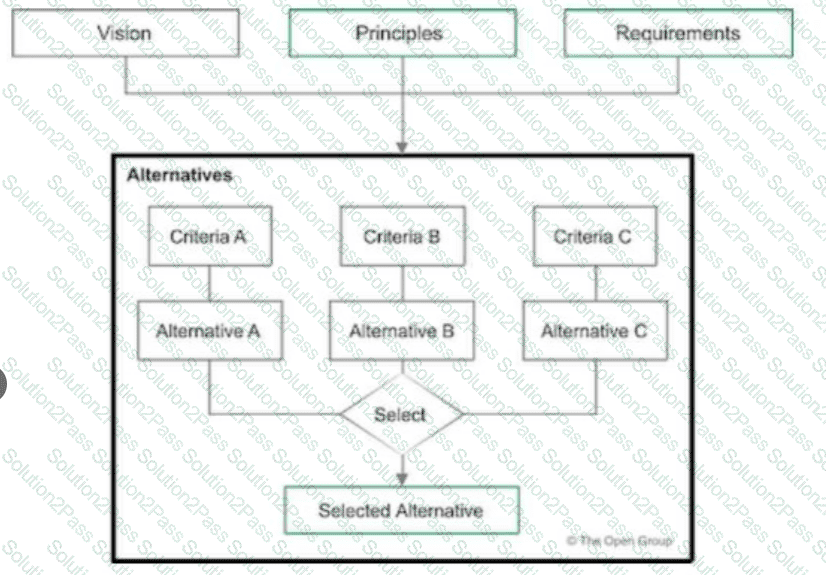
Consider the graphic from the TOGAF Standard.
The graphic shows Vision, Principles, and Requirements feeding into a box labeled Alternatives. Inside that box, multiple alternatives are assessed against Criteria A, Criteria B, and Criteria C. A selection step then leads to a Selected Alternative.
What does this illustrate?
Which of the following statements about architecture partitioning are correct*?
1 Partitions are used to simplify the management of the Enterprise Architecture
2 Partitions are equivalent to architecture levels
3 Partitions enable different teams to work on different element of the architecture at the same time.
4 Partitions reflect the organization ' s structure
Consider the following statements.
1. All processes, decision-making, and mechanisms used will be established so as to minimize or avoid potential conflicts of interest.
2. More effective strategic decision-making will be made by C-Level executives and business leaders.
3. All actions implemented and their decision support will be available for inspection by authorized organization and provider parties.
4. Digital Transformation and operations will be more effective and efficient.
Which statements highlight the value and necessity for Architecture Governance to be adopted within organizations?
Consider the following statements of Phase E and Phase F objectives:
Determine whether an incremental approach is required, and if so identify Transition Architectures that will deliver continuous business value
Generate the initial complete version of the Architecture Roadmap, based upon the gap analysis and candidate Architecture Roadmap components from Phases B, C, and D
Finalize the Architecture Roadmap and the supporting Implementation and Migration Plan
Ensure that the business value and cost of work packages and Transition Architectures is understood by key stakeholders
Which two are objectives of ADM Phase E?
Consider the following statements describing the TOGAF ADM:
All ADM activities are carried out within an iterative cycle of continuous architecture definition and realization
The Requirements Management phase is a continuous phase
Output from an early phase may be modified in a later phase
When a phase starts, the previous phase closes
Which statements are correct?
In which part of the ADM cycle do building block gaps become associated with work packages that will address the gaps?
Which of the following can be used to structure the collection of work products and models that describe the architecture?
Complete the sentence When considering agile development Architecture to Support Project will identify what products the Enterprise needs the boundary of the products and what constraints a product owner has. this defines the Enterprise ' s___________.