Pre-Summer Sale Special - Limited Time 70% Discount Offer - Ends in 0d 00h 00m 00s - Coupon code: xmaspas7

Easiest Solution 2 Pass Your Certification Exams

OGEA-103 The Open Group TOGAF Enterprise Architecture Combined Part 1 and Part 2 Exam Free Practice Exam Questions (2026 Updated)

Prepare effectively for your The Open Group OGEA-103 TOGAF Enterprise Architecture Combined Part 1 and Part 2 Exam certification with our extensive collection of free, high-quality practice questions. Each question is designed to mirror the actual exam format and objectives, complete with comprehensive answers and detailed explanations. Our materials are regularly updated for 2026, ensuring you have the most current resources to build confidence and succeed on your first attempt.

Page: 2 / 2
Total 180 questions

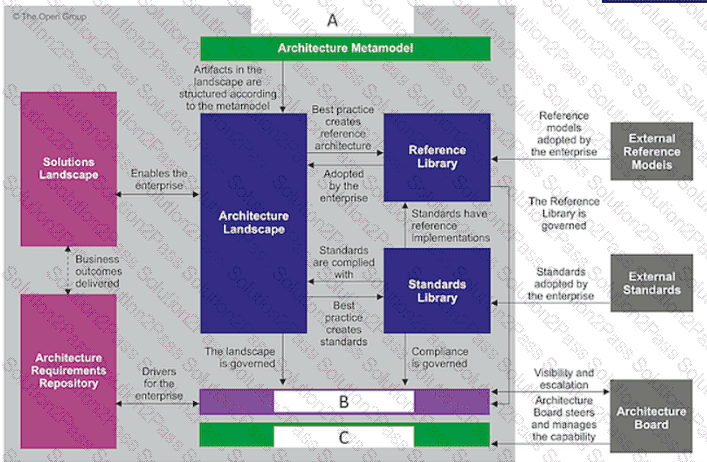
What concept enables the simultaneous operation of multiple ADM phases?

A.

Iteration

B.

Change Management

C.

Digital Transformation

D.

Transition Planning

Consider the following statements.

1. All processes, decision-making, and mechanisms used will be established so as to minimize or avoid potential conflicts of interest.

2. More effective strategic decision-making will be made by C-Level executives and business leaders.

3. All actions implemented and their decision support will be available for inspection by authorized organization and provider parties.

4. Digital Transformation and operations will be more effective and efficient.

Which statements highlight the value and necessity for Architecture Governance to be adopted within organizations?

A.

1and4

B.

1and3

C.

2and4

D.

2and3

Which of the following best describes a purpose of the Gap Analysis technique?

A.

To validate non-functional requirements

B.

To establish quality metrics for the architecture

C.

To determine service levels for the architecture

D.

To identify missing functions

Which of the following are two of the architecture domains that are considered as subsets of an overall Enterprise Architecture?

A.

Strategy, Enterprise

B.

Vision, Target

C.

Technology, Digital

D.

Business, Technology

What are the four dimensions used to scope an architecture?

A.

Business Data Application Technology

B.

Strategy Segment Capability Budget

C.

Breadth Depth Time Period Architecture Domains

D.

Strategy Portfolio Project Solution Delivery

Consider the following ADM phases objectives.

Which phase does each objective match?

A.

1F-2G-3G-4H

B.

1H-2F-3F-4G

C.

1F-2G-3H-4H

D.

1G-2H-3H-4F

Consider the following statements describing the TOGAF ADM:

    All ADM activities are carried out within an iterative cycle of continuous architecture definition and realization

    The Requirements Management phase is a continuous phase

    Output from an early phase may be modified in a later phase

    When a phase starts, the previous phase closes

Which statements are correct?

A.

2, 3 & 4

B.

1, 2 & 3

C.

1, 2 & 4

D.

1, 3 & 4

Consider the following statements about Architecture Partitioning:

    The TOGAF ADM requires a partitioning model for architecture development

    Architectures are partitioned when different teams need to work on different elements of the architecture at the same time

    Partitions can be used to facilitate architecture re-use

Which statements are correct?

A.

1, 2 and 3

B.

1 and 3

C.

1 and 2

D.

2 and 3

You are working as an Enterprise Architect within an Enterprise Architecture (EA) team at a multinational energy company. The company is committed to becoming a net-zero emissions energy business by 2050. To achieve this, the company is focusing on shifting to renewable energy production and adopting eco-friendly practices.

The EA team, which reports to the Chief Technical Officer (CTO), has been tasked with overseeing the transformation to make the company more effective through acquisitions. The company plans to fully integrate these acquisitions, including merging operations and systems.

To address the integration challenges, the EA team leader wants to know how to manage risks and ensure that the company succeeds with the proposed changes. Based on the TOGAF Standard, which of the following is the best answer?

A.

The EA team should create a Business Scenario to fully describe the business problem that is being addressed by the transformation. Once requirements are identified, they should be evaluated in terms of risks. Any residual risks should be escalated to the Architecture Board.

B.

The EA team should develop Business Architecture views that demonstrate how stakeholder concerns are addressed and assess each factor for readiness, urgency, and degree of difficulty.

C.

The EA team should evaluate the company’s readiness for change by identifying factors that will impact the transformation. These factors will be used to determine initial risks associated with the initiative.

D.

The EA team should document the risks associated with the transformation in an Implementation Factor Catalog to inform decisions during implementation and deployment.

Full Scenario

You are employed as an Enterprise Architect within the Enterprise Architecture (EA) team at a clinical research and health technologies company. The company has multiple divisions. Your team works within the healthcare division.

The healthcare division is always creating new products and needs to show the effectiveness and safety of the products. This happens in a set of clinical trials that satisfy the legal requirements of the relevant health authorities. The clinical trials are undertaken by the division’s research laboratories at multiple facilities worldwide. At any time, there are many clinical trials happening. In addition to internal research and development activities, the healthcare division is also involved in publicly funded research projects with industrial and academic partners.

Your team is working on an architecture project to develop a secure system that will allow the healthcare researchers to share information more easily about their clinical trials. It will make working together easier across the organization. This system will also allow secured collaboration with external partners.

The EA team uses the TOGAF Architecture Development Method with adaptations required to support healthcare production methods and laboratory procedures. Due to the highly sensitive nature of the information that is managed, special care has been taken to ensure that each architecture domain considers the privacy and safety concerns.

The EA team has been instructed to minimize disruptions to the trials and to gradually introduce the new system.

The company has an established EA practice and has adopted the TOGAF standard for use in its architecture work. The EA practice is federated, which allows some interoperability and information sharing between the divisions yet permits partially independent activity. The Vice President of the healthcare division is the sponsor of the Enterprise Architecture activity for your EA team.

Question:

As part of introducing the new system, how would you go about breaking down the project into work packages?

Based on the TOGAF standard which of the following is the best answer?

A.

Identify Solution Building Blocks needing development or procurement, eliminate duplicates, group with CRUD matrices, rank work packages, select cost-effective options, and schedule rollouts in Transition Architectures.

B.

Create an Implementation Factor Catalog to indicate actions and constraints. Draw up a matrix with architecture domains and gaps. For each gap, classify solutions as new development, purchased, or existing product. Group similar activities into work packages, identify dependencies, and regroup them into Capability Increments scheduled across Transition Architectures.

C.

Use a Consolidated Gaps, Solutions, and Dependencies Matrix as a planning tool; classify solutions, group similar ones, and regroup into Capability Increments documented in an Architecture Definition Increments Table.

D.

Use Solution Building Blocks from a Consolidated Gaps, Solutions, and Dependencies Matrix and group into work packages, sequence them, and document rollout using a Transition Architecture State Evolution Table.

You are working as an Enterprise Architect within an Enterprise Architecture (EA) team at a large government agency with multiple divisions. The agency has a well-established EA practice and follows the TOGAF standard as its method for architecture development. The government has mandated that the agency prepare for an "AI-first" world.

The agency wants to determine the impact and role of AI in its future services. The CIO has approved a Request for Architecture Work to explore the use of AI in services. Some leaders are concerned about reliance on AI, security, and employees’ need to acquire new skills.

The EA team leader seeks suggestions on managing the risks associated with a new architecture for the AI-first project. Based on the TOGAF standard, which of the following is the best answer?
A.

Conduct an analysis of stakeholders, documenting their concerns and recording them in the Architecture Vision document. Risks should be recorded in the Architecture Requirements Specification and reviewed regularly.

B.

Identify key stakeholders and develop a Communication Plan that addresses their needs. Ensure the architecture addresses risk management and summarizes features of the architecture.

C.

Separate stakeholders into groups and categorize them. Develop models for each group and verify that their concerns are addressed in Phase G, Implementation Governance.

D.

Create an organization map to show the links between different agency parts. Hold a meeting to teach stakeholders to interpret the models. Manage risks as part of Security Architecture development.

Please read this scenario prior to answering the question

You are employed as an Enterprise Architect at a company. The company manages

large-scale farming operations with food production, processing, and distribution. The

goal of the company is to maximize profit while satisfying the needs of consumers for

its products. Its customers demand food that is produced sustainably, safely, and

transparently, while reducing environmental impact.

The business is highly mechanized, and this mechanization has brought about a

decrease in the number of workers needed, together with a focus on agricultural

engineering to improve the efficiency of its farms, its processing facilities, and the

overall enterprise. As part of this, the company has established an Enterprise

Architecture (EA) practice based on the TOGAF standard, using it as the method and

guiding framework. The Chief Information Officer (CIO) is the sponsor of EA practice.

The practice has adopted an iterative approach for its architecture development. This

has enabled the decision makers to have valuable insights into the different aspects

of the business.

In recent years there have been a series of bad harvests, and a major reduction in

yields of the main crop produced by the company. This combined with an increase in

costs for energy, feed, fuel, and fertilizer, had led to a significant decrease in profits.

The rising costs and lower profits mean that the company is unable to take as much

planned action on climate measures as it would like, such as reducing its carbon

footprint. The Chief Executive Officer (CEO) has stated that big changes are needed

to improve yields and profitability.

The outline strategy for change, includes new products, and new markets. The

company will switch to a mix of crops rather than depend on a main crop and will

allow use of its processing facilities by third parties. This is a major decision, and the

CEO has stated a desire to repurpose and reuse rather than replace so as to manage

the risks and limit the costs.

The CIO has assigned the EA team to manage this project. The CIO has stated that

although the overall objective is known, the EA team are expected to define the

scope, a shared vision, and the requirements.

Refer to the scenario

You have been asked to recommend the best approach for architecture development

to realize the CEO's change in direction for the company.

Based on the TOGAF standard which of the following is the best answer?

A.

The team should start on architecture definition and operate multiple ADMphases concurrently to support this change in direction. Once understood, theteam will identify the requirements, drivers, issues, and constraints for thechange. You would include non-functional requirements in the architecturedevelopment to make sure that the target architecture meets it compliance andregulatory requirements.

B.

The team first needs to understand the problem and define the structure of thechange. It should start iteration cycles on a baseline first approach toarchitecture development, and then transition planning. This will identify thechange needed to transition from the baseline to the target and can be used towork out in detail what the agreed vision is for the change.

C.

The team should start its iteration cycles of architecture development by goingthrough the architecture definition phases (B-D) with a baseline first approach.This will support the change in direction as stated by the CEO. It will ensurethat the change can be defined in a structured manner and address therequirements needed to realize the change.

D.

The team should start by defining the baseline Technology Architecture in orderto assess the current infrastructure capacity and capability for the company.Then the focus should be on transition planning and incremental architecturedeployment. This will identify requirements to ensure that the projects aresequenced in an optimal way to realize the change.

Please read this scenario prior to answering the question

You are the Lead Enterprise Architect at a major agribusiness company. The company's main harvest is lentils, a highly valued food grown worldwide. The lentil parasite, broomrape, has been an increasing concern for many years and is now becoming resistant to chemical controls. In addition, changes in climate favor the propagation and growth of the parasite. As a result, the parasite cannot realistically be exterminated, and it has become pandemic, with lentil yields falling globally.

In response to the situation, the CEO has decided that the lentil fields will be used for another harvest. The company will also cease to process third-party lentils and will repurpose its processing plants. Thus, the target market will change, and the end-products will be different and more varied.

The company has recently established an Enterprise Architecture practice based on the TOGAF standard as method and guiding framework. The CIO is the sponsor of the activity. A formal request for architecture change has been approved. At this stage there is no fixed scope, shared vision, or objectives.

Refer to the scenario

You have been asked to propose the best approach for architecture development to realize the CEO's change in direction for the company.

Based on the TOGAF standard which of the following is the best answer?

A.

You propose that this engagement define the baseline Technology Architecture first in order to assess the current infrastructure capacity and capability for the company. Then the focus should be on transition planning and incremental architecture deployment. This will identify requirements to ensure that the projects are sequenced in an optimal fashion so as to realize the change.

B.

You propose that the team uses the architecture definition document and focus on architecture development starting simultaneously phases B, C and D. This is because the CEO has identified the need to change. This will ensure that the change can be defined in a structured manner and address the requirements needed to realize the change.

C.

You propose that the team focus on architecture definition including development of business models, with emphasis on defining the change parameters to support this new business strategy that the CEO has identified. Once understood, the team will be in the best position to identify the requirements, drivers, issues, and constraints for the change.

D.

You propose that the priority is to produce a new Request for Architecture Work leading to development of a new Architecture Vision. The trade-off method should be applied to identify and select an architecture satisfying the stakeholders. For an efficient change the EA team should be aligned with the organization's planning, budgeting, operational, and change processes.

Please read this scenario prior to answering the question

You are working as an Enterprise Architect at a large supermarket. The company runs many retail

stores, as well as an online grocery shop. Many of the stores used to remain open 24/7, but the

number has decreased in recent years. Instead, they now focus on fulfilling online orders during

the night.

The company has a mature Enterprise Architecture (EA) practice and uses the TOGAF standard

for its architecture development method. The EA practice is involved in all aspects of the

business, with oversight provided by an Architecture Board with representatives from different

parts of the business. The EA program is sponsored by the Chief Information Officer (CIO).

Each store uses a standard method to track sales and inventory. This involves sending accurate

timely sales data to a central Al-based inventory management system that can predict demand,

adjust stock levels and automate reordering. The central inventory management system is housed

at the company's central data center.

The company has bought a major rival. The Chief Executive Officer believes that a merger will

enable growth through combined offerings and cost savings. The decision has been taken to fully

integrate the two organizations, including merging retail operations and systems. This means that

duplicated systems will be replaced with one standard retail management system. Also, the

company will reduce the number of applications that are used. The CIO expects significant

savings will be achieved by implementing these changes across the newly merged company.

One improvement that the rival has successfully implemented is the use of hand-held devices

within stores, for both customers and staff. This has increased both customer and staff employee

satisfaction due to the time savings this has brought. The CIO has given the go-ahead to roll out

the devices in all stores but has stated that training on how to use the hand-held devices should

be brief because there are a lot of employees, many of whom are part-time.

The Request for Architecture Work to oversee the merger has been approved. The project has

been scoped and you have been assigned to work on it. Your role includes managing the

architecture for the retail stores.

Refer to the scenario

You have been asked to confirm the most relevant architecture principles for the transformation.

Based on the TOGAF Standard, which of the following is the best answer?

[Note: The sequence of the principles listed in each answer does not matter. You should assume

the company follows the set of principles that are provided in the TOGAF Standard, ADM

Techniques, Architecture Principles chapter. You may need to refer to section 2.6 located in ADM

Techniques within the reference text to answer this question.]

A.

Maximize Benefit to the Enterprise, Common Use Applications, Data is an Asset, Responsive Change Management, Technology Independence

B.

Control Technical Diversity, Interoperability, Data is an Asset, Data is Shared, Business Continuity

C.

Common Vocabulary and Data Definitions, Compliance with the Law, Requirements Based Change, Responsive Change Management, Data Security

D.

Common Use Applications, Data is an Asset, Data is Accessible, Ease of Use, Business Continuity

Please read this scenario prior to answering the question

You are working as the Chief Enterprise Architect within a law firm specializing in personal injury cases. Many of the firm's competitors have improved their litigation strategies, and efficiency by streamlining their processes using Artificial Intelligence {Al).

The CIO has approved a Request for Architecture Work to examine the use of Machine Learning in defining a new Al-driven litigation and finance process for the firm. This process would instruct the lawyers and analysts as to what tasks and portfolio they should work on. The key objectives are to increase task profitability, maximize staff utilization, and increase individual profitability.

The CIO has emphasized that the architecture should enable the fast implementation of continuous Machine Learning. The solution will need to be constantly measured for delivered value and be quickly iterated to success.

Some of the partners have expressed concerns about letting the Al make the decisions, others about the risks associated with use of it for the type of service they deliver. The CIO wants to know if these concerns can be addressed, and how risks will be covered by a new architecture enabling Al and Machine Learning.

Refer to the scenario

You have been asked to respond to the CIO recommending an approach that would enable the development of an architecture that addresses the concerns of the CIO and the concerns of the partners.

Based on the TOGAF standard which of the following is the best answer?

A.

You recommend that a Communications Plan be created to address the key stakeholders, the most powerful and influential partners. This plan should include a report that summarizes the key features of the architecture reflecting their requirements. You will check with each key stakeholder that their concerns are being addressed. Risk mitigation and agility will be explicitly addressed as a component of the architecture being developed.

B.

You recommend that an analysis of the stakeholders is undertaken resulting in documenting the stakeholders and their concerns in a Stakeholder Map. The concerns and relevant views should then be defined for each group and recorded in the Architecture Vision document. Therequirements will include risk mitigation through regular assessments. This will also allow a supervised agile implementation of the continuous Machine Learning.

C.

You recommend that all possible models be created for each candidate architecture that will enable the Al and Machine Learning solution. This ensures that all the necessary data and detail is addressed. A formal review should be held with the stakeholders to verify that their concerns have been properly addressed by the models. Agility will be considered during Phase G Implementation Governance.

D.

You recommend creation of a set of business models that can be applied uniformly across all architecture projects. The stakeholders will be trained to understand the business models to ensure they can see that their concerns are being addressed. Risk will be addressed once the Security Architecture is developed, which will happen later to avoid slowing down the agility required by the CIO.

Full Scenario (Complete and Unmodified):

You are employed as an Enterprise Architect at a healthcare company. The company operates over 250 hospitals and is dedicated to transforming healthcare with new ideas and advancements. The company has multiple divisions including surgery centers, freestanding emergency departments, urgent care clinics, and physician practices. They also develop and supply a range of products and services, many with specialized systems and clinical needs.

The company's Enterprise Architecture (EA) department has been operating for several years and has mature, well-developed architecture governance and development processes following the TOGAF standard. The Chief Information Officer (CIO) is the sponsor of the Enterprise Architecture program.

Healthcare is a highly controlled sector, and the company must maintain robust security practices to keep patient information private and prevent data breaches. The company shares electronic health records with multiple providers and has standardized its medical coding for billing and reporting.

Many of the company’s rivals have begun using Artificial Intelligence (AI) in their operations, and the indications are that this will be transformative for healthcare delivery. This is something the EA department has been interested in for a while, and they had recently submitted an architecture Change Request which was approved. As a result, the CIO has approved a Request for Architecture Work to implement AI-based solutions in the company.

The project has been established and you have been assigned to work on it. Stakeholders, concerns, and business requirements have been identified. The stakeholders have made it clear that timely implementation of changes can be life-critical, and that changes should be focused on improving patient outcomes. They also have a concern about disruption due to the changes and require the systems to preserve clinical data access and maintain critical life-support systems during any outages.

The scope of what is inside and what is outside the architecture efforts has now been confirmed. Your task is to revisit and review the Architecture Principles, as they form part of the constraints on architecture work.

Question:

The EA team leader has asked you to explain which Architecture Principles are most relevant for this project.

Based on the TOGAF standard, which of the following is the best answer?

(Assume the company follows the example Architecture Principles from the TOGAF ADM Techniques – Architecture Principles chapter.)

A.

Compliance with the Law, Interoperability, Control Technical Diversity

B.

Responsive Change Management, Primacy of Principles, Maximize Benefit to the Enterprise

C.

Common Vocabulary and Data Definitions, Data Security, Requirements-Based Change

D.

Common Use Applications, Information Management Is Everybody’s Business, Data Is Accessible

Scenario:

You are working as an Enterprise Architect at a large company. The company runs a chain of home improvement stores, as well as a website for selling products. The website lets many brands work with the company.

The stores open seven days a week and use a standard method to track sales and inventory. This involves sending accurate and timely sales data to a central inventory management system that can predict demand, adjust stock levels, and automate reordering. The website is supported by regional fulfillment centers and also uses the central inventory management system. The central inventory management system is housed at the company’s central data center.

The company has agreed to merge with a major competitor. The leadership teams of both organizations have said they are committed to a smooth transition for customers. All stores will keep their own brand names. They will combine the systems of the organizations, which includes merging retail operations and systems. Duplicated systems will be replaced with one standard retail management system. Additionally, they will reduce the number of applications being used. The CIO expects that these changes will lead to substantial cost savings for the newly merged company.

An enterprise plan for both organizations has been created. The aim is to set priorities for the transition, especially in terms of information management and application development. It is crucial to make decisions that will create long-term value.

The company has a mature Enterprise Architecture (EA) practice and uses the TOGAF standard for its architecture development method. The EA program is sponsored by the Chief Information Officer (CIO).

The Request for Architecture Work to oversee the transition has been approved. The project has been scoped, and you have been assigned to work on it.

You have been asked to confirm the most relevant architecture principles for the transition.

Based on the TOGAF Standard, which of the following is the best answer?

A.

Control Technical Diversity, Interoperability, Data is an Asset, Data is Shared, Business Continuity

B.

Service Orientation, Compliance with the Law, Requirements Based Change, Responsive Change Management, Data Security

C.

Common Use Applications, Data is an Asset, Common Vocabulary and Data Definitions, Maximize Benefit to the Enterprise, Business Continuity

D.

Ease of Use, Common Use Applications, Data is an Asset, Technology Independence, Business Continuity

Page: 2 / 2
Total 180 questions
Copyright © 2014-2026 Solution2Pass. All Rights Reserved