Cyber Monday Sale Special - Limited Time 70% Discount Offer - Ends in 0d 00h 00m 00s - Coupon code: xmaspas7

Easiest Solution 2 Pass Your Certification Exams

Deep-Security-Professional Trend Micro Certified Professional for Deep Security Exam Free Practice Exam Questions (2025 Updated)

Prepare effectively for your Trend Micro Deep-Security-Professional Trend Micro Certified Professional for Deep Security Exam certification with our extensive collection of free, high-quality practice questions. Each question is designed to mirror the actual exam format and objectives, complete with comprehensive answers and detailed explanations. Our materials are regularly updated for 2025, ensuring you have the most current resources to build confidence and succeed on your first attempt.

When viewing the details for a policy, as displayed in the exhibit, you notice that the Application Control Protection Module is not available. In this example, why would this Protection Modules not be available?
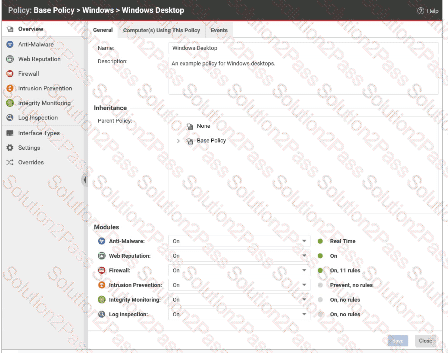
A.

The Application Control Protection Module has been disabled at the Base Policy level and is not displayed in the details for child policies.

B.

The Application Control Protection Module is only supported on Linux computers, the policy details displayed are for Windows computers only.

C.

An Activation Code for the Application Control Protection Module has not been pro-vided. Unlicensed Protection Modules will not be displayed.

D.

The Application Control Protection Modules has not been enabled for this tenant.

What is the result of performing a Reset operation on a Deep Security Agent?

A.

A Reset operation generates Event information that can be used to troubleshoot Agent-to -Manager communication issues.

B.

A Reset operation forces an update to the Deep Security Agent software installed on a managed computer.

C.

A Reset operation forces the Deep Security Agent service to restart on the managed computer.

D.

A Reset operation wipes out any Deep Security Agent settings, including its relationship with Deep Security Manager.

The details for an event are displayed in the exhibit. Based on these details, which Protection Module generated the event?
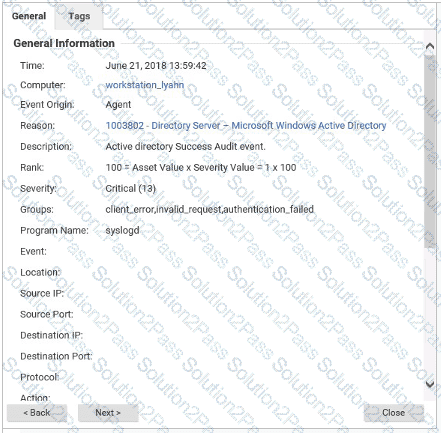
A.

Firewall

B.

Intrusion Prevention

C.

Log Inspection

D.

Integrity Monitoring

Which of the following statements is true regarding Deep Security Manager-todatabase com-munication?

A.

Deep Security Manager-to-database traffic is not encrypted by default, but can be en-abled by modifying settings in the ssl.properties file.

B.

Deep Security Manager-to-database traffic is encrypted by default, but can be disabled by modifying settings in the dsm.properties file.

C.

Deep Security Manager-to-database traffic is encrypted by default but can be disabled by modifying settings in the db.properties file.

D.

Deep Security Manager-to-database traffic is not encrypted by default, but can be en-abled by modifying settings in the dsm.properties file.

Which of the following VMware components is not required to enable agentless protection using Deep Security.

A.

VMware NSX

B.

VMware ESXi

C.

VMware vRealize

D.

VMware vCenter

A Recommendation Scan is run to determine which Intrusion Prevention rules are appropriate for a Server. The scan is configured to apply the suggested rules automatically and ongoing scans are enabled. Some time later, an operating system patch is applied. How can you determine which Intrusion Prevention rules are no longer needed on this Server?

A.

The README file provided with the software patch will indicate which issues were addressed with this release. Compare this list to the rules that are applied to determine which rules are no longer needed and can be disabled.

B.

Since the rules are being applied automatically, when the next Intrusion Prevention Recommendation Scan is run automatically, any rules that are no longer needed will be automatically unassigned. These are rules that are no longer needed as the vulnerability was corrected with the patch.

C.

Since there is no performance effect when multiple Intrusion Prevention rules are applied, there is no need to determine which rules are no longer needed. The original recommended rules can remain in place without affecting the system.

D.

Since the rules are being applied automatically, when the next Intrusion Prevention Recommendation Scan is run automatically, any rules that are no longer needed will be displayed on the Recommended for Unassignment tab in the IPS Rules. These are rules that are no longer needed and can be disabled as the vulnerability was corrected with the patch.

Which of the following statements correctly describes Smart Folders?

A.

Smart Folders identify the folders that will be scanned when a Real-Time, Manual or Scheduled malware scan is run.

B.

Smart Folders are a collection of subfolders containing the policy settings that are ap-plied to child policies or directly to Computers.

C.

Smart Folders act as a saved search of computers which is executed each time the folder is clicked to display its contents.

D.

Smart Folders are the containers used to store the results of Recommendation Scans. Once a Recommendation Scan has completed, and administrator can click a Smart Folder and select which of the recommended rules to apply.

Recommendation scans can detect applications and/or vulnerabilities on servers on the network. Which of the following Protection Modules make use of Recommendation scans?

A.

Firewall, Application Control, and Integrity Monitoring

B.

Intrusion Prevention, Firewall, Integrity Monitoring and Log Inspection

C.

Log Inspection, Application Control, and Intrusion Prevention

D.

Intrusion Prevention, Integrity Monitoring, and Log Inspection

What is the purpose of the override.properties file?

A.

This file is used to transfer policy settings from one installation of Deep Security Man-ager to another

B.

This file allows properties to be tested on Deep Security Manager without affecting the original configuration.

C.

This file contains the original out-of-the-box configuration properties for Deep Security Manager. This file is renamed to dsm.properties upon initialization of Deep Security Manager.

D.

This file allows Deep Security Agents to override enforced behavior by providing new policy configuration details.

The Intrusion Prevention Protection Module is enabled, its Behavior is set to Prevent and rules are assigned. When viewing the events, you notice that one of Intrusion Prevention rules is being triggered and an event is being logged but the traffic is not being blocked. What is a possible reason for this?

A.

The Deep Security Agent is experiencing a system problem and is not processing packets since the "Network Engine System Failure" mode is set to "Fail Open".

B.

The network engine is running in Inline mode. In Inline mode, Deep Security provides no protection beyond a record of events.

C.

The Intrusion Prevention rule is being triggered as a result of the packet sanity check failing and the packet is being allowed to pass.

D.

The default Prevention Behavior in this particular rule may be set to Detect. This logs the triggering of the rule, but does not actually enforce the block.

Your organization stores PDF and Microsoft Office files within the SAP Netweaver platform and requires these documents to be scanned for malware. Which Deep Security component is required to satisfy this requirement?

A.

The Netweaver plug-in must be installed on the Deep Security Agent.

B.

A Smart Protection Server must be installed and configured to service the SAP Netweaver platform

C.

No extra components are required, this can be done by enabling the AntiMalware Pro-tection Module on the SAP Netweaver server.

D.

Deep Security Scanner is required.

The maximum disk space limit for the Identified Files folder is reached. What is the expected Deep Security Agent behavior in this scenario?

A.

Any existing files are in the folder are compressed and forwarded to Deep Security Manager to free up disk space.

B.

Deep Security Agents will delete any files that have been in the folder for more than 60 days.

C.

Files will no longer be able to be quarantined. Any new files due to be quarantined will be deleted instead.

D.

Deep Security Agents will delete the oldest files in this folder until 20% of the allocated space is available.

In the policy displayed in the exhibit, the state of the Web Reputation Protection Module is set to "Inherited (On)", while the state for the other Protection Module is set to "On". Why is the Web Reputation Protection Module displayed differently than the other Protection Modules.
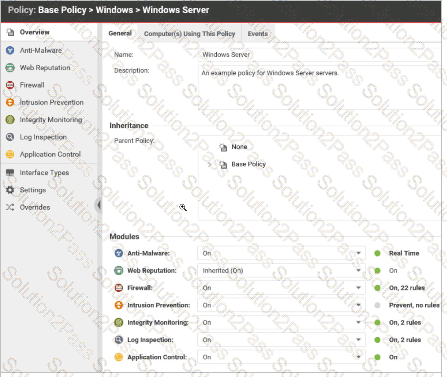
A.

In this example, the state for the Web Reputation Protection Module is inherited from the parent policy, while the other Protection Modules were turned on specifically in this child policy.

B.

The state for a Protection Module is always displayed as "Inherited (On)" until the module components are installed on the Deep Security Agent.

C.

In this example, the state for the Web Reputation Protection Module is inherited from the parent policy, while the other Protection Modules were turned on at the computer level.

D.

In this example, the state for the Web Reputation Protection Module is listed as "In-herited (On)" as it was inherited from the default setting in the Base Policy.

Where does Deep Security Manager store the credentials it uses to access the database?

A.

In the logging.properties file

B.

In the dsm.properties file

C.

In the Windows Registry

D.

In the database.properties file

How is scan caching used in agentless implementations of Deep Security?

A.

Scan caching maintains the Inclusions and Exclusions lists from the Malware Scan Configuration in memory to improve performance.

B.

Scan caching manages resource usage by staggering the launch of malware scans to prevent scan storms

C.

Scan caching is used in Agent-based installations only and is not supported in an agentless implementation.

D.

Scan caching enhances the performance of the Deep Security Virtual Appliance in that files scanned for malware on a virtual machine that appear on other virtual machines may not need to be scanned again.

Which of the following statements is true regarding the Log Inspection Protection Module?

A.

Deep Security Agents forward Log Inspection Event details to Deep Security Manager in real time.

B.

Log Inspection can only examine new Events and cannot examine logs entries created before the Protection Module was enabled.

C.

Log Inspection can only examine Deep Security log information.

D.

The Log Inspection Protection Module is supported in both Agent-based and Agentless implementations.

New servers are added to the Computers list in Deep Security Manager Web config by running a Discover operation. What behavior can you expect for newly discovered computers?

A.

Any servers discovered in the selected Active Directory branch hosting a Deep Security Agent will be added to the Computers list.

B.

Any servers within the IP address range hosting a Deep Security Agent will be added to the Computers list.

C.

Any servers within the IP address range that are hosting Deep Security Agents will be added to the Computers list and will be automatically activated.

D.

Any servers within the IP address range will be added to the Computers list, regardless of whether they are hosting a Deep Security Agent or not.

The Firewall Protection Module is enabled on a server through the computer details. What is default behavior of the Firewall if no rules are yet applied?

A.

All traffic is permitted through the firewall until either a Deny or Allow rule is assigned.

B.

A collection of default rules will automatically be assigned when the Firewall Protection Module is enabled.

C.

All traffic is blocked by the firewall until an Allow rule is assigned.

D.

All traffic is passed through the Firewall using a Bypass rule

Which of the following statements correctly identifies the purpose of the Integrity Monitoring Protection Module?

A.

The Integrity Monitoring Protection Module monitors traffic to verify the integrity of incoming traffic to identify protocol deviations, packets fragments and other protocol anomalies.

B.

The Integrity Monitoring Protection Module monitors critical operating system objects such as services, processes, registry keys and ports to detect and report malicious or unexpected changes.

C.

The Integrity Monitoring Protection Module monitors incoming traffic to confirm the integrity of header information including packet source and destination details.

D.

The Integrity Monitoring Protection Module monitors and analyzes the integrity of application logs to identify tampering, corruption and other suspicious modifications to the logs.

Which of the following statements is true regarding Deep Security Relays?

A.

Both 32-bit and 64-bit Deep Security Agents can be promoted to a Deep Security Relay.

B.

Deep Security Agents promoted to Deep Security Relays no longer provide the security capabilities enabled by the Protection Modules.

C.

Deep Security Relays are able to process Deep Security Agent requests during updates.

D.

Deep Security Agents communicate with Deep Security Relays to obtain security updates.

Copyright © 2014-2025 Solution2Pass. All Rights Reserved