Pre-Summer Sale Special - Limited Time 70% Discount Offer - Ends in 0d 00h 00m 00s - Coupon code: xmaspas7

Easiest Solution 2 Pass Your Certification Exams

AgilePM-Practitioner APMG-International Agile Project Management (AgilePM) Practitioner Exam Free Practice Exam Questions (2026 Updated)

Prepare effectively for your APMG-International AgilePM-Practitioner Agile Project Management (AgilePM) Practitioner Exam certification with our extensive collection of free, high-quality practice questions. Each question is designed to mirror the actual exam format and objectives, complete with comprehensive answers and detailed explanations. Our materials are regularly updated for 2026, ensuring you have the most current resources to build confidence and succeed on your first attempt.

Which information could be recorded on an ‘empathy map’ for the marketing staff?

A.

The Promotions Team Leader has noted that staff have raised concerns about how the change may reduce their sales during the seasonal promotions.

B.

The Marketing Manager has identified potential stakeholders, drawn symbolic figures of each of them and positioned them on a visual diagram.

C.

The Marketing analyst staff have made a list of potential stakeholders and plan to share this with everyone else at the next sales meeting.

D.

During a meeting of Brand Team Leaders, each participant created a list of stakeholders and then compared these lists in small groups.

The Legal Specialist has reviewed the plans for the rebranding work and has assessed how this will affect current and future contracts. They are now pressing the Change Manager to establish the deadlines and to schedule when their input will be most needed.

Which preference does this behavior BEST display?

A.

Thinking.

B.

Feeling.

C.

Judging.

D.

Perceiving.

As Sprint 5 comes to an end, the Infrastructure Delivery Team is facing delays due to:

. Heavy rainfall affecting the Wellness Garden.

. Local supplier issues causing material delivery delays.

· Dependency on external contractors for hydrotherapy equipment.

The Operations Delivery Team is unable to finalize details of the hydrotherapy treatments without testing them in the

context of the facilities being constructed. The marketing materials cannot be generated until this work is complete.

In addition to the Developers, the teams include:
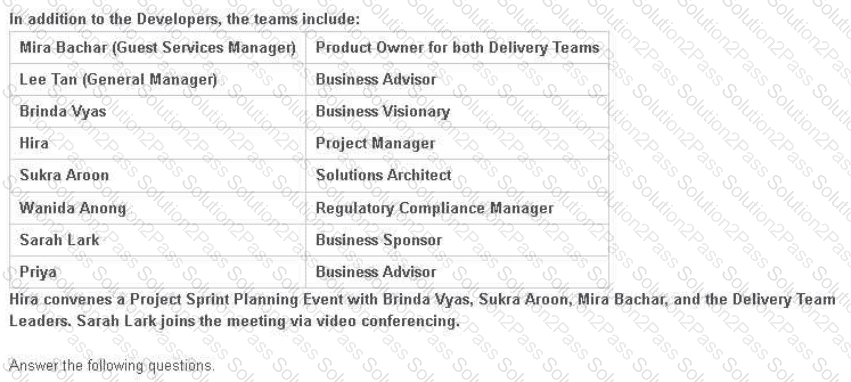
(The Wellness Garden (a Should Have) is delayed. Sukra Aroon suggests a workaround, using the River Pool Patio instead, and classifying the Garden as a ' Won ' t Have this time ' .

Is this an appropriate suggestion?)

A.

Yes, because reclassifying the garden reduces risk while maintaining an outdoor option.

B.

Yes, because unresolved dependencies justify removing requirements to prevent disruption.

C.

No, because a Should Have requirement should NOT be removed unless it threatens the delivery of a Must Have.

D.

No, because workarounds reduce quality and undermine the business case.

(Wanida Anong, working on some compliance issue in India, has limited availability to work with the Southeast Asia Delivery Teams.

Which 2 statements describe how this risk should be handled within the AgilePM framework?)

A.

Hira should coordinate a communication plan to ensure the Delivery Team has timely access to Wanida ' s expertise based on her availability.

B.

Hira should escalate to Sarah Lark, the Business Sponsor, to allocate more compliance resources and protect the projects integrity.

C.

Hira should use the Risk Log to record risks and delay compliance-sensitive features until Wanida Anong is available.

D.

The Delivery Team should compile key compliance questions in advance and send in batches to Wanida Anong to minimize real-time communication needs.

E.

The Delivery Team should proceed with assumptions and review with Wanida Anong at the end of the increment to minimize delays.

Towards the end of the Foundations phase of Project Increment 4, with the high-level requirements agreed, Hira, has asked the Developers to estimate the work required to deliver the Eco spa solution.
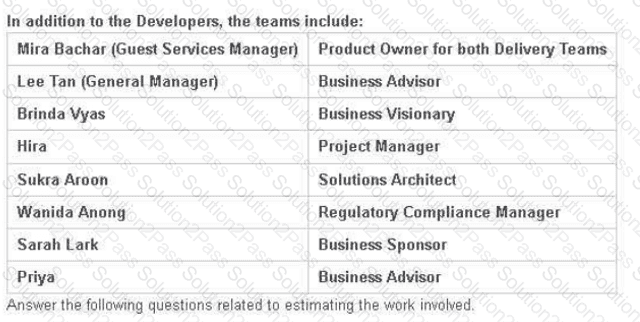
(Having provided some sample estimates for Hira to review, a number of stakeholders have challenged their accuracy—some suggesting that the work has been significantly over-estimated, while others believe it has been significantly under-estimated.

What should the Developers do?)

A.

Explain that early estimates are inherently uncertain and that they will be refined progressively as more details emerge throughout the project.

B.

Defend their estimates as accurate, assuring stakeholders that the numbers provided are fixed and reliable for planning purposes.

C.

Adjust estimates to align with stakeholder expectations, increasing or decreasing them based on their concerns to gain buy-in.

D.

Document key assumptions behind the estimates to provide transparency of rationale and support further refinement as more information becomes available.

Brinda Vyas and Mira Bachar have agreed to use content from a marketing brochure to describe guest-centric Product Goals for the Eco-Spa. These goals describe specific treatments that the Spa might offer and will be used to identify prioritizable Product Backlog items that could contribute to that treatment. One such Product Goal is described as:

Hydrotherapy in Mineral-Rich Spring Pools

Immerse yourself in mineral-rich hydrotherapy pools designed to soothe muscies, improve circulation, and promote

deep relaxation. Experience the gentle power of temperature-controlled waters and therapeutic massage jets in a lush

and tranquil tropical garden setting and let nature ' s healing embrace rejuvenate both your body and your mind.

In addition to the Developers, the teams include:
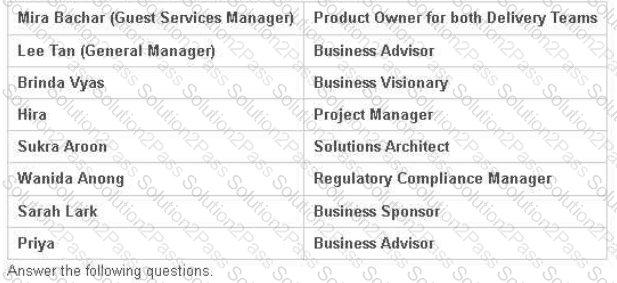
(Which of the following actions is NOT appropriate when using when using MoSCoW prioritization to manage business expectations related to the ' Hydrotherapy in Mineral-Rich Spring Pools ' Product Goal?)

A.

Ensure Product Backlog items are MoSCoW prioritized to align with business needs and expectations.

B.

Ensure that Product Backlog item prioritization reflects a balance between business value, technical feasibility, expectations, risk and dependencies.

C.

Review the prioritization of Product Backlog items periodically to maintain ongoing alignment of planned work with evolving business needs and project viability.

D.

Assume that all Must Have requirements and Should Have requirements in the Product Backlog will be delivered as they are part of the Business Case.

Brinda Vyas and Mira Bachar have agreed to use content from a marketing brochure to describe guest-centric Product Goals for the Eco-Spa. These goals describe specific treatments that the Spa might offer and will be used to identify prioritizable Product Backlog items that could contribute to that treatment. One such Product Goal is described as:

Hydrotherapy in Mineral-Rich Spring Pools

Immerse yourself in mineral-rich hydrotherapy pools designed to soothe muscies, improve circulation, and promote

deep relaxation. Experience the gentle power of temperature-controlled waters and therapeutic massage jets in a lush

and tranquil tropical garden setting and let nature ' s healing embrace rejuvenate both your body and your mind.

In addition to the Developers, the teams include:
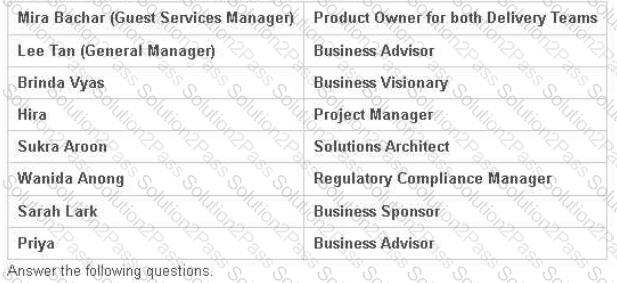
(Which one of the following actions will ensure that Product Backlog items for the Hydrotherapy infrastructure remain aligned with the planned treatment experience throughout development?)

A.

The Infrastructure Team should regularly review and refine Backlog items with Mira Bachar to maintain alignment.

B.

Lock all Backlog items after initial prioritization to prevent scope change and allow the Infrastructure Team to focus on delivering them.

C.

Frequently reassess the priority of Product Backlog items to ensure the Infrastructure Team remain focused on the highest value features.

D.

Encourage the Infrastructure Team to prioritize features for the hydrotherapy treatments since they understand what can be achieved within each Sprint.

(At the Sprint Review for Sprint 3, it became clear that the Spa infrastructure will not support hydrotherapy treatments. The equipment is unable to chill the plunge pool, making these treatments ineffective.

Demonstrating Agile Leadership and Collaboration, what action should have taken place during the Project Sprint Planning Event to prevent this?)

A.

Mira Bachar and Lee Tan should have worked together to integrate stakeholder feedback into the Product Backlogs before the next Sprint.

B.

Mira Bachar should have amended the Product Backlogs to include explicit hydrotherapy infrastructure requirements for both Delivery Teams.

C.

Hira should have ensured transparency of the Delivery Plan so each Delivery Team could plan the remainder of their Sprints accordingly.

D.

Hira should have worked with Sukra Aroon to adjust project timelines to give flexibility to the Infrastructure Team and Treatments Teams before the next Sprint.

E.

Sukra Aroon should have documented hydrotherapy infrastructure requirements in the Solution Architecture Definition so the two Delivery Teams were aligned.

F.

Sukra Aroon and Mira Bachar should have collaborated to prioritize and communicate hydrotherapy requirements to the Infrastructure Team.

G.

Brinda Vyas and Hira should have ensured hydrotherapy treatments were align with business strategy.

(During the Foundations phase, Lee Tan raised concerns about the lack of detailed upfront requirements for the Eco-spa, fearing confusion, constant changes, uncertainty and inefficiency.)

A.

Approach-based, because there is lack of clarity of purpose preventing development from starting.

B.

Approach-based, because Lee should understand AgilePM uses iterative development and increment delivery, translating high-level requirements into valuable solutions.

C.

VUCA-based, because market shifts and changing guest expectations require detailed definition of requirements.

D.

VUCA-based, because external sustainability pressures create uncertainty that requires a flexible scope.

(Sukra Aroon wants to ensure alignment between the emerging Spa infrastructure and innovative spa treatments being developed.

Which approach effectively combines Agile Leadership with practical application?)

A.

Empower Team Leaders to resolve dependencies, escalating major issues to Sukra for a solution-wide view if needed.

B.

Empower Team Leaders to independently handle alignment through informal discussions, documenting key decisions for later review.

C.

Encourage Delivery Teams to define shared acceptance criteria for interdependent deliverables ensuring alignment on needs.

D.

Encourage Delivery Teams to define shared acceptance criteria for interdependent deliverables and Brinda approving.

E.

Hold a joint Retrospective after each Sprint to review alignment and identify remedial actions to ensure alignment.

F.

Hold a joint Retrospective after each Sprint so Team Leaders can share learning and provide feedback.

G.

Use hierarchical reporting where decisions would be documented collaboratively between Brinda Vyas, Mira Bachar, Hira and Sukra Aroon.

Mira Bachar has spoken with a guest who wanted an aromatherapy scent to remember their holiday. Inspired by this, Mira suggested creating a unique aromatherapy oil for spa treatments and guest sales, which could also serve as a marketing tool.

Brinda Vyas supports exploring the idea, but Sukra Aroon notes that selling products is not in scope and could introduce complexities.
(Hira is holding a series of 2-hour estimation workshops for Project Increment 4.

Which 2 of the following instructions provide appropriate guidance to the workshop attendees?)

A.

Develop task-level estimates for all work within the Project Increment.

B.

Use Planning Poker to generate precise estimates for infrastructure, treatments, and IT.

C.

Allow flexibility and accept uncertainty in estimates that may be refined later.

D.

Ensure estimates are fixed and precise to maintain accountability.

E.

Use team-based estimation techniques as collective knowledge will improve accuracy.

As Sprint 5 comes to an end, the Infrastructure Delivery Team is facing delays due to:

. Heavy rainfall affecting the Wellness Garden.

. Local supplier issues causing material delivery delays.

· Dependency on external contractors for hydrotherapy equipment.

The Operations Delivery Team is unable to finalize details of the hydrotherapy treatments without testing them in the

context of the facilities being constructed. The marketing materials cannot be generated until this work is complete.

In addition to the Developers, the teams include:
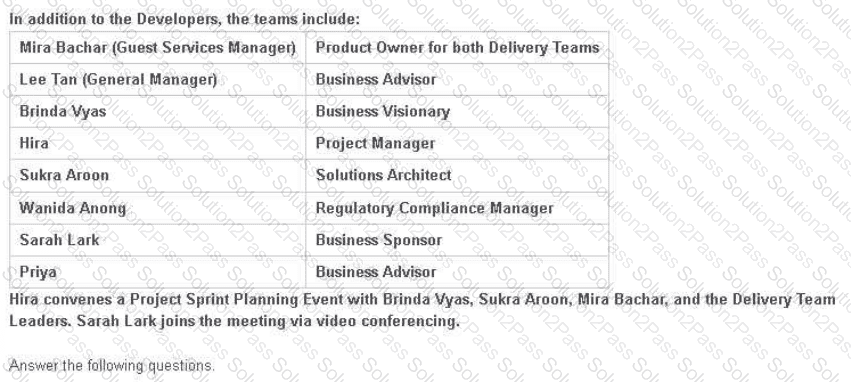
(It is appropriate that the Delivery Team Leaders attend this Project Sprint Planning Event?)

A.

Yes, because AgilePM mandates joint decision-making between leadership and Delivery Teams.

B.

Yes, because Team Leaders provide real-time insights on progress, risks, and dependencies.

C.

No, because Team Leaders should focus on development work, not planning meetings.

D.

No, because planning should be handled by project leaders, with Team Leaders informed later.

(In the Ecolodge Panthera Resort (EPR) Project, answer the following questions about risk management.

In addition to the Developers, the teams include:

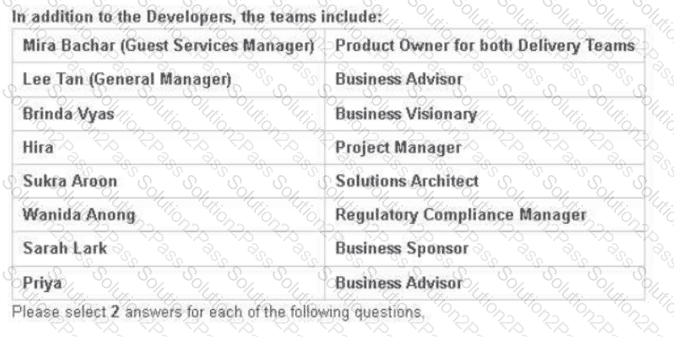
Mira Bachar (Guest Services Manager) – Product Owner for both Delivery Teams

Lee Tan (General Manager) – Business Advisor

Brinda Vyas – Business Visionary

Hira – Project Manager

Sukra Aroon – Solutions Architect

Wanida Anong – Regulatory Compliance Manager

Sarah Lark – Business Sponsor

Priya – Business Advisor

Select 2 answers to each question.

Which 2 statements describe the application of AgilePM ' s approach to managing risk?)

A.

AgilePM allows Mira Bachar to adjust Backlog priorities with advice from Sukra Aroon and Hira to address risks.

B.

AgilePM removes all risks before execution, prioritizing avoidance over mitigation.

C.

AgilePM embeds risk management in processes, proactively addressing risks at multiple levels.

D.

AgilePM leverages Sprint Reviews and feedback loops to surface and mitigate risks.

E.

AgilePM assigns risk management solely to the Project Manager, Hira.)

As Sprint 5 comes to an end, the Infrastructure Delivery Team is facing delays due to:

. Heavy rainfall affecting the Wellness Garden.

. Local supplier issues causing material delivery delays.

· Dependency on external contractors for hydrotherapy equipment.

The Operations Delivery Team is unable to finalize details of the hydrotherapy treatments without testing them in the

context of the facilities being constructed. The marketing materials cannot be generated until this work is complete.

In addition to the Developers, the teams include:
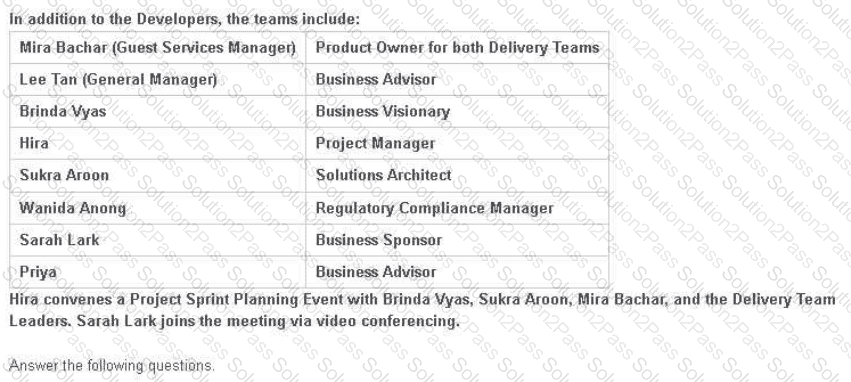
(Hira decides to update the Delivery Plan to prioritize the delivery of the hydrotherapy facilities first for early testing.

Is this action appropriate?)

A.

Yes, because the Delivery Plan should adapt to real-world conditions.

B.

Yes, because all sequencing changes should be documented in the Delivery Plan.

C.

No, because the Delivery Plan is fixed after the Foundations phase unless a Must Have requirement is at risk.

D.

No, because sequencing should be a collaborative decision, not determined by Hira alone.

(New food hygiene laws take effect in six months. Sukra Aroon and Wanida Anong are assessing if kitchen remodeling is needed, which may divert Infrastructure Team resources.)

A.

Approach-based, because past Project Increment planning failed to account for regulatory change, causing lack of contingency and resource risks.

B.

Approach-based, because Sukra Aroon should have tracked evolving legislation from the start to mitigate the risk.

C.

VUCA-based, because new legislation is an external factor requiring adaptability to respond to unplanned demands.

D.

VUCA-based, because gaps in internal compliance cause uncertainty in responding to changing regulations.

Copyright © 2014-2026 Solution2Pass. All Rights Reserved