Cyber Monday Sale Special - Limited Time 70% Discount Offer - Ends in 0d 00h 00m 00s - Coupon code: xmaspas7

Easiest Solution 2 Pass Your Certification Exams

SPI ARDMS Sonography Principles and Instrumentation Free Practice Exam Questions (2025 Updated)

Prepare effectively for your ARDMS SPI Sonography Principles and Instrumentation certification with our extensive collection of free, high-quality practice questions. Each question is designed to mirror the actual exam format and objectives, complete with comprehensive answers and detailed explanations. Our materials are regularly updated for 2025, ensuring you have the most current resources to build confidence and succeed on your first attempt.

Page: 3 / 3
Total 187 questions

Which control determines the amount of amplification occurring in the receiver?

A.

Output power

B.

Overall gain

C.

Dynamic range

D.

Persistence

What is effected by increasing the color scale?

A.

The Nyquist limit is increased

B.

More colors are displayed

C.

The color box width decreases

D.

The color priority decreases

What is the primary determining factor of a pulsed wave transducer's fundamental frequency?

A.

Element thickness

B.

Aperture size

C.

Tissue propagation speed

D.

Transducer type

Which adjustment can maintain the same frame rate when the depth is increased?

A.

Increase number of focal zones

B.

Decrease image width

C.

Increase frequency

D.

Decrease persistence

What is a potential negative consequence of using a high wall filter?

A.

Desired signal may be eliminated

B.

Aliasing could occur

C.

Penetration is reduced

D.

Too much noise may appear on the image

Which unfocused transducer will have the greatest divergence?

A.

4 mm aperture, 4 MHz

B.

4 mm aperture, 6 MHz

C.

6 mm aperture, 4 MHz

D.

6 mm aperture, 6 MHz

Which system control adjusts amplification of signals as a function of depth?

A.

Output power

B.

Time gain compensation

C.

Transmit focus

D.

Reject

Which settings will lead to the highest temporal resolution?

A.

45-degree sector width, 4 cm scan depth, color Doppler off

B.

60-degree sector width, 5 cm scan depth, color Doppler off

C.

45-degree sector width, 4 cm scan depth, color Doppler on

D.

60-degree sector width, 5 cm scan depth, color Doppler on

Which control should a sonographer use to change contrast resolution?

A.

Reject

B.

Output power

C.

Gain

D.

Dynamic range

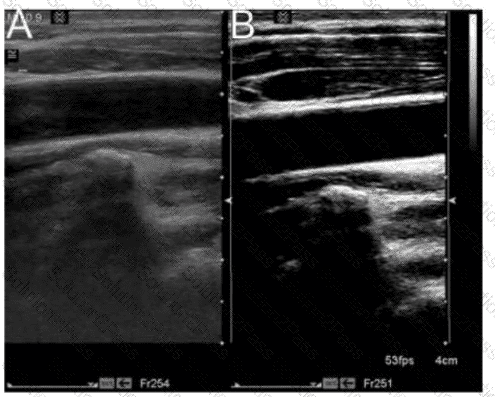
Which type of resolution is improved by transmit focus?
A.

Elevational

B.

Axial

C.

Lateral

D.

Temporal

Which factor improves axial resolution?

A.

Shorter spatial pulse length

B.

Lower frequency transducer

C.

Narrower beamwidth

D.

Decreased compression

Which change improves temporal resolution during color flow imaging?

A.

Increase field of view

B.

Decrease transmit frequency

C.

Decrease packet size

D.

Increase line density

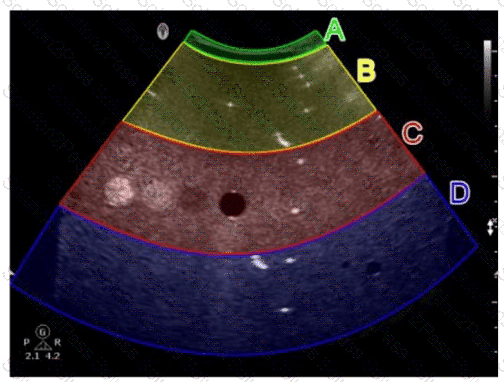
In this image obtained from a tissue-mimicking phantom, which area of the sector is used to evaluate the dead zone?
A.

Option A

B.

Option B

C.

Option C

D.

Option D

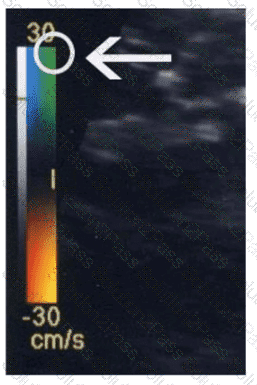
In this image, which characteristics of flow are represented by the upper right side of a variance mode color map?
A.

Higher velocity, laminar with a positive Doppler shift

B.

Higher velocity, laminar with a negative Doppler shift

C.

Higher velocity, turbulent with a positive Doppler shift

D.

Higher velocity, turbulent with a negative Doppler shift

Which type of resolution does damping improve?

A.

Lateral

B.

Contrast

C.

Temporal

D.

Axial

Page: 3 / 3
Total 187 questions
Copyright © 2014-2025 Solution2Pass. All Rights Reserved