Spring Sale Special - Limited Time 70% Discount Offer - Ends in 0d 00h 00m 00s - Coupon code: xmaspas7

Easiest Solution 2 Pass Your Certification Exams

MLA-C01 Amazon Web Services AWS Certified Machine Learning Engineer - Associate Free Practice Exam Questions (2026 Updated)

Prepare effectively for your Amazon Web Services MLA-C01 AWS Certified Machine Learning Engineer - Associate certification with our extensive collection of free, high-quality practice questions. Each question is designed to mirror the actual exam format and objectives, complete with comprehensive answers and detailed explanations. Our materials are regularly updated for 2026, ensuring you have the most current resources to build confidence and succeed on your first attempt.

Page: 1 / 4
Total 207 questions

An ML engineer needs to organize a large set of text documents into topics. The ML engineer will not know what the topics are in advance. The ML engineer wants to use built-in algorithms or pre-trained models available through Amazon SageMaker AI to process the documents.

Which solution will meet these requirements?

A.

Use the BlazingText algorithm to identify the relevant text and to create a set of topics based on the documents.

B.

Use the Sequence-to-Sequence algorithm to summarize the text and to create a set of topics based on the documents.

C.

Use the Object2Vec algorithm to create embeddings and to create a set of topics based on the embeddings.

D.

Use the Latent Dirichlet Allocation (LDA) algorithm to process the documents and to create a set of topics based on the documents.

An ML engineer has an Amazon Comprehend custom model in Account A in the us-east-1 Region. The ML engineer needs to copy the model to Account В in the same Region.

Which solution will meet this requirement with the LEAST development effort?

A.

Use Amazon S3 to make a copy of the model. Transfer the copy to Account B.

B.

Create a resource-based IAM policy. Use the Amazon Comprehend ImportModel API operation to copy the model to Account B.

C.

Use AWS DataSync to replicate the model from Account A to Account B.

D.

Create an AWS Site-to-Site VPN connection between Account A and Account В to transfer the model.

A company regularly receives new training data from a vendor of an ML model. The vendor delivers cleaned and prepared data to the company’s Amazon S3 bucket every 3–4 days.

The company has an Amazon SageMaker AI pipeline to retrain the model. An ML engineer needs to run the pipeline automatically when new data is uploaded to the S3 bucket.

Which solution will meet these requirements with the LEAST operational effort?

A.

Create an S3 lifecycle rule to transfer the data to the SageMaker AI training instance and initiate training.

B.

Create an AWS Lambda function that scans the S3 bucket and initiates the pipeline when new data is uploaded.

C.

Create an Amazon EventBridge rule that matches S3 upload events and configures the SageMaker pipeline as the target.

D.

Use Amazon Managed Workflows for Apache Airflow (MWAA) to orchestrate the pipeline when new data is uploaded.

An ML engineer uses one ML framework to train multiple ML models. The ML engineer needs to optimize inference costs and host the models on Amazon SageMaker AI.

Which solution will meet these requirements MOST cost-effectively?

A.

Create a multi-container inference endpoint for direct invocation.

B.

Create a multi-model inference endpoint for all the models.

C.

Create a multi-container inference endpoint for sequential invocation.

D.

Create multiple single-model inference endpoints for each model.

An ML engineer needs to use AWS services to identify and extract meaningful unique keywords from documents.

Which solution will meet these requirements with the LEAST operational overhead?

A.

Use the Natural Language Toolkit (NLTK) library on Amazon EC2 instances for text pre-processing. Use the Latent Dirichlet Allocation (LDA) algorithm to identify and extract relevant keywords.

B.

Use Amazon SageMaker and the BlazingText algorithm. Apply custom pre-processing steps for stemming and removal of stop words. Calculate term frequency-inverse document frequency (TF-IDF) scores to identify and extract relevant keywords.

C.

Store the documents in an Amazon S3 bucket. Create AWS Lambda functions to process the documents and to run Python scripts for stemming and removal of stop words. Use bigram and trigram techniques to identify and extract relevant keywords.

D.

Use Amazon Comprehend custom entity recognition and key phrase extraction to identify and extract relevant keywords.

A company is using Amazon SageMaker and millions of files to train an ML model. Each file is several megabytes in size. The files are stored in an Amazon S3 bucket. The company needs to improve training performance.

Which solution will meet these requirements in the LEAST amount of time?

A.

Transfer the data to a new S3 bucket that provides S3 Express One Zone storage. Adjust the training job to use the new S3 bucket.

B.

Create an Amazon FSx for Lustre file system. Link the file system to the existing S3 bucket. Adjust the training job to read from the file system.

C.

Create an Amazon Elastic File System (Amazon EFS) file system. Transfer the existing data to the file system. Adjust the training job to read from the file system.

D.

Create an Amazon ElastiCache (Redis OSS) cluster. Link the Redis OSS cluster to the existing S3 bucket. Stream the data from the Redis OSS cluster directly to the training job.

An ML engineer needs to deploy ML models to get inferences from large datasets in an asynchronous manner. The ML engineer also needs to implement scheduled monitoring of the data quality of the models. The ML engineer must receive alerts when changes in data quality occur.

Which solution will meet these requirements?

A.

Deploy the models by using scheduled AWS Glue jobs. Use Amazon CloudWatch alarms to monitor the data quality and to send alerts.

B.

Deploy the models by using scheduled AWS Batch jobs. Use AWS CloudTrail to monitor the data quality and to send alerts.

C.

Deploy the models by using Amazon Elastic Container Service (Amazon ECS) on AWS Fargate. Use Amazon EventBridge to monitor the data quality and to send alerts.

D.

Deploy the models by using Amazon SageMaker AI batch transform. Use SageMaker Model Monitor to monitor the data quality and to send alerts.

A company is using Amazon SageMaker AI to build an ML model to predict customer behavior. The company needs to explain the bias in the model to an auditor. The explanation must focus on demographic data of the customers.

Which solution will meet these requirements?

A.

Use SageMaker Clarify to generate a bias report. Send the report to the auditor.

B.

Use AWS Glue DataBrew to create a job to detect drift in the model's data quality. Send the job output to the auditor.

C.

Use Amazon QuickSight integration with SageMaker AI to generate a bias report. Send the report to the auditor.

D.

Use Amazon CloudWatch metrics from the SageMaker AI namespace to create a bias dashboard. Share the dashboard with the auditor.

A company needs to deploy a custom-trained classification ML model on AWS. The model must make near real-time predictions with low latency and must handle variable request volumes.

Which solution will meet these requirements?

A.

Create an Amazon SageMaker AI batch transform job to process inference requests in batches.

B.

Use Amazon API Gateway to receive prediction requests. Use an Amazon S3 bucket to host and serve the model.

C.

Deploy an Amazon SageMaker AI endpoint. Configure auto scaling for the endpoint.

D.

Launch AWS Deep Learning AMIs (DLAMI) on two Amazon EC2 instances. Run the instances behind an Application Load Balancer.

An ML engineer develops a neural network model to predict whether customers will continue to subscribe to a service. The model performs well on training data. However, the accuracy of the model decreases significantly on evaluation data.

The ML engineer must resolve the model performance issue.

Which solution will meet this requirement?

A.

Penalize large weights by using L1 or L2 regularization.

B.

Remove dropout layers from the neural network.

C.

Train the model for longer by increasing the number of epochs.

D.

Capture complex patterns by increasing the number of layers.

A company is planning to create several ML prediction models. The training data is stored in Amazon S3. The entire dataset is more than 5 ТВ in size and consists of CSV, JSON, Apache Parquet, and simple text files.

The data must be processed in several consecutive steps. The steps include complex manipulations that can take hours to finish running. Some of the processing involves natural language processing (NLP) transformations. The entire process must be automated.

Which solution will meet these requirements?

A.

Process data at each step by using Amazon SageMaker Data Wrangler. Automate the process by using Data Wrangler jobs.

B.

Use Amazon SageMaker notebooks for each data processing step. Automate the process by using Amazon EventBridge.

C.

Process data at each step by using AWS Lambda functions. Automate the process by using AWS Step Functions and Amazon EventBridge.

D.

Use Amazon SageMaker Pipelines to create a pipeline of data processing steps. Automate the pipeline by using Amazon EventBridge.

A company is using an Amazon Redshift database as its single data source. Some of the data is sensitive.

A data scientist needs to use some of the sensitive data from the database. An ML engineer must give the data scientist access to the data without transforming the source data and without storing anonymized data in the database.

Which solution will meet these requirements with the LEAST implementation effort?

A.

Configure dynamic data masking policies to control how sensitive data is shared with the data scientist at query time.

B.

Create a materialized view with masking logic on top of the database. Grant the necessary read permissions to the data scientist.

C.

Unload the Amazon Redshift data to Amazon S3. Use Amazon Athena to create schema-on-read with masking logic. Share the view with the data scientist.

D.

Unload the Amazon Redshift data to Amazon S3. Create an AWS Glue job to anonymize the data. Share the dataset with the data scientist.

A company has developed a new ML model. The company requires online model validation on 10% of the traffic before the company fully releases the model in production. The company uses an Amazon SageMaker endpoint behind an Application Load Balancer (ALB) to serve the model.

Which solution will set up the required online validation with the LEAST operational overhead?

A.

Use production variants to add the new model to the existing SageMaker endpoint. Set the variant weight to 0.1 for the new model. Monitor the number of invocations by using Amazon CloudWatch.

B.

Use production variants to add the new model to the existing SageMaker endpoint. Set the variant weight to 1 for the new model. Monitor the number of invocations by using Amazon CloudWatch.

C.

Create a new SageMaker endpoint. Use production variants to add the new model to the new endpoint. Monitor the number of invocations by using Amazon CloudWatch.

D.

Configure the ALB to route 10% of the traffic to the new model at the existing SageMaker endpoint. Monitor the number of invocations by using AWS CloudTrail.

An ML engineer needs to use an ML model to predict the price of apartments in a specific location.

Which metric should the ML engineer use to evaluate the model's performance?

A.

Accuracy

B.

Area Under the ROC Curve (AUC)

C.

F1 score

D.

Mean absolute error (MAE)

A company has deployed an XGBoost prediction model in production to predict if a customer is likely to cancel a subscription. The company uses Amazon SageMaker Model Monitor to detect deviations in the F1 score.

During a baseline analysis of model quality, the company recorded a threshold for the F1 score. After several months of no change, the model's F1 score decreases significantly.

What could be the reason for the reduced F1 score?

A.

Concept drift occurred in the underlying customer data that was used for predictions.

B.

The model was not sufficiently complex to capture all the patterns in the original baseline data.

C.

The original baseline data had a data quality issue of missing values.

D.

Incorrect ground truth labels were provided to Model Monitor during the calculation of the baseline.

An ML engineer must choose the appropriate Amazon SageMaker algorithm to solve specific AI problems.

Select the correct SageMaker built-in algorithm from the following list for each use case. Each algorithm should be selected one time.

• Random Cut Forest (RCF) algorithm

• Semantic segmentation algorithm

• Sequence-to-Sequence (seq2seq) algorithm

An ML engineer is developing a neural network to run on new user data. The dataset has dozens of floating-point features. The dataset is stored as CSV objects in an Amazon S3 bucket. Most objects and columns are missing at least one value. All features are relatively uniform except for a small number of extreme outliers. The ML engineer wants to use Amazon SageMaker Data Wrangler to handle missing values before passing the dataset to the neural network.

Which solution will provide the MOST complete data?

A.

Drop samples that are missing values.

B.

Impute missing values with the mean value.

C.

Impute missing values with the median value.

D.

Drop columns that are missing values.

A company needs to combine data from multiple sources. The company must use Amazon Redshift Serverless to query an AWS Glue Data Catalog database and underlying data that is stored in an Amazon S3 bucket.

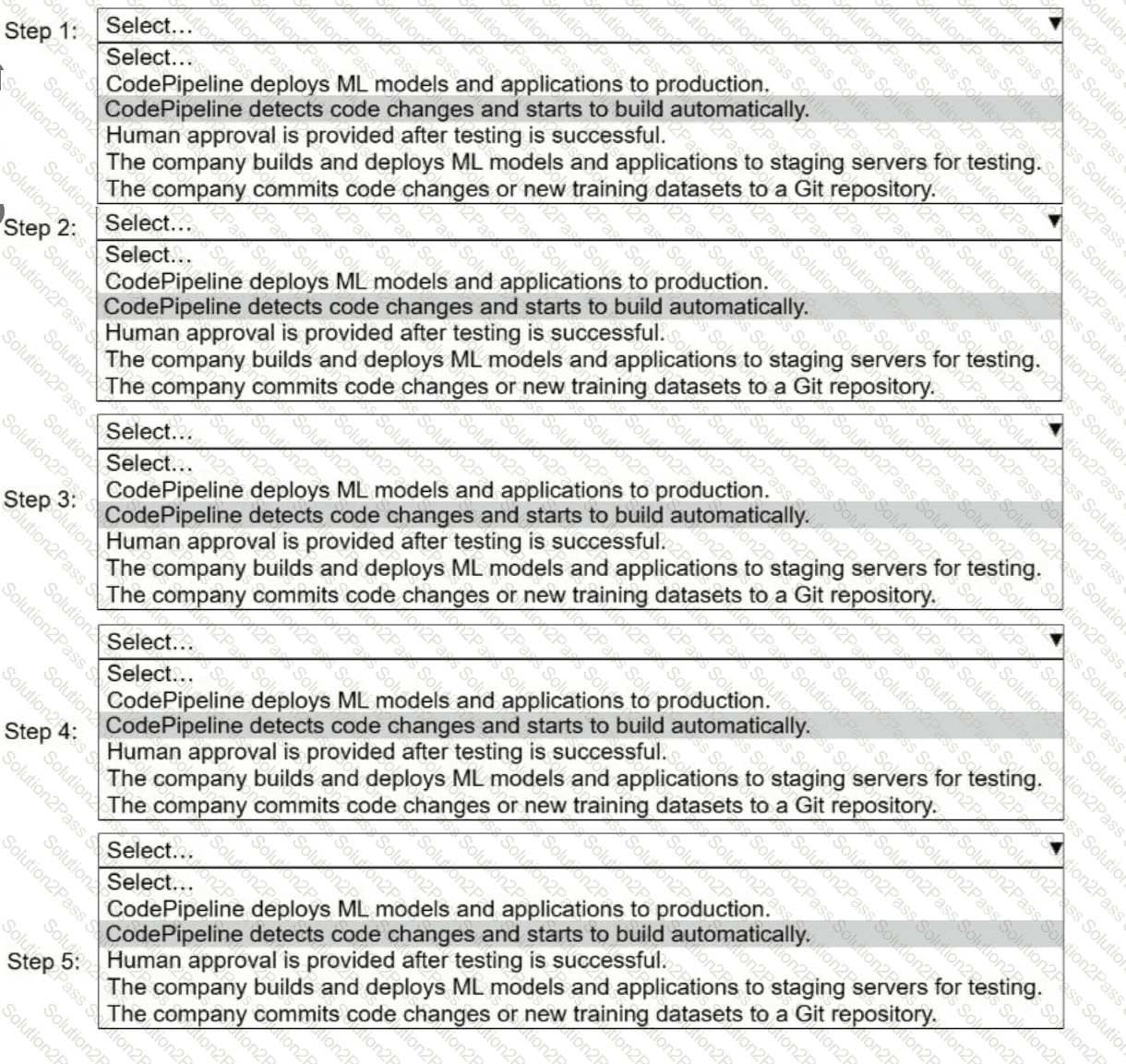
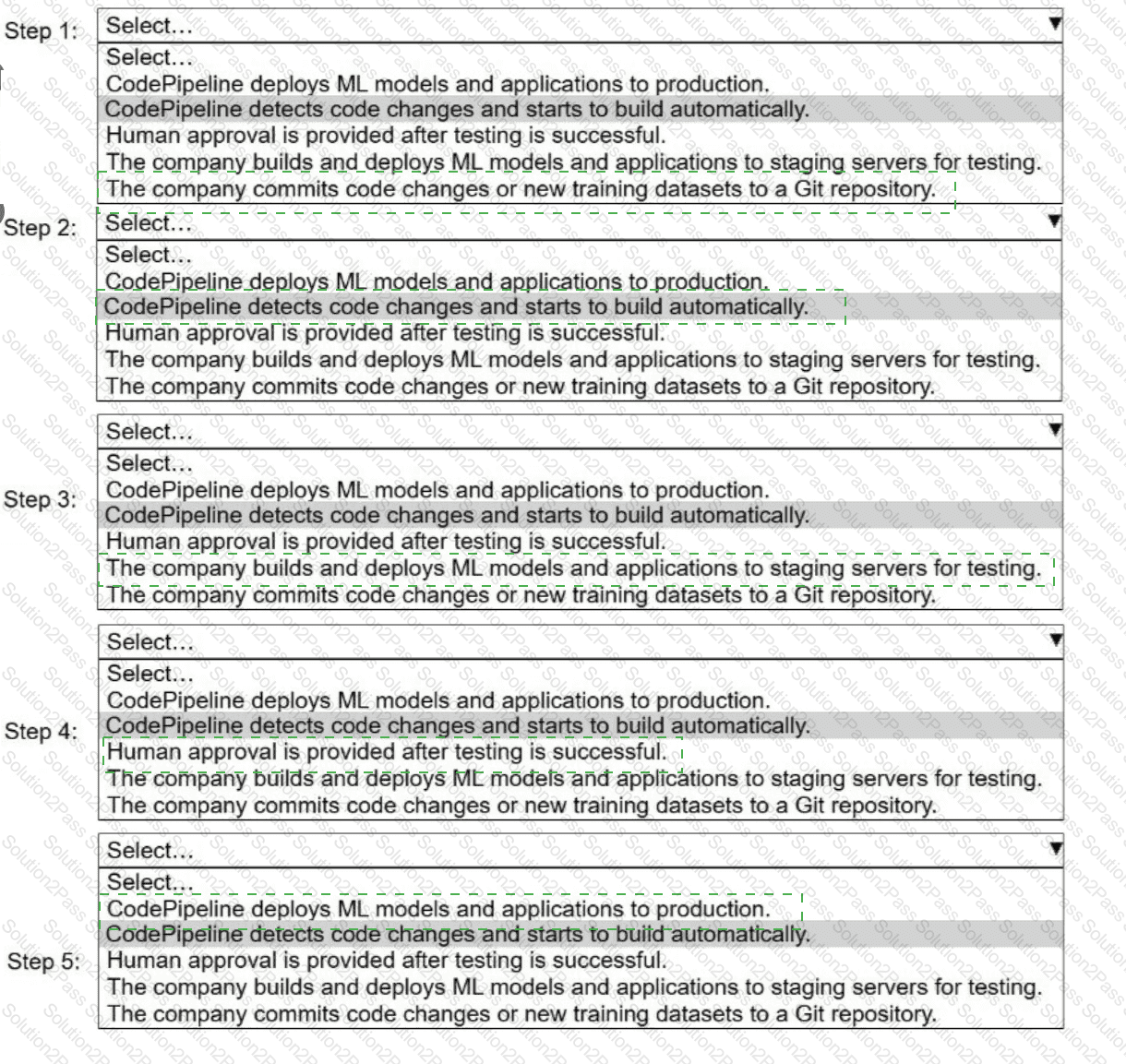
Select and order the correct steps from the following list to meet these requirements. Select each step one time or not at all. (Select and order three.)

• Attach the IAM role to the Redshift cluster.

• Attach the IAM role to the Redshift namespace.

• Create an external database in Amazon Redshift to point to the Data Catalog schema.

• Create an external schema in Amazon Redshift to point to the Data Catalog database.

• Create an IAM role for Amazon Redshift to use to access only the S3 bucket that contains underlying data.

• Create an IAM role for Amazon Redshift to use to access the Data Catalog and the S3 bucket that contains underlying data.

A travel company has trained hundreds of geographic data models to answer customer questions by using Amazon SageMaker AI. Each model uses its own inferencing endpoint, which has become an operational challenge for the company.

The company wants to consolidate the models' inferencing endpoints to reduce operational overhead.

Which solution will meet these requirements?

A.

Use SageMaker AI multi-model endpoints. Deploy a single endpoint.

B.

Use SageMaker AI multi-container endpoints. Deploy a single endpoint.

C.

Use Amazon SageMaker Studio. Deploy a single-model endpoint.

D.

Use inference pipelines in SageMaker AI to combine tasks from hundreds of models to 15 models.

An ML engineer has trained a neural network by using stochastic gradient descent (SGD). The neural network performs poorly on the test set. The values for training loss and validation loss remain high and show an oscillating pattern. The values decrease for a few epochs and then increase for a few epochs before repeating the same cycle.

What should the ML engineer do to improve the training process?

A.

Introduce early stopping.

B.

Increase the size of the test set.

C.

Increase the learning rate.

D.

Decrease the learning rate.

Page: 1 / 4
Total 207 questions
Copyright © 2014-2026 Solution2Pass. All Rights Reserved