Pre-Winter Sale Special - Limited Time 70% Discount Offer - Ends in 0d 00h 00m 00s - Coupon code: xmaspas7

Easiest Solution 2 Pass Your Certification Exams

CCAR-P Anthropic Claude Certified Architect - Professional Free Practice Exam Questions (2026 Updated)

Prepare effectively for your Anthropic CCAR-P Claude Certified Architect - Professional certification with our extensive collection of free, high-quality practice questions. Each question is designed to mirror the actual exam format and objectives, complete with comprehensive answers and detailed explanations. Our materials are regularly updated for 2026, ensuring you have the most current resources to build confidence and succeed on your first attempt.

Page: 2 / 2
Total 126 questions

A security audit uncovers two issues: (1) all end users share a single API key, and (2) tool calls are executed without logging the initiating user.

Which two mitigations directly address these specific findings? (Select two.)

A.

Validate structured outputs against a schema before downstream actions are executed.

B.

Enforce RBAC at the retrieval layer before content enters the model context.

C.

Move credentials out of the prompt context and resolve them from a server-side secret store.

D.

Add actor attribution to tool-call logs so each call records the initiating user identity.

E.

Replace the shared API key with per-user OAuth tokens carrying scope-restricted permissions.

You are identifying the highest-impact optimization for a deployment whose token cost is dominated by a long, repeated system prompt and a large retrieved context per request.

Which optimization most directly targets the dominant cost driver?

A.

Increase retrieval depth on every request to maximize recall, worsening the dominant cost driver by adding more retrieved tokens per request rather than reducing them.

B.

Add additional repeated content to the system prompt to give the model more guidance.

C.

Move the long, repeated system prompt into a cacheable prefix and trim retrieved context to the spans relevant to each query.

D.

Switch every request to the heaviest available model to maximize output quality, accepting that higher per-request inference cost compounds rather than addresses the dominant cost driver.

You are compiling factors that should drive the choice between Model Context Protocol (MCP), direct API integration, and agent-to-agent handoff.

Which two factors belong on the list? (Select two.)

Each correct answer presents a complete solution.

A.

Whether the vendor publishes detailed reference documentation for each candidate protocol.

B.

Whether the team has prior implementation experience with any of the candidate protocols.

C.

Whether the underlying transport supports encryption in transit between the integrated services.

D.

Whether the integration must be portable across multiple AI clients in the ecosystem.

E.

Whether the interaction is stateless and latency-sensitive or stateful and longer-running.

A revenue projection assistant has missed its monthly cost target by 38 percent. Profiling shows three contributors: a 6,000-token policy preamble repeated on every call (45 percent of cost), retrieval of historical sales chunks averaging 3,000 tokens per call (30 percent), and inference on a flagship-tier model (25 percent). Stakeholders require that projection accuracy remain unchanged.

Which two optimizations should you sequence first to reduce cost without affecting accuracy? (Select two.)

Each correct answer presents part of the solution.

A.

Reduce the number of historical sales chunks retrieved across each query run.

B.

Truncate the policy preamble to remove non-essential clauses from the prompt.

C.

Enable prompt caching on the static policy preamble across the recurring calls.

D.

Switch the workload to a smaller, faster Claude model tier across all queries.

E.

Cache common retrieved sales chunks accessed across many of the daily queries.

An architect is reviewing a Claude-based candidate-screening tool prior to deployment. A stakeholder asserts that because the model was not trained on company data, no bias evaluation is necessary.

Which two responses most accurately challenge this assertion? (Select two.)

A.

Transparency obligations are satisfied by disclosing that an AI system is in use, without further evaluation.

B.

Fairness testing is required only when the training dataset is known to contain protected-class labels.

C.

The model may carry demographic biases from pretraining that manifest in screening outcomes regardless of fine-tuning.

D.

The system should be evaluated on outcome-disparity metrics across protected groups before deployment.

E.

Bias evaluation is unnecessary when the model provider has published a responsible-use policy.

A Claude Architect is reviewing a post-deployment performance report for an AI-assisted legal-document summarization system. The report includes these observations:

    Average summarization time decreased from 47 minutes to 6 minutes per document.

    Associates spend less time on summaries, but overall billable output has not measurably changed.

    Infrastructure costs increased by 22% because redundant retry logic generated additional API calls.

    Some summaries require attorney correction, adding an average of 8 minutes of review per document.

Which analysis correctly attributes each observation to the appropriate business-value pillar?

A.

Observations 1 and 2 both indicate efficiency gains; Observation 3 is a solution-cost issue; Observation 4 is a performance-SLA issue.

B.

Observation 1 is a transformation outcome; Observation 2 is an efficiency gain; Observation 3 is a performance-SLA degradation; Observation 4 is a solution-cost issue.

C.

Observations 1 and 4 together indicate a net performance-SLA improvement; Observation 2 is a transformation gap; Observation 3 is a productivity drain from over-engineering.

D.

Observation 1 indicates an efficiency gain; Observation 2 shows that productivity has not yet been realized; Observation 3 is a solution-cost issue; Observation 4 is an efficiency loss that partially offsets Observation 1.

A Claude architect is auditing configuration scope assignments.

Which two statements correctly identify an appropriate use of user-scope configuration versus other scopes? (Select two.)

A.

Persisting personal editor theme preferences that follow an engineer across projects.

B.

Saving a preferred Claude response language that applies to all repositories the engineer uses.

C.

Enforcing a company-wide policy that disables a feature for all engineers.

D.

Defining MCP server endpoints shared by all contributors to a specific repository.

E.

Storing API authentication keys so they are not committed to version control.

A Claude architect is designing a HIPAA-compliant pipeline that processes patient records.

Which two design decisions directly support HIPAA compliance requirements? (Select two.)

A.

Setting max_tokens to a low value to minimize the volume of text generated per request.

B.

Selecting the highest-capability Claude model to maximize diagnostic accuracy.

C.

Enforcing role-based access controls so that PHI is retrievable only by authorized personnel.

D.

Ensuring patient data is never included in training feedback loops sent to the model provider without a BAA in place.

E.

Using streaming responses to reduce perceived latency for clinical users.

A customer support team has proposed delegating customer refund decisions to a Claude-driven workflow with no human review for refunds under 50 USD. The team ' s reasoning is that small refunds are low-risk and human review would erase the efficiency gain.

Which Delegation-competency principle should guide your response?

A.

Delegation should always include human review on every decision the workflow produces.

B.

Delegation scope should reflect the type of risk involved, not the transaction size alone.

C.

Delegation scope should be set primarily by maximizing efficiency gains across the workflow.

D.

Delegation should be avoided entirely wherever financial transactions occur in the workflow.

You are investigating an MCP server that fails on first launch but succeeds on subsequent runs. System permission dialogs appeared during the first launch.

Which response is most appropriate?

A.

Recognize the first-run permission grant as the cause, document the expected behavior in onboarding guidance, and confirm that subsequent runs succeed.

B.

Reinstall the operating system to clear all permission state without first confirming whether the one-time permission grant caused the failure.

C.

Disable operating-system permission dialogs entirely, accept the resulting security implications, and proceed without confirming whether the failure recurs.

D.

Treat the first-run failure as a permanent fault, replace the MCP server, and do not verify whether subsequent runs succeed.

You are evaluating a Claude-based deployment for adherence to a specific regulation.

Which two steps must be completed BEFORE mapping deployment data flows to specific regulatory clauses? (Select two.)

Each correct answer presents part of the solution.

A.

Compare the in-place controls against the regulatory requirements to identify any compliance gaps.

B.

Identify the applicability of the regulation based on data types, jurisdiction, and audience.

C.

Schedule the remediation work with the engineering team based on the prioritized gap findings.

D.

Document the identified gaps along with recommended remediations and residual risk for sign-off.

E.

Inventory the vendor-provided compliance tooling and confirm which compliance affordances are in place.

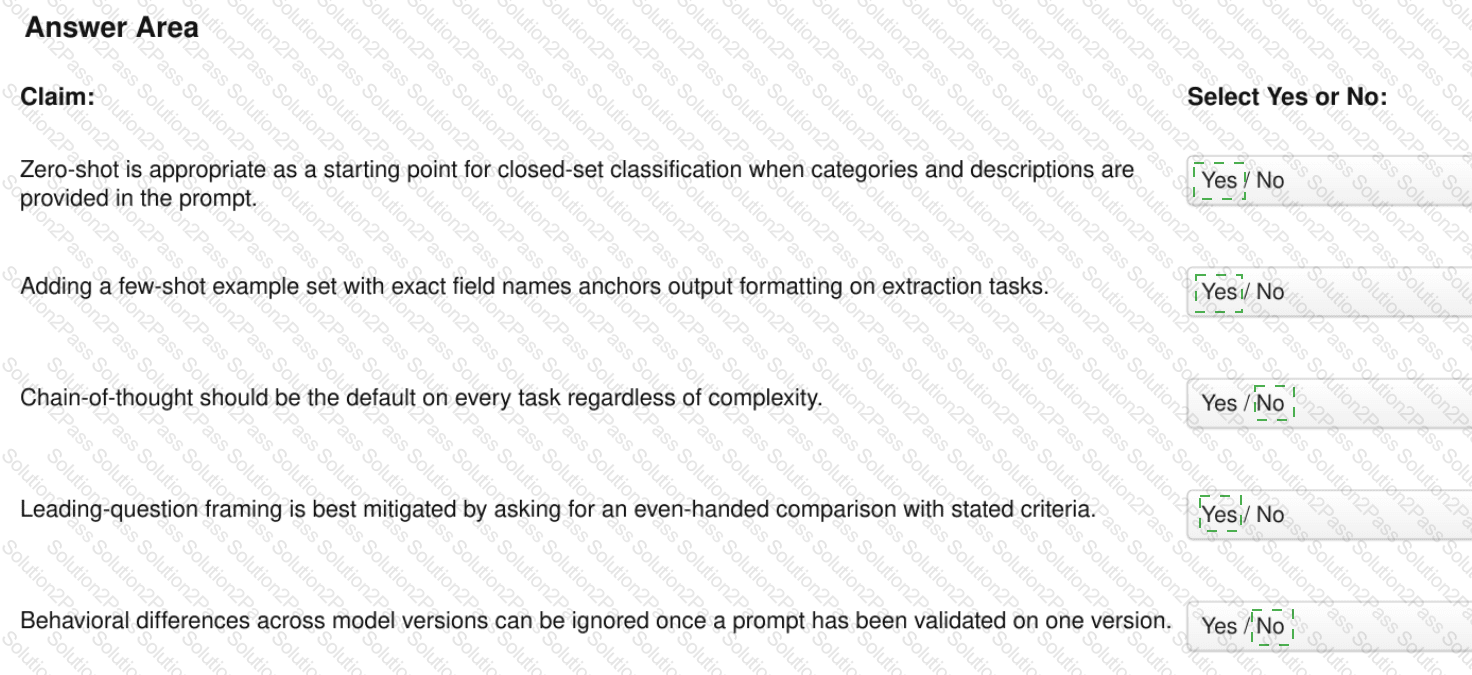
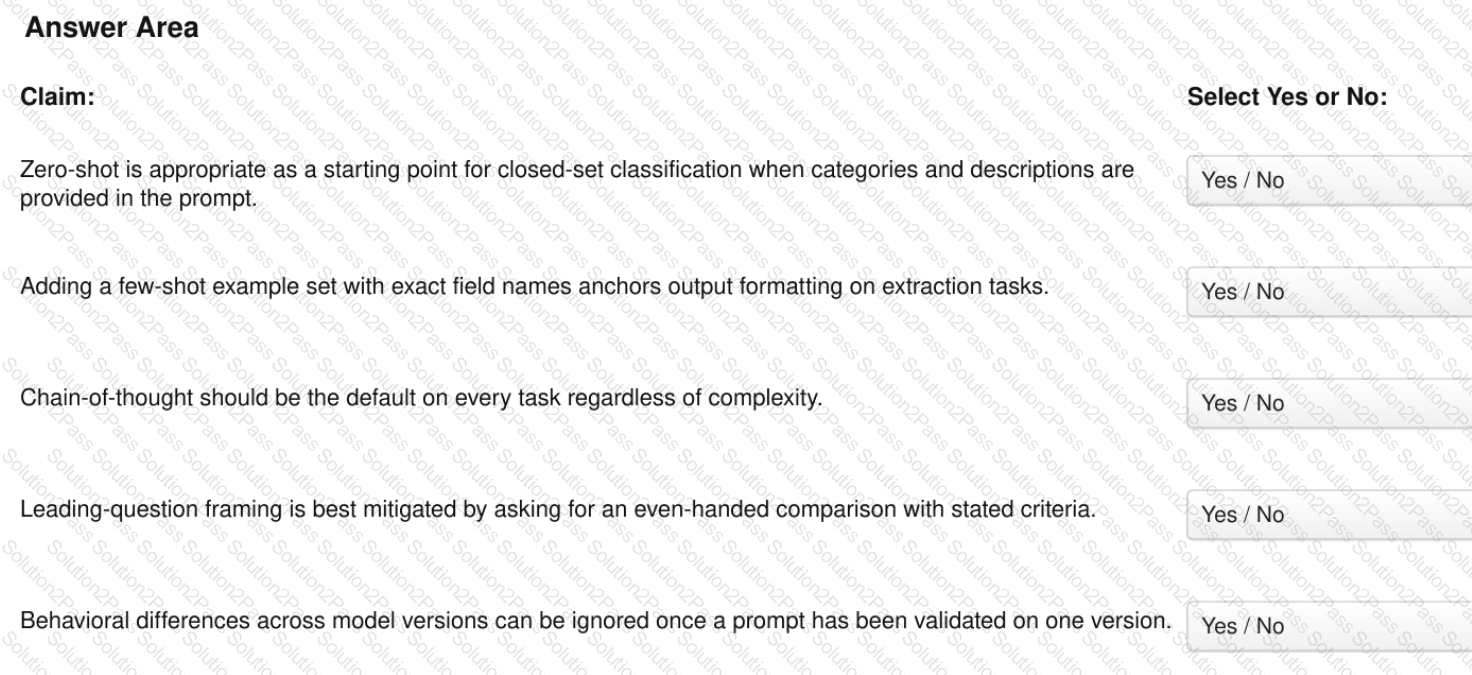
You are evaluating prompting claims in a peer’s design document.

For each claim, select yes if the claim reflects sound practice. Otherwise, select no.
A Claude architect is leading the discovery phase for a new AI-powered customer service solution.

Which two activities are characteristic of structured discovery and requirement gathering for a Claude-based deployment? (Select two.)

A.

Facilitating stakeholder workshops to surface latency, accuracy, and compliance constraints before scoping begins.

B.

Selecting the Claude model tier based on the architect’s prior project experience before stakeholder input is collected.

C.

Generating an initial prototype and iterating based on user reaction rather than written requirements.

D.

Documenting explicit success criteria and failure thresholds that will gate production deployment.

E.

Deferring constraint documentation until the integration design phase to avoid scope creep.

You are running a discovery engagement for a new Claude-based capability and must complete the requirements-gathering steps before validating with stakeholders.

Which two steps must be completed BEFORE validating the captured requirements with stakeholders? (Select two.)

Each correct answer presents part of the solution.

A.

Produce architecture decision records that capture the rationale for major design choices.

B.

Capture the business goals, success criteria, and the in-scope user population for the engagement.

C.

Document the consolidated requirements with traceability to the source stakeholder for each item.

D.

Schedule the rollout milestones and dependencies with engineering and product partners.

E.

Identify the non-functional constraints covering latency, cost, audit, data sensitivity, and regulatory needs.

You are defining where human review must remain in a planned automated pipeline. Which placement reflects sound human-in-the-loop design?

A.

Place a human reviewer only after the irreversible action has already executed, making the review a post-hoc audit rather than a meaningful pre-action check or approval gate.

B.

Place a human reviewer between the model’s output and any high-impact, irreversible action, with explicit criteria for what the reviewer must check before approval.

C.

Place a human reviewer in the loop for a randomly selected sample of requests, without defining criteria for what the reviewer should check or which output categories require mandatory review.

D.

Remove all human review steps from the pipeline to maximize throughput, accepting that high-impact and irreversible actions will be taken without any human approval or oversight.

A security team is evaluating two proposed controls. Control A adds an outbound tool allow-list with destination restrictions and per-call review. Control B scores responses against a stable adversarial evaluation set after each model-version change.

Which two risk categories are correctly matched to these controls? (Select two.)

A.

Control A — prompt injection from adversarial content in retrieved data

B.

Control A — silent quality drift after a model-version upgrade

C.

Control A — data exfiltration via outbound tool calls

D.

Control B — data exfiltration via outbound tool calls

E.

Control B — silent quality drift after a model-version upgrade

A technical team is debating whether to implement a new capability for generating regulatory filings from internal data as a Claude Skill or as an MCP server. The capability requires a fixed authoring procedure with embedded examples, does not need to call live external systems, and must be portable across three Claude deployments: claude.ai, an internal API integration, and Claude Code.

Which factor most strongly favors implementing the capability as a Skill?

A.

The capability needs to query a live database for the most recent regulatory filings.

B.

The capability must also be callable from a developer’s command-line interface.

C.

The capability requires direct authentication against the corporate identity provider.

D.

The capability is procedural knowledge with no live external-system calls required.

Page: 2 / 2
Total 126 questions
Copyright © 2014-2026 Solution2Pass. All Rights Reserved