Pre-Winter Sale Special - Limited Time 70% Discount Offer - Ends in 0d 00h 00m 00s - Coupon code: xmaspas7

Easiest Solution 2 Pass Your Certification Exams

CCAR-P Anthropic Claude Certified Architect - Professional Free Practice Exam Questions (2026 Updated)

Prepare effectively for your Anthropic CCAR-P Claude Certified Architect - Professional certification with our extensive collection of free, high-quality practice questions. Each question is designed to mirror the actual exam format and objectives, complete with comprehensive answers and detailed explanations. Our materials are regularly updated for 2026, ensuring you have the most current resources to build confidence and succeed on your first attempt.

Page: 1 / 2
Total 126 questions

You are defining escalation criteria for ambiguous cases in an automated workflow.

Which set of criteria best supports consistent escalation?

A.

No escalation criteria; the model decides independently on every turn whether to escalate, without explicit confidence thresholds, impact categories, or classifier-based ambiguity flags.

B.

Escalation only after an affected customer has contacted support to complain, after the automated workflow has already completed without human review.

C.

Escalation at the discretion of whoever is available when the team’s on-call engineer has spare capacity, without a defined threshold, category, or ambiguity criterion.

D.

A confidence score below a defined threshold, presence of high-impact decision categories, ambiguity flags raised by content classifiers, and the user’s explicit request for review.

You are operating an interactive assistant whose dominant performance constraint is per-turn latency. Quality on routine turns is already acceptable.

Which configuration adjustment most directly improves latency without disproportionately damaging quality?

A.

Disable prompt caching entirely to ensure fresh context processing on every request, preventing stale prefix content from affecting latency-sensitive interactions.

B.

Reduce retrieval depth to the top-k passages that historically cover the answer, and cache stable system-prompt content.

C.

Increase retrieval depth to the corpus maximum to improve recall regardless of latency.

D.

Switch every turn to the heaviest available model to maximize output quality, accepting that the increased model latency will worsen the per-turn SLO rather than improve it.

You are producing an architecture guide for a new deployment and must complete the planning steps before drafting each section.

Which two steps must be completed BEFORE drafting each section of the guide? (Select two.)

Each correct answer presents part of the solution.

A.

Identify the audience and the questions the guide must answer for that audience.

B.

Translate the guide into the supported regional languages for the candidate population.

C.

Validate the guide with the implementation team and incorporate corrections.

D.

Establish the document under version control with a defined review cadence and approver list.

E.

Outline the guide sections covering the overview, components, contracts, flows, runbooks, and limitations.

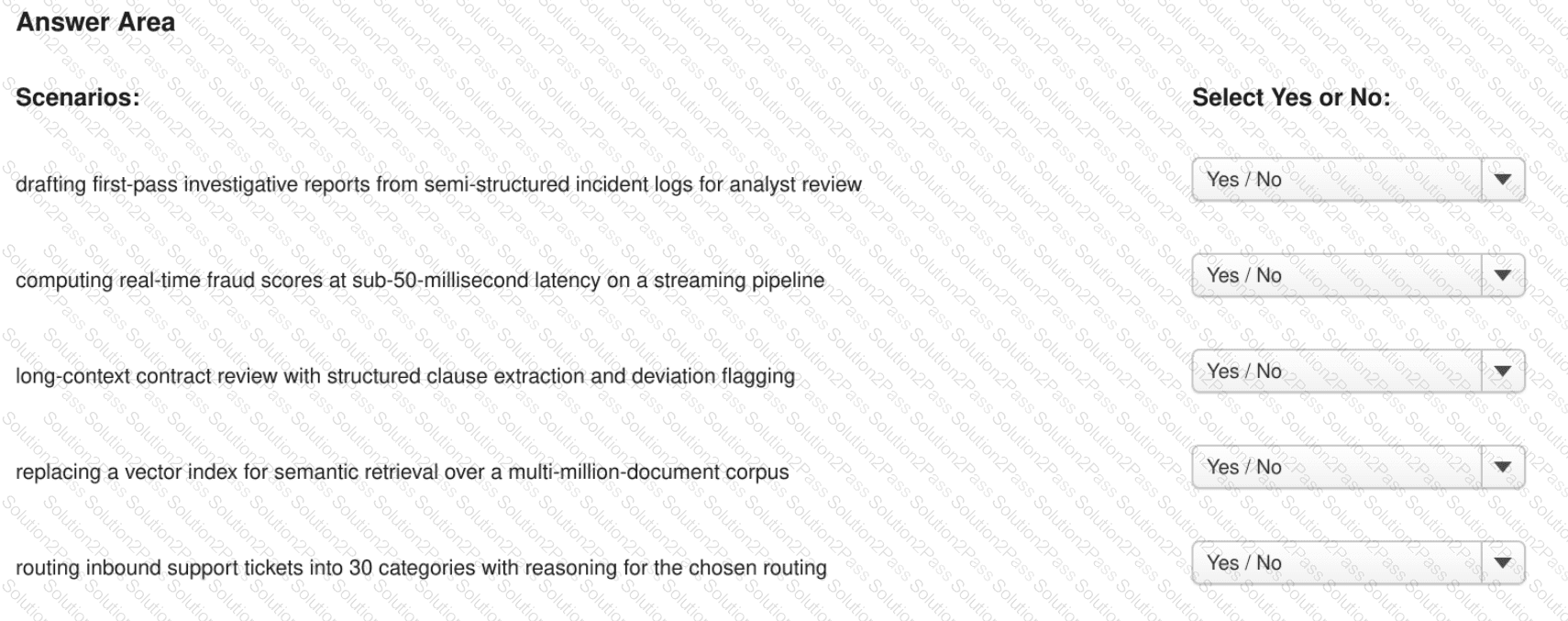
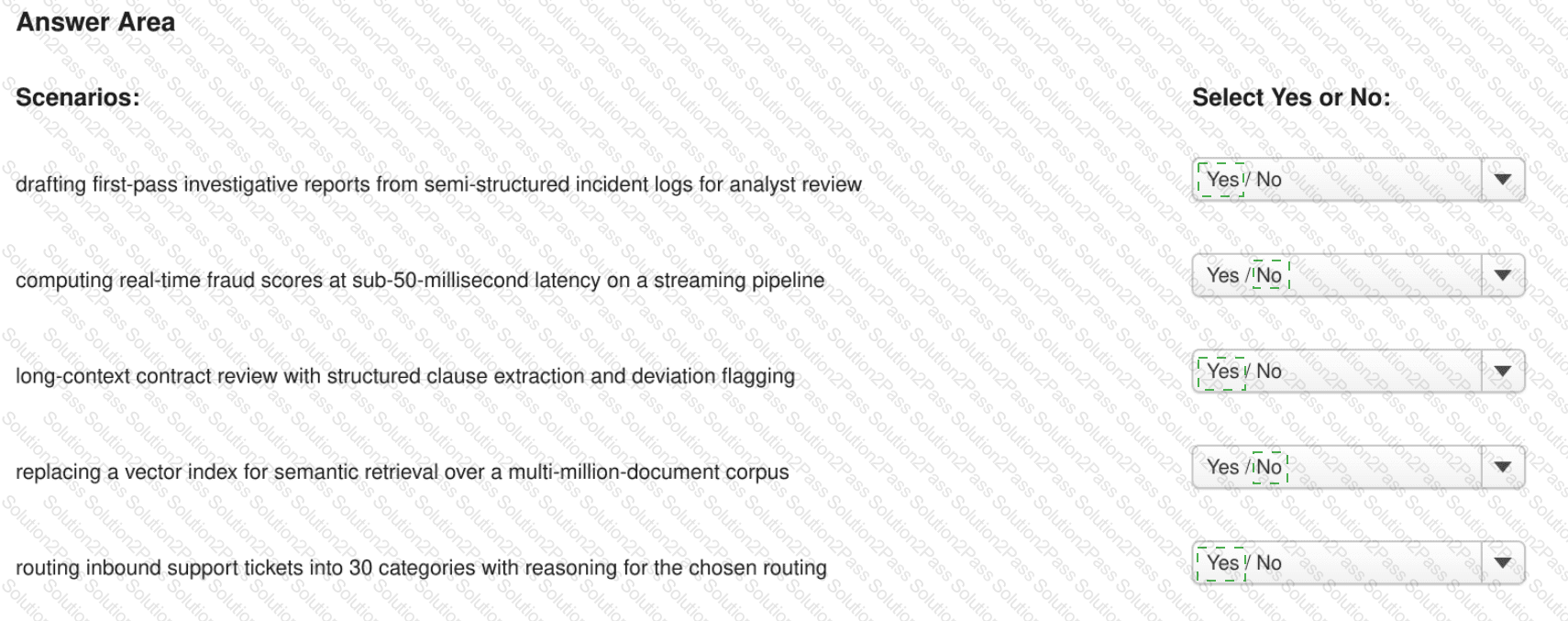
You are a solution architect evaluating candidate use cases for a Claude-based program.

For each scenario, select Yes if Claude is appropriate as the primary solution at the architectural level. Otherwise, select No.
You are an architect supporting the iteration phase of a deployed Claude-based system.

Which activity most directly fits this phase?

A.

Rebuild the entire system architecture from scratch at the start of every iteration cycle regardless of what production telemetry, evaluations, and stakeholder feedback indicate is needed.

B.

Stop measuring production outcomes once the deployment has successfully launched, treating the go-live milestone as the end of the evaluation and iteration cycle.

C.

Discard the evaluation framework and reference set once the deployment is in production, accepting that future iterations will have no structured basis for measuring the impact of changes.

D.

Review production telemetry, sampled output evaluations, and stakeholder feedback to identify the highest-impact change for the next cycle, then plan the change against the evaluation framework.

You are designing a feedback session for a deployment in flight.

Which structure best supports productive stakeholder feedback?

A.

Hold an open-ended meeting with no pre-distributed agenda or artifacts, and rely on participants’ memory to carry decisions and follow-up owners forward.

B.

Define a focused agenda, share the artifacts in advance, capture decisions and follow-ups in writing, and confirm action owners and dates.

C.

Distribute artifacts at the session start rather than in advance, so stakeholders review materials in real time without preparation before the discussion begins.

D.

End the session without recording decisions, follow-up items, action owners, or dates, relying on participant memory to carry the session’s outcomes forward.

After a prompt-template update, several previously passing test cases now produce unexpected outputs.

Which test type is specifically designed to detect this category of failure?

A.

Adversarial tests that probe for prompt-injection vulnerabilities.

B.

Regression tests scored against a stable reference set of known-good behavior.

C.

Smoke tests that confirm high-level system availability after the change.

D.

Integration tests that validate cross-component pipeline behavior.

You are running a discovery session with a business sponsor who asks for “an AI system to fix our customer escalations.”

Which approach best yields actionable requirements?

A.

Accept the sponsor’s original phrasing as a complete and final requirement and proceed directly to design without asking targeted questions to surface actors, triggers, or constraints.

B.

Decompose the request by asking targeted questions about who escalates, what triggers escalation, what good resolution looks like, and which constraints—latency, cost, audit, and data sensitivity—apply.

C.

Defer the discovery session indefinitely on the grounds that the sponsor must fully specify the system before the architect can ask any clarifying or scoping questions.

D.

Assume the requirement matches the architect’s previous engagement in a different industry and proceed with that context, without validating actors, triggers, or constraints for this sponsor.

An engineering organization is adopting Claude Code across 200 developers. A team lead proposes that AI-generated pull requests bypass standard code review for changes under 50 lines because small changes are considered low risk and review capacity is constrained.

Which two Diligence-competency objections should you raise? (Select two.)

Each correct answer presents part of the solution.

A.

Removing review eliminates the verification mechanism required for AI-generated output across the workflow.

B.

Code-review capacity should be expanded to handle every code change submitted across the team.

C.

The threshold should be increased to 200 lines to capture more changes.

D.

AI-generated pull requests should be rejected by default across the organization.

E.

Line count is a poor proxy for the actual risk introduced by a code change.

A Claude architect is implementing safety controls for a customer-facing advice assistant that must never provide regulated investment recommendations.

Which two guardrail implementations most directly enforce this constraint? (Select two.)

A.

Increase response temperature to introduce variability that reduces the likelihood of specific recommendations.

B.

Add an output classifier that detects and blocks responses containing regulated investment-recommendation language.

C.

Limit session length to reduce the volume of queries processed per user per day.

D.

Log all user queries to a SIEM for post-hoc compliance review.

E.

Define explicit out-of-scope categories in the system prompt with fixed refusal phrasing for investment advice requests.

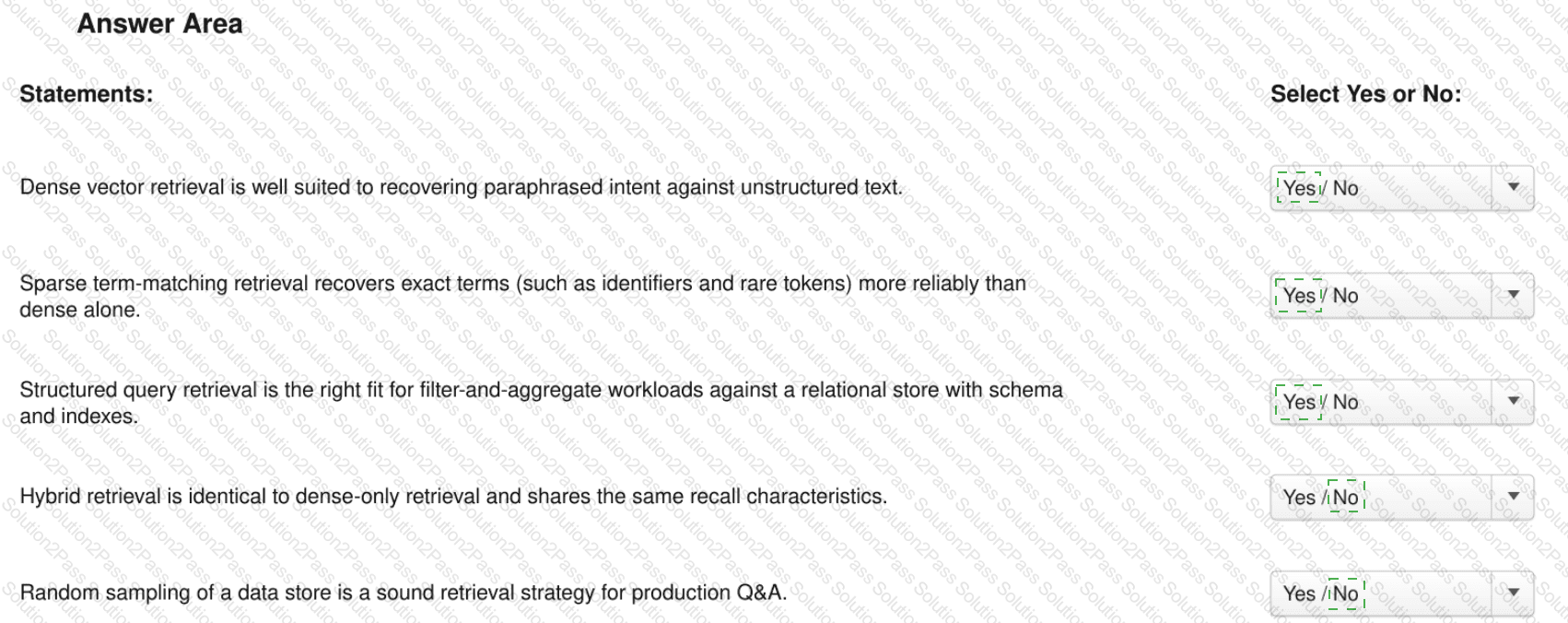
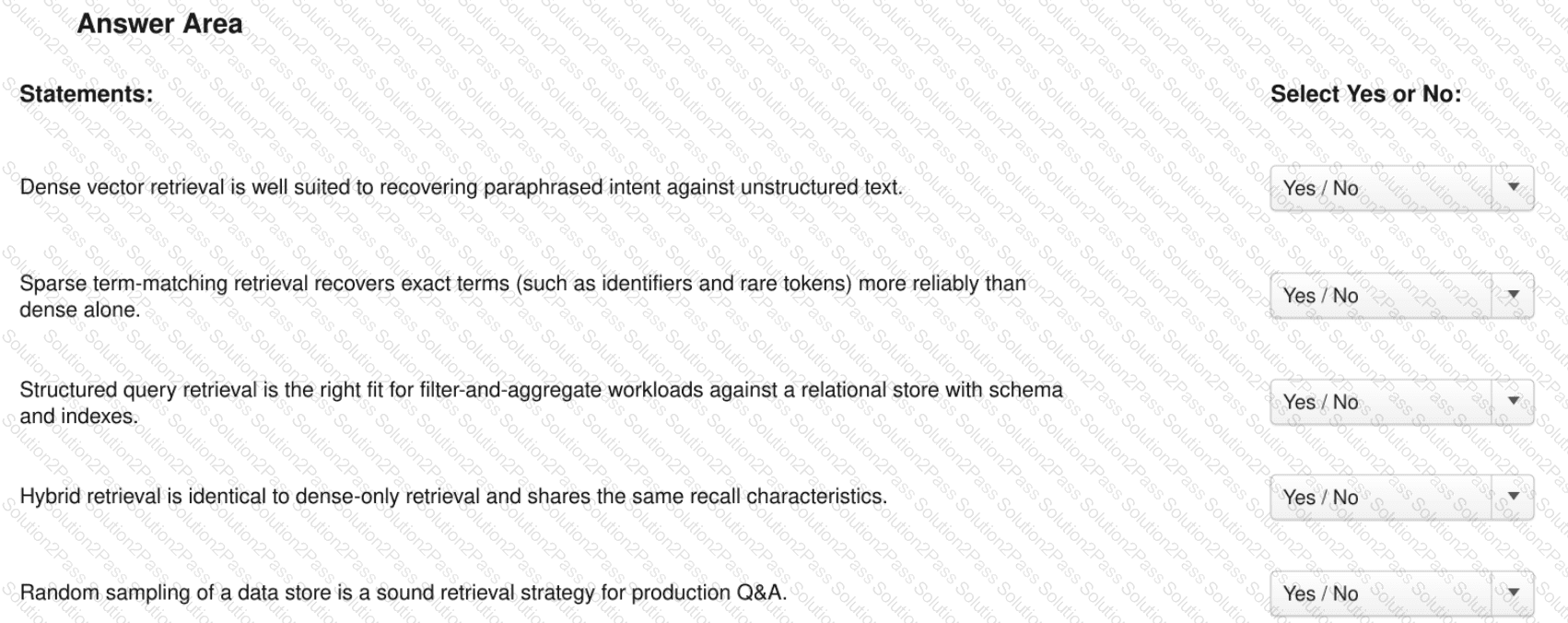
You are evaluating retrieval-strategy claims used by a peer team.

For each claim, select yes if the statement is generally accurate. Otherwise, select no.
A research summarization assistant has been deployed for six months. A user has flagged that a generated summary contained a fabricated citation. The product team has asked whether the incident requires architectural action or whether it is an isolated case.

Which two Diligence-competency actions should you take? (Select two.)

Each correct answer presents part of the solution.

A.

Sample recent summaries to estimate the fabrication frequency across the population.

B.

Disable the assistant immediately for all current users without any prior diagnostic analysis.

C.

Review whether citation-grounding controls exist anywhere in the current generation pipeline.

D.

Communicate to users that the assistant does not fabricate output as a matter of design.

E.

Treat the incident as an anecdotal isolated case and take no further investigative action.

You are designing a human-in-the-loop validation workflow for a new Claude-based deployment and must complete the design steps before piloting the workflow.

Which two steps must be completed BEFORE piloting the workflow with a representative subset of traffic? (Select two.)

Each correct answer presents part of the solution.

A.

Define the sampling strategy and the escalation criteria at each oversight point in the pipeline.

B.

Iterate the workflow design based on observed pilot findings before broader rollout to production.

C.

Onboard the reviewer pool with role-specific training on the check criteria and escalation procedures.

D.

Document the workflow with check criteria, escalation paths, and service-level agreements (SLAs) for each step.

E.

Identify the decision points in the pipeline that require human oversight by impact and reversibility.

You are integrating Claude Code into the team’s pull-request workflow. The team wants AI-assisted review without removing human approval.

Which integration design best fits this requirement?

A.

Claude Code reviews the pull request and posts a structured analysis as a comment, while a human reviewer retains the approval decision under the existing branch-protection rules.

B.

Claude Code merges every pull request automatically after completing its analysis, bypassing human approval and the existing branch-protection rules.

C.

Claude Code disables all existing branch-protection rules to streamline the merge process, removing human approval as a required gate.

D.

Claude Code silently deletes pull requests it assesses as low quality without posting a comment or notifying the author.

You are listing characteristics of strong architectural-decision communication.

Which two characteristics belong on the list? (Select two.)

Each correct answer presents a complete solution.

A.

Ownership and review cadence for revisiting the decision when conditions or assumptions change.

B.

Distribution to a standing review forum with mandatory attendance from senior engineering leaders.

C.

Omission of rejected alternatives to keep the decision document focused and concise for readers.

D.

Alternatives considered along with the criteria that were used to evaluate each alternative.

E.

Use of a consistent template across the team to standardize the visual presentation of decisions.

You are building a feedback-and-alignment routine for a multi-stakeholder deployment.

Which two practices belong in the routine? (Select two.)

Each correct answer presents a complete solution.

A.

Record each session and distribute the recording to stakeholders who could not attend live.

B.

Escalate any disagreement among stakeholders to the executive sponsor for binding resolution.

C.

Rotate facilitation among the participating stakeholder groups to share ownership of the routine.

D.

Set a regular cadence for revisiting expectations and assumptions as conditions evolve over time.

E.

Reconcile divergent stakeholder positions explicitly rather than papering over them in the moment.

You are supporting an engineer whose Claude Code session reports a permission denial when the engineer expected the action to be allowed.

Which resolution step is most appropriate?

A.

Tell the engineer to retry the denied action verbatim repeatedly until the denial stops appearing, without inspecting the active permission rules to determine whether the denial is intentional.

B.

Disable the permission system entirely across all scopes to remove the denial, eliminating all tool-pattern and deny-rule controls rather than identifying and amending the specific rule.

C.

Inspect the active permission rules across all scopes—managed, command-line, local, project, and user—to identify which rule is denying the action and confirm whether it should be amended or remain denied.

D.

Grant the engineer unrestricted Bash access to bypass the specific rule causing the denial, removing all tool-pattern constraints rather than amending only the rule in question.

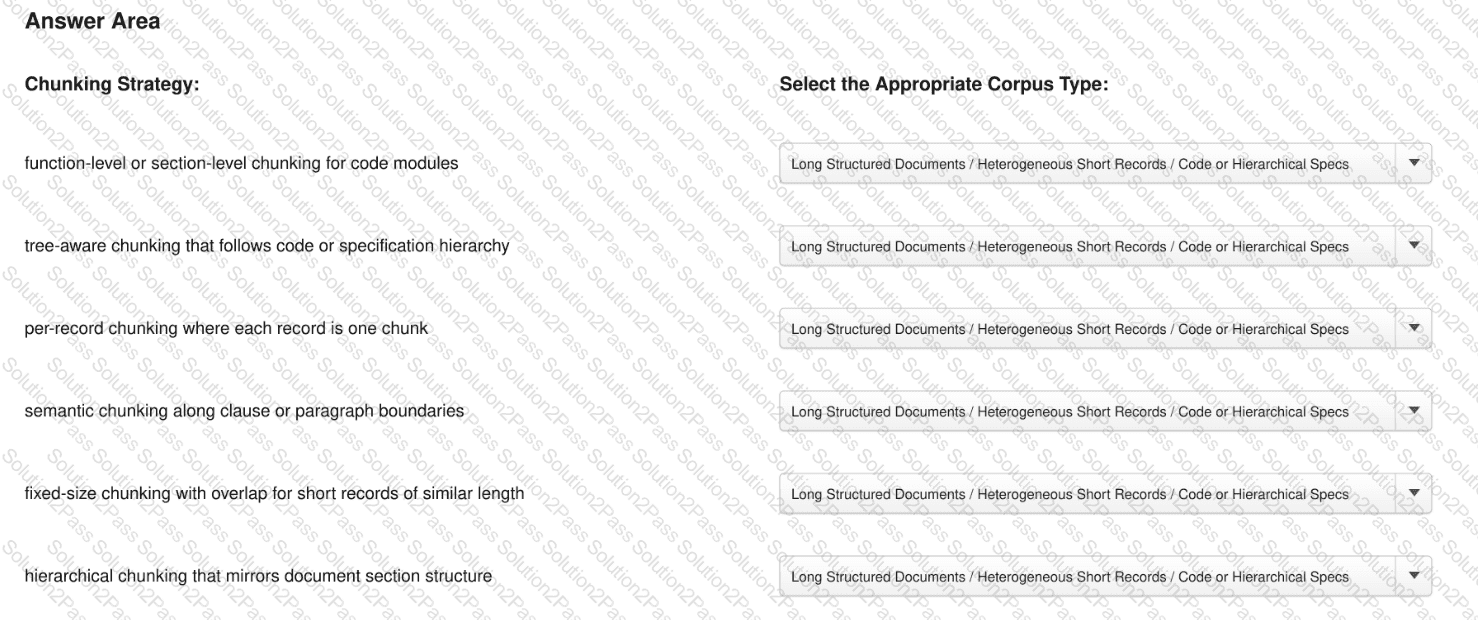
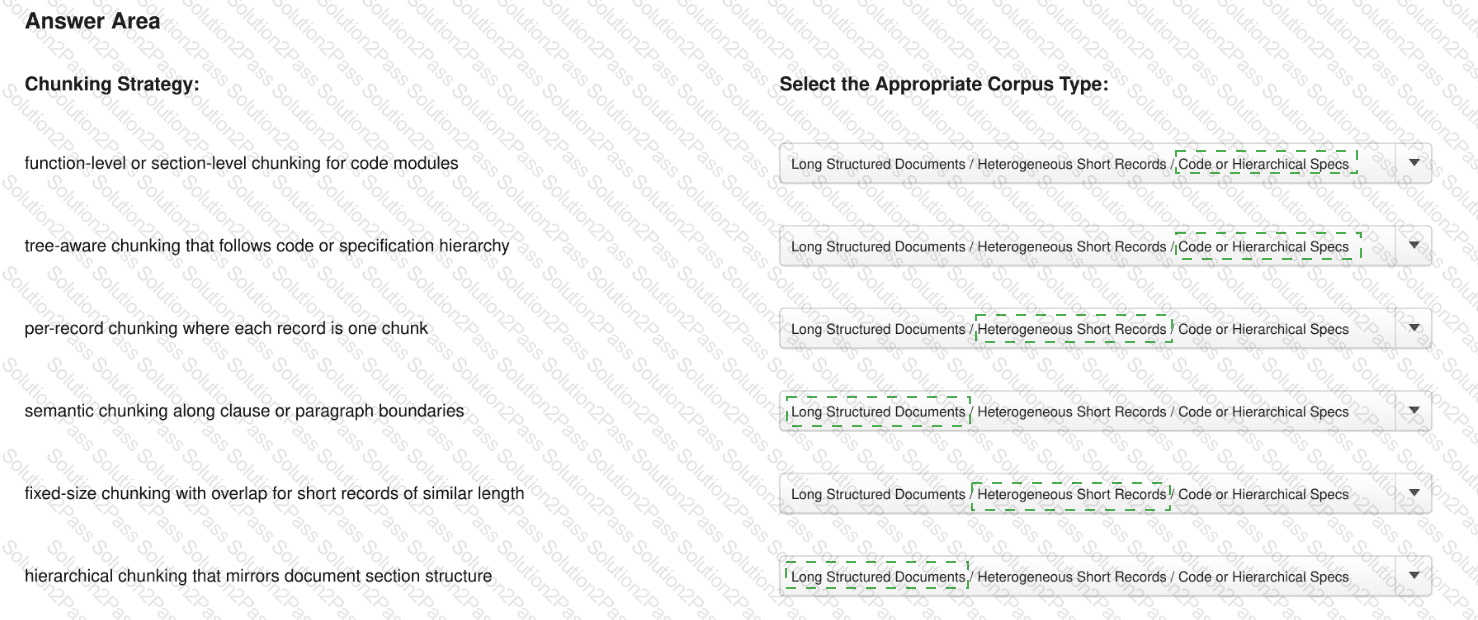
You are classifying chunking strategies by the corpus type each is best suited to.

For each chunking strategy, select the appropriate corpus type: “Long Structured Documents,” “Heterogeneous Short Records,” or “Code or Hierarchical Specifications.”
You are compiling a diagnostic toolkit for Claude Code operational issues.

Which two diagnostic actions belong in the toolkit? (Select two.)

Each correct answer presents a complete solution.

A.

Increase the model sampling temperature so that intermittent issues surface more frequently for analysis.

B.

File a support ticket with vendor support before any local reproduction or evidence collection.

C.

Reproduce the issue with a minimal reproduction case that isolates one variable at a time.

D.

Roll back to the previous Claude Code version immediately to confirm whether the issue is version specific.

E.

List the configured Model Context Protocol (MCP) servers and inspect server status to identify connection failures.

You are defining when to introduce a project subagent versus relying on Claude Code ' s general capabilities.

Which scenario most directly justifies a dedicated subagent?

A.

The team has a recurring specialized task, such as database schema review, that requires a focused system prompt, narrow tool permissions, and a specific model selection across many sessions.

B.

The team has a one-time ad hoc question that will not recur and does not require a focused system prompt, narrow tool permissions, or dedicated model selection.

C.

The team has no recurring specialized tasks and uses Claude Code only for isolated general-purpose work that does not justify a dedicated system prompt or tool scope.

D.

The team wants every Claude Code interaction to use the same generic system prompt with no task-specific specialization, narrow tool permissions, or dedicated model selection.

Page: 1 / 2
Total 126 questions
Copyright © 2014-2026 Solution2Pass. All Rights Reserved