200-201 Cisco Understanding Cisco Cybersecurity Operations Fundamentals Free Practice Exam Questions (2026 Updated)
Prepare effectively for your Cisco 200-201 Understanding Cisco Cybersecurity Operations Fundamentals certification with our extensive collection of free, high-quality practice questions. Each question is designed to mirror the actual exam format and objectives, complete with comprehensive answers and detailed explanations. Our materials are regularly updated for 2026, ensuring you have the most current resources to build confidence and succeed on your first attempt.
Which NIST IR category stakeholder is responsible for coordinating incident response among various business units, minimizing damage, and reporting to regulatory agencies?
What is the purpose of a host-based intrusion detection system (HIDS)?
During which phase of the forensic process is data that is related to a specific event labeled and recorded to preserve its integrity?
Which type of attack occurs when an attacker is successful in eavesdropping on a conversation between two IP phones?
What is an attack surface as compared to a vulnerability?
What is sliding window anomaly detection?
An employee reports that someone has logged into their system and made unapproved changes, files are out of order, and several documents have been placed in the recycle bin. The security specialist reviewed the system logs, found nothing suspicious, and was not able to determine what occurred. The software is up to date; there are no alerts from antivirus and no failed login attempts. What is causing the lack of data visibility needed to detect the attack?
What is the difference between the ACK flag and the RST flag?
Which statement describes indicators of attack?
What are two differences in how tampered and untampered disk images affect a security incident? (Choose two.)
What is a difference between inline traffic interrogation and traffic mirroring?
Drag and drop the definition from the left onto the phase on the right to classify intrusion events according to the Cyber Kill Chain model.
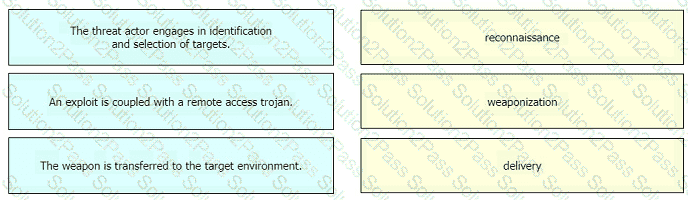
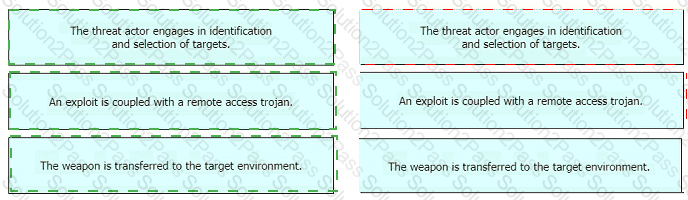
The security team has detected an ongoing spam campaign targeting the organization. The team's approach is to push back the cyber kill chain and mitigate ongoing incidents. At which phase of the cyber kill chain should the security team mitigate this type of attack?
What is the difference between deep packet inspection and stateful inspection?
What is a difference between tampered and untampered disk images?
The SOC team detected an ongoing port scan. After investigation, the team concluded that the scan was targeting the company servers. According to the Cyber Kill Chain model, which step must be assigned to this type of event?
What is a collection of compromised machines that attackers use to carry out a DDoS attack?
A user reports that a mobile application is working very slowly. A DDoS detection tool reports high-volume traffic. During which phase does the CSIRT ensure that the incident does not continue and confirm that the organization has taken the required actions?
An engineer is working on a ticket for an incident from the incident management team A week ago. an external web application was targeted by a DDoS attack Server resources were exhausted and after two hours it crashed. An engineer was able to identify the attacker and technique used Three hours after the attack, the server was restored and the engineer recommended implementing mitigation by Blackhole filtering and transferred the incident ticket back to the IR team According to NIST SP800-61, at which phase of the incident response did the engineer finish work?
What is a scareware attack?