200-201 Cisco Understanding Cisco Cybersecurity Operations Fundamentals Free Practice Exam Questions (2026 Updated)
Prepare effectively for your Cisco 200-201 Understanding Cisco Cybersecurity Operations Fundamentals certification with our extensive collection of free, high-quality practice questions. Each question is designed to mirror the actual exam format and objectives, complete with comprehensive answers and detailed explanations. Our materials are regularly updated for 2026, ensuring you have the most current resources to build confidence and succeed on your first attempt.
Why should an engineer use a full packet capture to investigate a security breach?
An engineer runs a suspicious file in a sandbox analysis tool to see the outcome. The analysis report shows that outbound callouts were made post infection.
Which two pieces of information from the analysis report are needed to investigate the callouts? (Choose two.)
A SOC analyst is investigating an incident that involves a Linux system that is identifying specific sessions. Which identifier tracks an active program?
A company receptionist received a threatening call referencing stealing assets and did not take any action assuming it was a social engineering attempt. Within 48 hours, multiple assets were breached, affecting the confidentiality of sensitive information. What is the threat actor in this incident?
Refer to the exhibit.
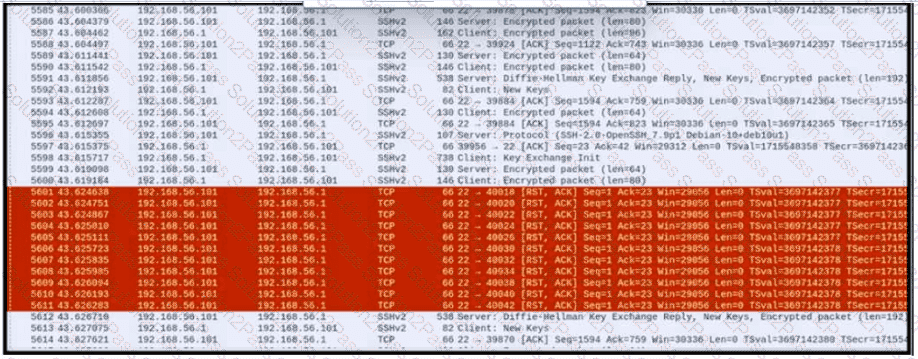
An engineer is analyzing a PCAP file after a recent breach An engineer identified that the attacker used an aggressive ARP scan to scan the hosts and found web and SSH servers. Further analysis showed several SSH Server Banner and Key Exchange Initiations. The engineer cannot see the exact data being transmitted over an encrypted channel and cannot identify how the attacker gained access How did the attacker gain access?
Which action prevents buffer overflow attacks?
What are two social engineering techniques? (Choose two.)
A company encountered a breach on its web servers using IIS 7 5 Dunng the investigation, an engineer discovered that an attacker read and altered the data on a secure communication using TLS 1 2 and intercepted sensitive information by downgrading a connection to export-grade cryptography. The engineer must mitigate similar incidents in the future and ensure that clients and servers always negotiate with the most secure protocol versions and cryptographic parameters. Which action does the engineer recommend?
Which action matches the weaponization step of the Cyber Kill Chain model?
A security incident occurred with the potential of impacting business services. Who performs the attack?
What is the principle of defense-in-depth?
Which event is user interaction?
An engineer received a ticket to investigate a potentially malicious file detected by a malware scanner that was trying to execute multiple commands. During the initial review, the engineer discovered that the file was created two days prior. Further analyses show that the file was downloaded from a known malicious domain after a successful phishing attempt on an asset owner. At which phase of the Cyber Kill Chain was this attack mitigated?
What causes events on a Windows system to show Event Code 4625 in the log messages?
What are two denial-of-service (DoS) attacks? (Choose two)
Which metric should be used when evaluating the effectiveness and scope of a Security Operations Center?
An engineer received a flood of phishing emails from HR with the source address HRjacobm@companycom. What is the threat actor in this scenario?
Why is HTTPS traffic difficult to screen?
A user received an email attachment named "Hr405-report2609-empl094.exe" but did not run it. Which category of the cyber kill chain should be assigned to this type of event?
Refer to the exhibit.
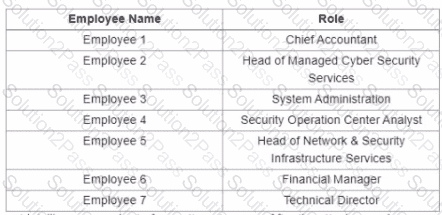
A suspicious IP address is tagged by Threat Intelligence as a brute-force attempt source After the attacker produces many of failed login entries, it successfully compromises the account. Which stakeholder is responsible for the incident response detection step?