Summer Sale Special - Limited Time 70% Discount Offer - Ends in 0d 00h 00m 00s - Coupon code: xmaspas7

Easiest Solution 2 Pass Your Certification Exams

200-301 Cisco Implementing and Administering Cisco Solutions (200-301 CCNA) v1.1 Free Practice Exam Questions (2026 Updated)

Prepare effectively for your Cisco 200-301 Implementing and Administering Cisco Solutions (200-301 CCNA) v1.1 certification with our extensive collection of free, high-quality practice questions. Each question is designed to mirror the actual exam format and objectives, complete with comprehensive answers and detailed explanations. Our materials are regularly updated for 2026, ensuring you have the most current resources to build confidence and succeed on your first attempt.

Page: 5 / 8
Total 1240 questions

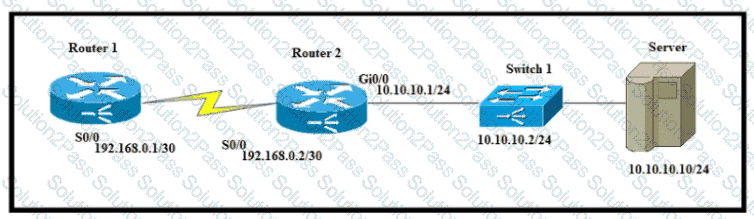
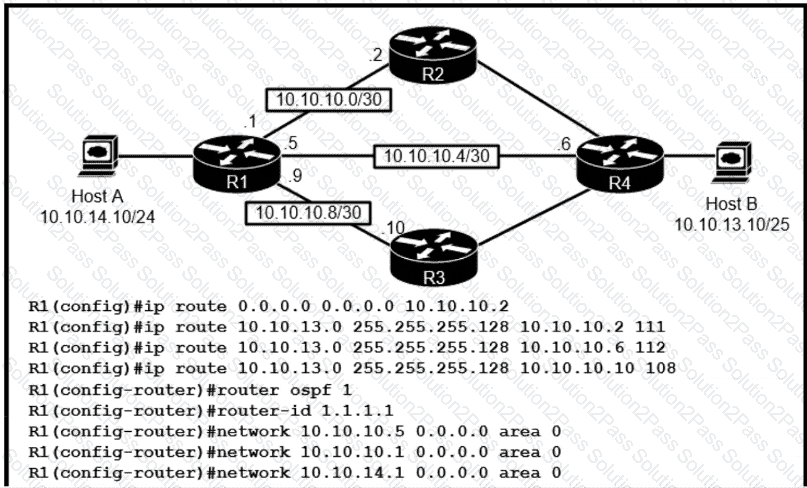
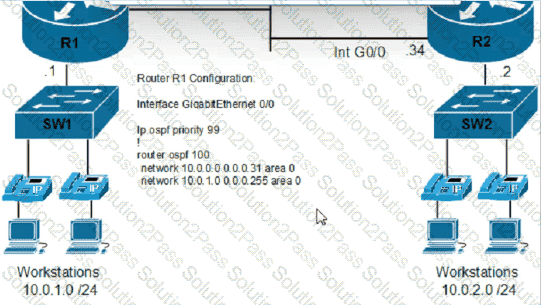
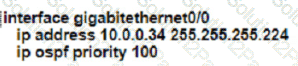
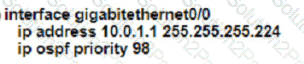
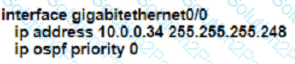
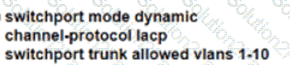
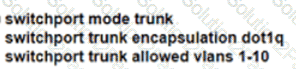
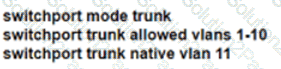
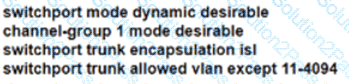
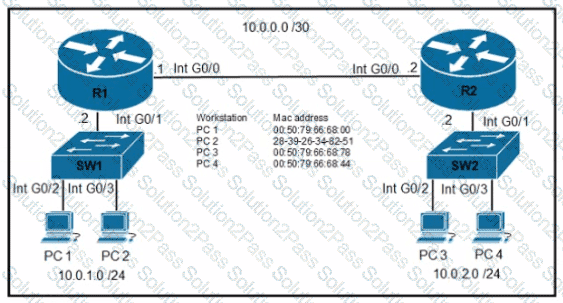
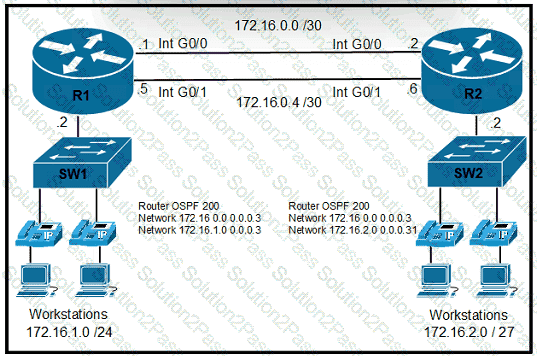
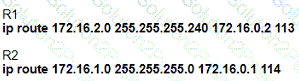
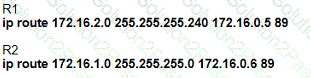
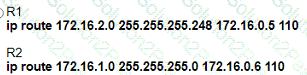
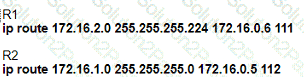
Refer to the exhibit. Routers R1 and R2 have been configured with their respective LAN interfaces. The two circuits are operational and reachable across the WAN. Which command set establishes failover redundancy if the primary circuit goes down?

A.

Option A

B.

Option B

C.

Option C

D.

Option D

What are two functions of a Layer 2 switch? (Choose two)

A.

acts as a central point for association and authentication servers

B.

selects the best route between networks on a WAN

C.

moves packets within a VLAN

D.

moves packets between different VLANs

E.

makes forwarding decisions based on the MAC address of a packet

What is a benefit of VRRP?

A.

It provides traffic load balancing to destinations that are more than two hops from the source.

B.

It provides the default gateway redundancy on a LAN using two or more routers.

C.

It allows neighbors to share routing table information between each other.

D.

It prevents lloops in a Layer 2 LAN by forwarding all traffic to a root bridge, which then makes the final forwarding decision.

What is recommended for the wireless infrastructure design of an organization?

A.

group access points together to increase throughput on a given channel

B.

configure the first three access points are configured to use Channels 1, 6, and 11

C.

include a least two access points on nonoverlapping channels to support load balancing

D.

assign physically adjacent access points to the same Wi-Fi channel

What is an appropriate use for private IPv4 addressing?

A.

on the public-facing interface of a firewall

B.

to allow hosts inside to communicate in both directions with hosts outside the organization

C.

on internal hosts that stream data solely to external resources

D.

on hosts that communicates only with other internal hosts

Which two WAN architecture options help a business improve scalability and reliability for the network? (Choose two.)

A.

asynchronous routing

B.

single-homed branches

C.

dual-homed branches

D.

static routing

E.

dynamic routing

What is the purpose of a southbound API in a control based networking architecture?

A.

Facilities communication between the controller and the applications

B.

Facilities communication between the controller and the networking hardware

C.

allows application developers to interact with the network

D.

integrates a controller with other automation and orchestration tools.

Which resource is able to be shared among virtual machines deployed on the same physical server?

A.

disk

B.

applications

C.

VM configuration file

D.

operating system

What are two improvements provided by automation for network management in an SDN environment? (Choose two)

A.

Data collection and analysis tools establish a baseline for the network

B.

Artificial intelligence identifies and prevents potential design failures.

C.

Machine learning minimizes the overall error rate when automating troubleshooting processes

D.

New devices are onboarded with minimal effort

E.

Proprietary Cisco APIs leverage multiple network management tools.

Which CRUD operation corresponds to the HTTP GET method?

A.

read

B.

update

C.

create

D.

delete

By default, how does EIGRP determine the metric of a route for the routing table?

A.

it uses the bandwidth and delay values of the path to calculate the route metric

B.

it uses a default metric of 10 for all routes that are learned by the router

C.

it uses a reference bandwidth and the actual bandwidth of the connected link to calculate the route metric

D.

it counts the number of hops between the receiving and destination routers and uses that value as the metric

How do servers connect to the network in a virtual environment?

A.

wireless to an access point that is physically connected to the network

B.

a cable connected to a physical switch on the network

C.

a virtual switch that links to an access point that is physically connected to the network

D.

a software switch on a hypervisor that is physically connected to the network

What is the purpose of traffic shaping?

A.

to mitigate delays over slow links

B.

to provide fair queuing for buffered flows

C.

to limit the bandwidth that a flow can use to

D.

be a marking mechanism that identifies different flows

What software-defined architecture plane assists network devices with making packet-forwarding decisions by providing Layer 2 reachability and Layer 3 routing information?

A.

data plane

B.

control plane

C.

policy plane

D.

management plane

How do TCP and UDP differ in the way that they establish a connection between two endpoints?

A.

TCP uses synchronization packets, and UDP uses acknowledgment packets.

B.

UDP uses SYN, SYN ACK and FIN bits in the frame header while TCP uses SYN, SYN ACK and ACK bits

C.

UDP provides reliable message transfer and TCP is a connectionless protocol

D.

TCP uses the three-way handshake and UDP does not guarantee message delivery

Refer to Exhibit.

The loopback1 interface of the Atlanta router must reach the loopback3 interface of the Washington router. Which two static host routes must be configured on the New York router? (Choose two)

A.

ipv6 route 2000::1/128 2012::1

B.

ipv6 route 2000::3/128 2023::3

C.

ipv6 route 2000::3/128 s0/0/0

D.

ipv6 route 2000::1/128 2012::2

E.

ipv6 route 2000::1/128 s0/0/1

What is a DHCP client?

A.

a host that is configured to request an IP address automatically

B.

a server that dynamically assigns IP addresses to hosts

C.

a workstation that requests a domain name associated with its IP address

D.

a router that statically assigns IP addresses to hosts

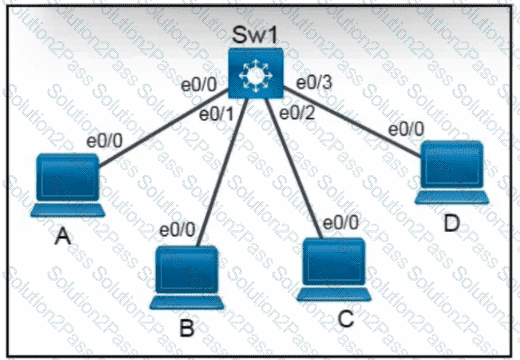
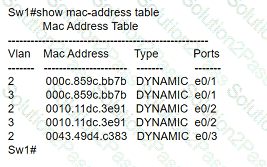
How does a switch process a frame received on Fa0/1 with the destination MAC address of 0e38.7363.657b when the table is missing the address?

A.

lt drops the frame immediately.

B.

It forwards the frame back out of interface Fa0/1.

C.

It floods the frame to all interfaces except Fa0/1.

D.

It holds the frame until the MAC address timer expires and then drops the frame.

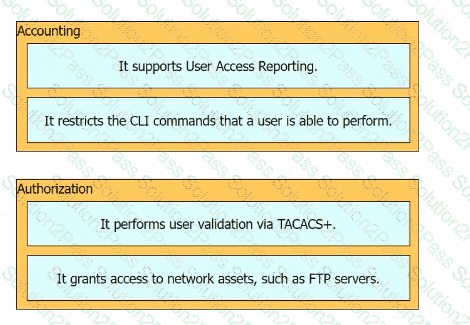
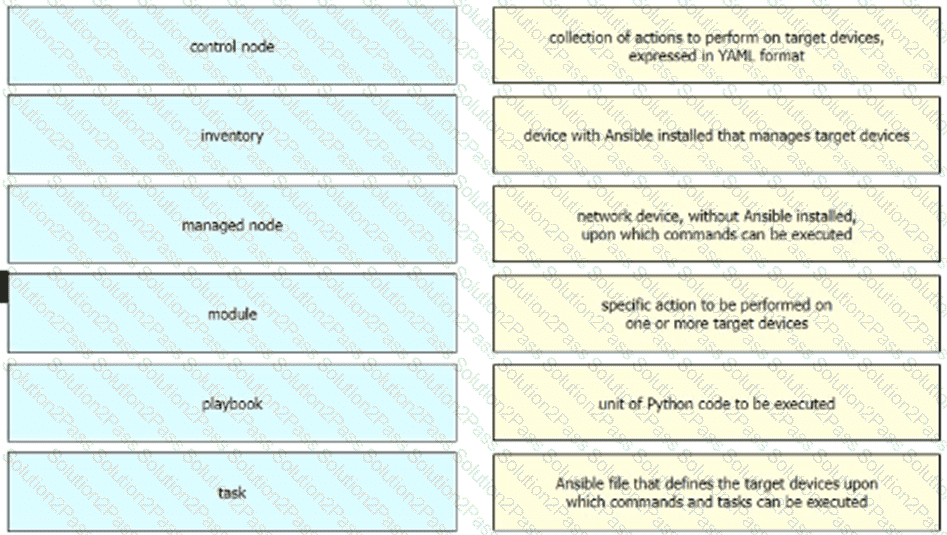
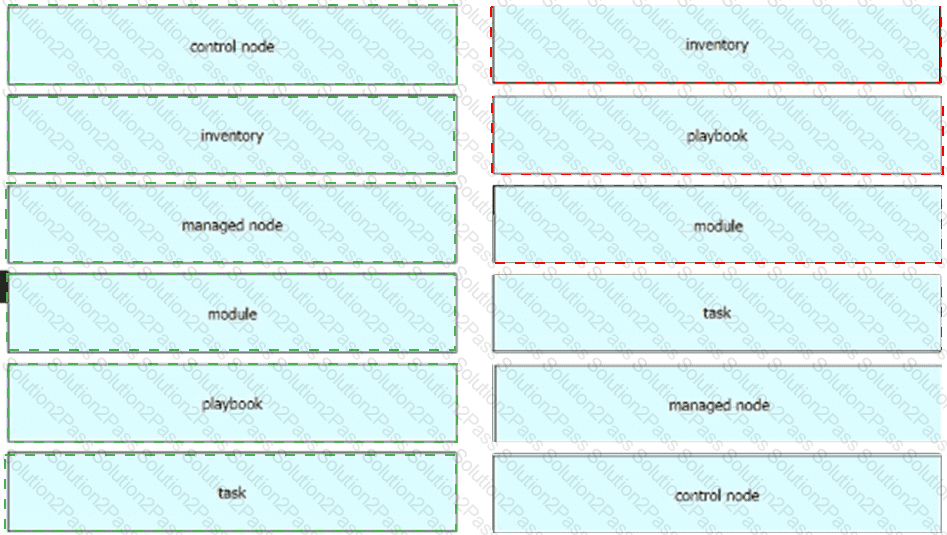
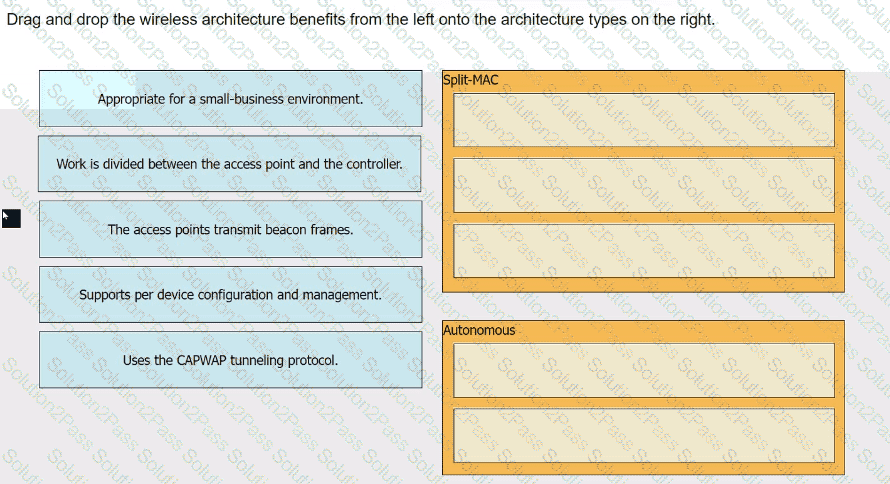
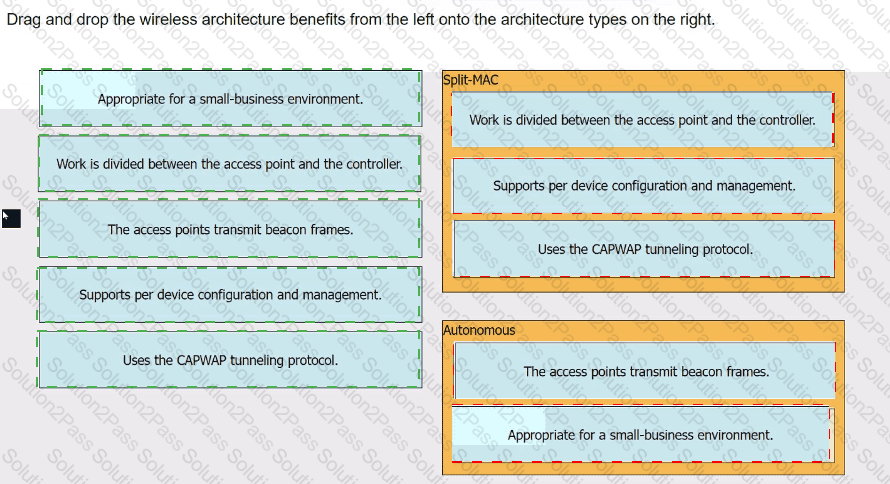
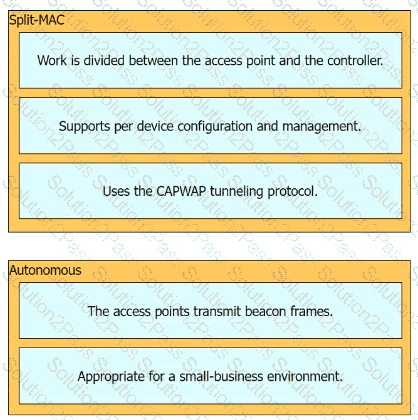
Drag and drop the functions of DHCP from the left onto any of the positions on the right Not all functions are used

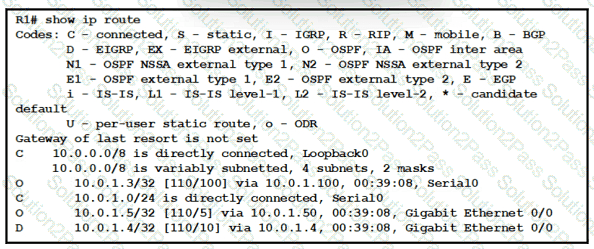
Refer to the exhibit.

If R1 receives a packet destined to 172.161.1, to which IP address does it send the packet?

A.

192.168.12.2

B.

192.168.13.3

C.

192.168.14.4

D.

192.168.15.5

A user configured OSPF and advertised the Gigabit Ethernet interface in OSPF By default, which type of OSPF network does this interface belong to?

A.

point-to-multipoint

B.

point-to-point

C.

broadcast

D.

nonbroadcast

Refer to the exhibit.

A network administrator assumes a task to complete the connectivity between PC A and the File Server. Switch A and Switch B have been partially configured with VLAN 10, 11, 12, and 13. What is the next step in the configuration?

A.

Add PC A to VLAN 10 and the File Server to VLAN 11 fa VLAN segmentation

B.

Add VLAN 13 to the trunk links on Switch A and Switch B for VLAN propagation

C.

Add a router on a stick between Switch A and Switch B allowing for Inter-VLAN routing.

D.

Add PC A to the same subnet as the Fie Server allowing for intra-VLAN communication.

What is the difference in data transmission delivery and reliability between TCP and UDP?

A.

TCP transmits data at a higher rate and ensures packet delivery. UDP retransmits lost data to ensure applications receive the data on the remote end.

B.

UDP sets up a connection between both devices before transmitting data. TCP uses the three-way handshake to transmit data with a reliable connection.

C.

UDP is used for multicast and broadcast communication. TCP is used for unicast communication and transmits data at a higher rate with error checking.

D.

TCP requires the connection to be established before transmitting data. UDP transmits data at a higher rate without ensuring packet delivery.

Refer to the exhibit.

A packet is being sent across router R1 to host 172.16.0.14. What is the destination route for the packet?

A.

209.165.200.254 via Serial0/0/1

B.

209.165.200.254 via Serial0/0/0

C.

209.165.200.246 via Serial0/1/0

D.

209.165.200.250 via Serial0/0/0

Which virtual MAC address is used by VRRP group 1?

A.

0050.0c05.ad81

B.

0007.c061.bc01

C.

0000.5E00.0101

D.

0500.3976.6401

What is the role of a firewall in an enterprise network?

A.

Forwards packets based on stateless packet inspection

B.

Processes unauthorized packets and allows passage to less secure segments of the network

C.

determines which packets are allowed to cross from unsecured to secured networks

D.

explicitly denies all packets from entering an administrative domain

Connectivity between four routers has been established. IP connectivity must be configured in the order presented to complete the implementation. No dynamic routing protocols are included.

1. Configure static routing using host routes to establish connectivity from router R3 to the router R1 Loopback address using the source IP of 209.165.200.230.

2. Configure an IPv4 default route on router R2 destined for router R4.

3. Configure an IPv6 default router on router R2 destined for router R4.

Physical connectivity is implemented between the two Layer 2 switches,

and the network connectivity between them must be configured.

I . Configure an LACP EtherChanneI and number it as 44; configure it

between switches SWI and SW2 using interfaces EthernetO/O and

Ethernet0/1 on both sides. The LACP mode must match on both ends.

2. Configure the EtherChanneI as a trunk link.

3. Configure the trunk link with 802. Iq tags.

4. Configure VLAN ' MONITORING ' as the untagged VLAN of the

EtherChannel.

==================

Guidelines

This is a lab item in which tasks will be performed on virtual devices.

• Refer to the Tasks tab to view the tasks for this lab item.

• Refer to the Topology tab to access the device console(s) and perform the tasks.

• Console access is available for all required devices by clicking the device icon or using

the tab(s) above the console window.

• All necessary preconfigurations have been applied.

• Do not change the enable password or hostname for any device.

• Save your configurations to NVRAM before moving to the next item.

• Click Next at the bottom of the screen to submit this lab and move to the next question.

• When Next is clicked, the lab closes and cannot be reopened.

All physical cabling is in place. Router R4 and PCI are fully configured and

inaccessible. R4 ' s WAN interfaces use .4 in the last octet for each subnet.

Configurations should ensure that connectivity is established end-to-end.

1 . Configure static routing to ensure RI prefers the path through R2 to

reach only PCI on R4 ' s LAN

2. Configure static routing that ensures traffic sourced from RI will take

an alternate path through R3 to PCI in the event of an outage along

the primary path

3. Configure default routes on RI and R3 to the Internet using the least number of hops

Guidelines

This is a lab item in which tasks will be performed on virtual devices.

• Refer to the Tasks tab to view the tasks for this lab item.

• Refer to the Topology tab to access the device console(s) and perform the tasks.

• Console access is available for all required devices by clicking the device icon or using

the tab(s) above the console window.

• All necessary preconfigurations have been applied.

• Do not change the enable password or hostname for any device.

• Save your configurations to NVRAM before moving to the next item.

• Click Next at the bottom of the screen to submit this lab and move to the next question.

• When Next is clicked, the lab closes and cannot be reopened.

All physical cabling between the two switches is installed. Configure the network connectivity between the switches using the designated VLANs and interfaces.

1. Configure VLAN 100 named Compute and VLAN 200 named Telephony where required for each task.

2. Configure Ethernet0/1 on SW2 to use the existing VLAN named Available.

3. Configure the connection between the switches using access ports.

4. Configure Ethernet0/1 on SW1 using data and voice VLANs.

5. Configure Ethemet0/1 on SW2 so that the Cisco proprietary neighbor discovery protocol is turned off for the designated interface only.

IP connectivity and OSPF are preconfigured on all devices where necessary. Do not make any changes to the IP addressing or OSPF. The company policy uses connected interfaces and next hops when configuring static routes except for load balancing or redundancy without floating static. Connectivity must be established between subnet 172.20.20.128/25 on the Internet and the LAN at 192.168.0.0/24 connected to SW1:

1. Configure reachability to the switch SW1 LAN subnet in router R2.

2. Configure default reachability to the Internet subnet in router R1.

3. Configure a single static route in router R2 to reach to the Internet subnet considering both redundant links between routers R1 and R2. A default route is NOT allowed in router R2.

4. Configure a static route in router R1 toward the switch SW1 LAN subnet where the primary link must be through Ethernet0/1. and the backup link must be through Ethernet0/2 using a floating route. Use the minimal administrative distance value when required.

Connectivity between three routers has been established, and IP services must be configured jn the order presented to complete the implementation Tasks assigned include configuration of NAT, NTP, DHCP, and SSH services.

1. All traffic sent from R3 to the R1 Loopback address must be configured for NAT on R2. All source addresses must be translated from R3 to the IP address of Ethernet0/0 on R2, while using only a standard access list named NAT To verify, a ping must be successful to the R1 Loopback address sourced from R3. Do not use NVI NAT configuration.

2. Configure R1 as an NTP server and R2 as a client, not as a peer, using the IP address of the R1 Ethernet0/2 interface. Set the clock on the NTP server for midnight on January 1, 2019.

3. Configure R1 as a DHCP server for the network 10.1.3.0/24 in a pool named TEST. Using a single command, exclude addresses 1-10 from the range. Interface Ethernet0/2 on R3 must be issued the IP address of 10.1.3.11 via DHCP.

4. Configure SSH connectivity from R1 to R3, while excluding access via other remote connection protocols. Access for user root and password Cisco must be set on router R3 using RSA and 1024 bits. Verify connectivity using an SSH session from router R1 using a destination address of 10.1.3.11. Do NOT modify console access or line numbers to accomplish this task.

All physical cabling is in place. A company plans to deploy 32 new sites.

The sites will utilize both IPv4 and IPv6 networks.

1 . Subnet 172.25.0.0/16 to meet the subnet requirements and maximize

the number of hosts

Using the second subnet

• Assign the first usable IP address to e0/0 on Sw1O1

• Assign the last usable IP address to e0/0 on Sw102

2. Subnet to meet the subnet requirements and maximize

the number of hosts

c Using the second subnet

• Assign an IPv6 GUA using a unique 64-Bit interface identifier

on e0/0 on Sw101

• Assign an IPv6 GUA using a unique 64-Bit interface identifier

on eO/O on swi02

Guidelines

This is a lab item in which tasks will be performed on virtual devices.

• Refer to the Tasks tab to view the tasks for this lab item.

• Refer to the Topology tab to access the device console(s) and perform the tasks.

• Console access is available for all required devices by clicking the device icon or using

the tab(s) above the console window.

• All necessary preconfigurations have been applied.

• Do not change the enable password or hostname for any device.

• Save your configurations to NVRAM before moving to the next item.

• Click Next at the bottom of the screen to submit this lab and move to the next question.

• When Next is clicked, the lab closes and cannot be reopened.

Configure IPv4 and IPv6 connectivity between two routers. For IPv4, use a /28 network from the 192.168.1.0/24 private range. For IPv6, use the first /64 subnet from the 2001:0db8:aaaa::/48 subnet.

1. Using Ethernet0/1 on routers R1 and R2, configure the next usable/28 from the 192.168.1.0/24 range. The network 192.168.1.0/28 is unavailable.

2. For the IPv4 /28 subnet, router R1 must be configured with the first usable host address.

3. For the IPv4 /28 subnet, router R2 must be configured with the last usable host address.

4. For the IPv6 /64 subnet, configure the routers with the IP addressing provided from the topology.

5. A ping must work between the routers on the IPv4 and IPv6 address ranges.

Three switches must be configured for Layer 2 connectivity. The company requires only the designated VLANs to be configured on their respective switches and permitted accross any links between switches for security purposes. Do not modify or delete VTP configurations.

The network needs two user-defined VLANs configured:

VLAN 110: MARKETING

VLAN 210: FINANCE

1. Configure the VLANs on the designated switches and assign them as access ports to the interfaces connected to the PCs.

2. Configure the e0/2 interfaces on Sw1 and Sw2 as 802.1q trunks with only the required VLANs permitted.

3. Configure the e0/3 interfaces on Sw2 and Sw3 as 802.1q trunks with only the required VLANs permitted.

Physical connectivity is implemented between the two Layer 2 switches, and the network connectivity between them must be configured

1. Configure an LACP EtherChannel and number it as 1; configure it between switches SW1 and SVV2 using interfaces Ethernet0/0 and Ethernet0/1 on both sides. The LACP mode must match on both ends

2 Configure the EtherChannel as a trunk link.

3. Configure the trunk link with 802.1 q tags.

4. Configure the native VLAN of the EtherChannel as VLAN 15.

IP connectivity between the three routers is configured. OSPF adjacencies must be established.

1. Configure R1 and R2 Router IDs using the interface IP addresses from the link that is shared between them.

2. Configure the R2 links with a max value facing R1 and R3. R2 must become the DR. R1 and R3 links facing R2 must remain with the default OSPF configuration for DR election. Verify the configuration after clearing the OSPF process.

3. Using a host wildcard mask, configure all three routers to advertise their respective Loopback1 networks.

4. Configure the link between R1 and R3 to disable their ability to add other OSPF routers.

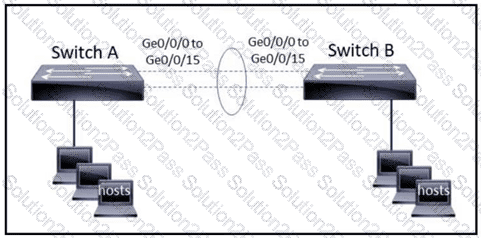
Refer to the exhibit. A network engineer is adding another physical interface as a new member to the existing Port-Channel1 bundle.

Which command set must be configured on the new interface to complete the process?

A.

switchport mode trunk channel-group 1 mode active

B.

no switchport channel-group 1 mode active

C.

no switchport channel-group 1 mode on

D.

switchport switchport mode trunk

Refer to the exhibit.

Which action must be taken so that neighbofing devices rapidly discover switch Cat9300?

A.

Configure the cdp timer 10 command on switch Cat9300.

B.

Enable portfast on the ports that connect to neighboring devices.

C.

Configure the cdp holdtime 10 command on switch Cat9300.

D.

Configure the cdp timer 10 command on the neighbors of switch Cat9300.

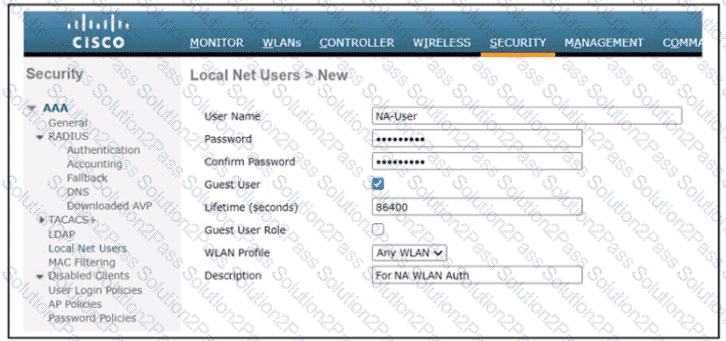
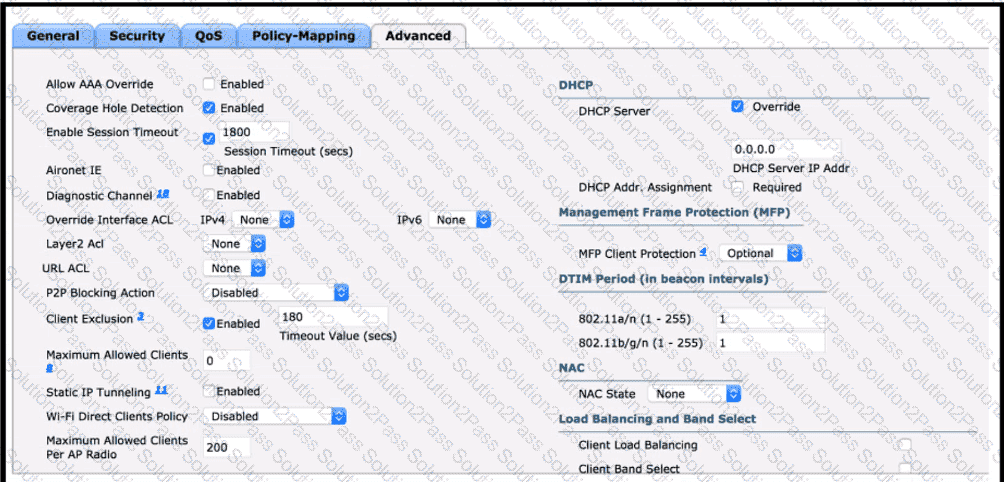
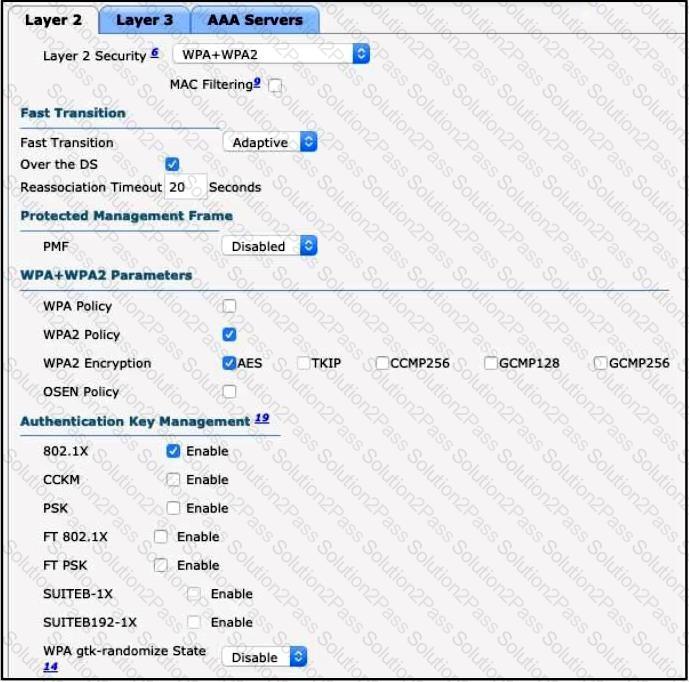
Refer to the exhibit. An engineer is using the Cisco WLC GUI to configure a WLAN for WPA2 encryption with AES and pre-shared key Cisc0123456. After the engineer selects the WPA + WPA2 option froin the Layer 2 Security drop-down list, which two tasks must they perform to complete the process? (Choose two.)

A.

Select the WPA2 Policy, AES, and TKIP check boxes.

B.

Select ASCII froin the PSK Format drop-down list, enter the key, and leave the Auth Key Mgmt setting blank.

C.

Select PSK froin the Auth Key Mgmt drop-down list, set the PSK Format to ASCII, and enter the key.

D.

Select the WPA2 Policy and AES check boxes.

Page: 5 / 8
Total 1240 questions
Copyright © 2014-2026 Solution2Pass. All Rights Reserved