300-110 Cisco Designing Cisco Wireless Networks Free Practice Exam Questions (2026 Updated)
Prepare effectively for your Cisco 300-110 Designing Cisco Wireless Networks certification with our extensive collection of free, high-quality practice questions. Each question is designed to mirror the actual exam format and objectives, complete with comprehensive answers and detailed explanations. Our materials are regularly updated for 2026, ensuring you have the most current resources to build confidence and succeed on your first attempt.
A customer is migrating from a legacy Cisco AireOS WLC to a new Cisco 9800 IOS XE WLC with Cisco 9100 APs. The new APs must associate to the Catalyst 9800 WLC, and wireless clients must seamlessly roam between the old and new WLCs even during SSO. The new Catalyst 9800 WLC deployment is configured to use SSO. Which command must be added to meet the requirements?
A consulting engineer is preparing to survey a brownfield deployment for a 6000-sqft building with four floors that have APs. The entire building is being remodeled and the furniture, office walls, and decoration are being updated. The engineer must perform a survey analysis on the potential RF impact of newer furniture materials. How must the survey be conducted?
A network engineer is designing a new wireless network. The network must include these requirements: • optimized performance • avoid interference • availability in high-density areas • roaming Which two approaches must be taken? (Choose two.)
A customer has an existing wireless network with a Cisco 9800 WLC high availability cluster and Cisco 9120 APs. The customer asks an engineer to perform a post wireless survey that includes a list of any non-802.11 devices on the 5 GHz band. The engineer performs the survey using an 802.11a/b/g/n/ac/ax WLAN adapter but did not use a spectrum analyzer. Which approach meets the requirements?
A wireless consultant must design a Cisco WLAN. The consultant recommends a solution that requires 12 Cisco 9100 Series APs connected to a Cisco 3800 Series PoE+ switch. Each AP requires PoE+ for full functionality. What is the total PoE requirement in watts?
The wireless team must configure a new voice SSID for optimized roaming across multiple WLCs with Cisco 8821 phones. Which two settings accomplish this goal? (Choose two.)
A network engineer is designing a new wireless network for a campus. The network must include optimized performance, avoid interference, availability in high-density areas, and roaming. Which two approaches must be taken? (Choose two.)
A network engineer is deploying Cisco 9130I APs on multiple Cisco Catalyst 9800-80 WLCs with Cisco Catalyst Center. The engineer must enable Cisco AI Analytics and location analytics to use the RRM features to automatically manage the WLC RF profiles. Which type of license must be used on Cisco Catalyst Center?
A customer designs a Cisco wireless environment to provide connectivity to employees and guests. The guest SSID must be configured on three anchor WLCs named Anchor1, Anchor2, and Anchor3 in a DMZ. The guest anchor priority must be configured to ensure that Anchor1 has the highest priority. Which priority level must be incorporated in the design for Anchor1?
An enterprise is using two wireless controllers to support the wireless network. The data centre is located in the head office. Each controller has a corporate WLAN configured with different SSID names. The APs are installed using a round-robin approach to load balance the traffic. What should be changed in the configuration to optimize roaming?
A university wants to deploy a high density of APs in an area where a high number of users congregate. Which functionality allows the university to optimize the RF settings for APs that operate in different environments or coverage zones?
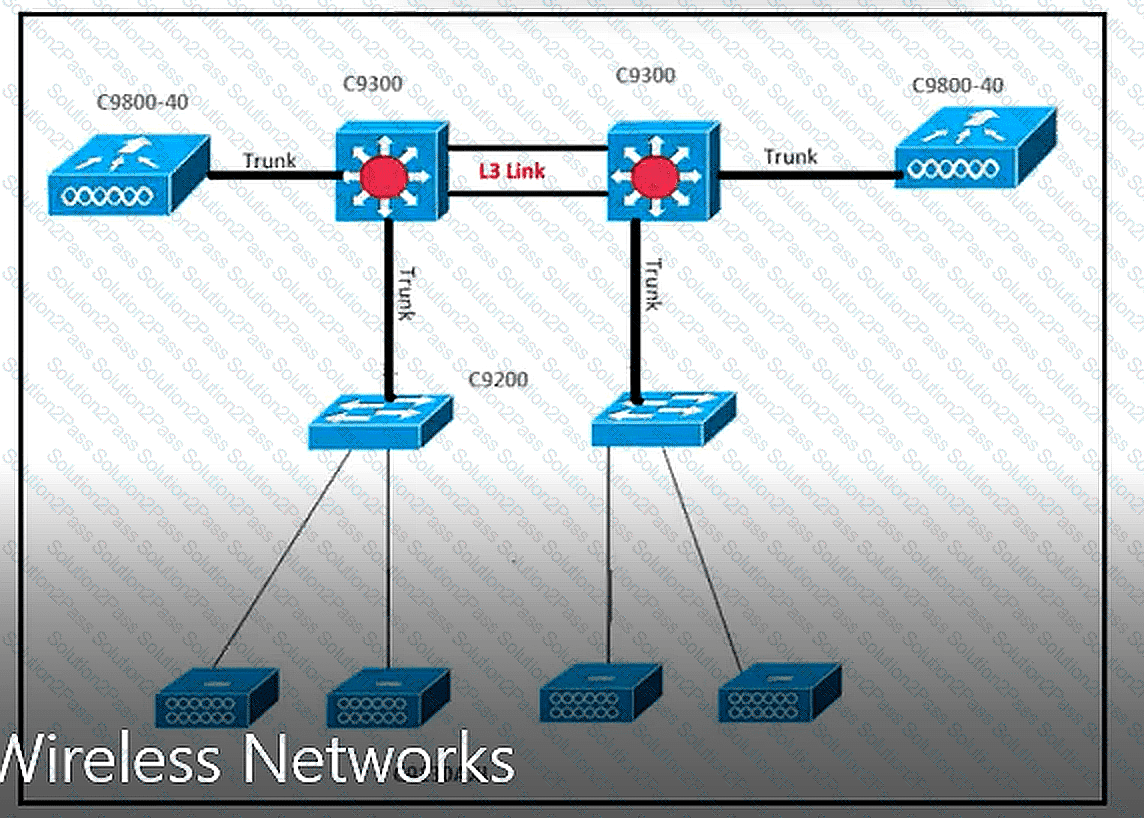
Refer to the exhibit. A network engineer is designing a high availability SSO on a Cisco Catalyst 9800-40 WLC with multi-LAG network redundancy on two Catalyst 9300 switches. The LAG requirements are: • Each LAG must be connected to a single switch. • Different VLANs must be assigned to different LAGs. • The controller must learn the identity of partners that can support LAG capabilities in each port. • When any active LAG ports fail, a standby LAG port must provide redundancy. Which protocol must be used for the port channel on the interface to meet the design requirements?
A customer has two Cisco Catalyst 9800 Series WLCs named WLC-A and WLC-B in an N+1 configuration with the same WLANs but different Layer 3 interfaces for each WLC, and APs in local mode. WLC-A manages Building A APs and WLC-B manages Building B APs. The customer wants users to remain connected and retain their session state including the IP address when moving between buildings. How must this requirement be incorporated into the design?
An enterprise network is deploying two Cisco Catalyst 9800 WLCs in a data center to ensure uninterrupted wireless services for a campus with thousands of users. The IT management requests a design that enables seamless failover without client reauthentication or loss of connectivity if one controller fails. Ease of configuration and ongoing management are high priorities. The controllers will be connected via a high-speed LAN segment, and both must support full active-passive redundancy for all managed APs. Which design approach meets the requirements?
What causes the most signal attenuation based on the wireless design tools?
A university has three campus locations and the main data center. Each campus location has a Cisco Catalyst 9800-40 WLC that manages 600 APs. The data center has a Catalyst 9800-40 WLC, which serves as N+1 backup for each campus WLC. A consulting engineer must install four additional Catalyst 9800-40 WLCs to serve as high availability SSO pairs for each campus, but only two have been approved due to budget restrictions. Requirements: Data center WLC must always be available as N+1 backup, Campus1 WLC must operate with zero downtime, and in the event of multiple campus outages, the AP priority order is to support Campus3, Campus2, then Campus1. Which design approach must the consulting engineer take?
An engineer is performing a passive survey report. The coverage heat map shows the entire site with all signal levels. To see only the desired coverage, which action must the engineer take?
A customer has two Cisco WLCs configured in a SSO cluster. The wireless network supports a large warehouse. The customer purchases new iPads to replace legacy scanners. Both devices connect to a single SSID named Scanning by using WPA2 Personal. The customer wants to use a standards-based method for fast roaming on the new iPads. Which approach meets the scanner requirement and still supports the legacy scanners?
How are mobility groups created, excluding mobility anchors?
A network engineer must design a new wireless solution for a company, but the budget can only stretch to include a single Cisco 9800-40 WLC. The company requires high availability between the WLC and the core switch in the event of a cable failure. The WLC must dynamically manage port redundancy and perform load balancing between APs transparently. Which design approach must the engineer take to meet the requirements?