Summer Sale Special - Limited Time 70% Discount Offer - Ends in 0d 00h 00m 00s - Coupon code: xmaspas7

Easiest Solution 2 Pass Your Certification Exams

300-420 Cisco Designing Cisco Enterprise Networks (ENSLD) v1.1 Free Practice Exam Questions (2026 Updated)

Prepare effectively for your Cisco 300-420 Designing Cisco Enterprise Networks (ENSLD) v1.1 certification with our extensive collection of free, high-quality practice questions. Each question is designed to mirror the actual exam format and objectives, complete with comprehensive answers and detailed explanations. Our materials are regularly updated for 2026, ensuring you have the most current resources to build confidence and succeed on your first attempt.

Page: 1 / 6
Total 379 questions

A client is moving to Model-Driven Telemetry and requires periodic updates. What must the network architect consider with this design?

A.

Updates that contain changes within the data are sent only when changes occur.

B.

Empty data subscriptions do not generate empty update notifications.

C.

Periodic updates include a full copy of the data that is subscribed to.

D.

The primary push update is sent immediately and cannot be delayed.

An organization plans to deploy multicast across two different autonomous systems. Their solution must allow RPs to:

•discover active sources outside their domain

•use the underlying routing information for connectivity with other RPs

•announce sources joining the group

Which solution supports these requirements?

A.

MSDP

B.

SSM

C.

PIM-SM

D.

PIM-DM

When designing interdomain multicast, which two protocols are deployed to achieve communication between multicast sources and receivers? (Choose two.)
A.

IGMPv2

B.

BIDIR-PIM

C.

MP-BGP

D.

MSDP

E.

MLD

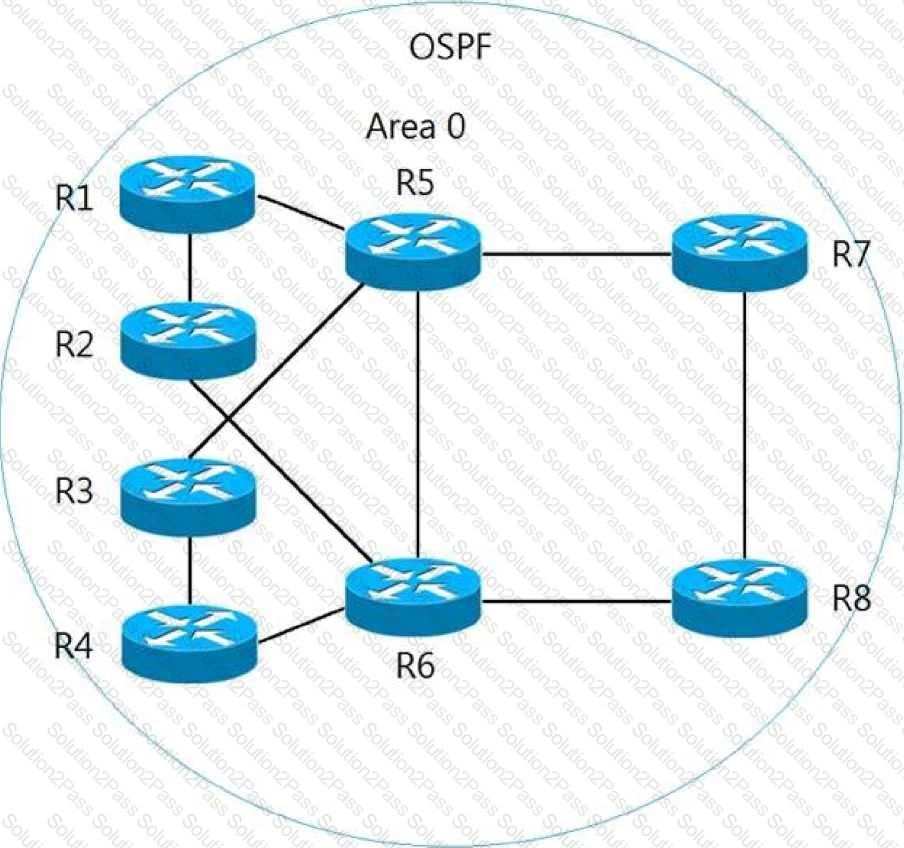
Refer to the exhibit. All routers currently reside in OSPF area 0. The network manager recently used R1 and R2 as aggregation routers for remote branch locations and R3 and R4 for aggregation routers for remote office locations. The network has since been suffering from outages, which are causing frequent SPF runs. To enhance stability and introduce areas to the OSPF network with the minimal number of ABRs possible, which two solutions should the network manager recommend? (Choose two.)

A.

a new OSPF area for R1 and R2 connections, with R1 and R2 as ABRs

B.

a new OSPF area for R3 and R4 connections, with R5 and R6 as ABRs

C.

a new OSPF area for R3 and R4 connections, with R3 and R4 as ABRs

D.

a new OSPF area for R1, R2, R3, and R4 connections, with R1, R2, R3, and R4 as

ABRs

E.

a new OSPF area for R1 and R2 connections, with R5 and R6 as ABRs

What is a primary capability of the cloud-based services model in an IaaS deployment?

A.

It provides workload-migration capabilities, which allows seamless movement of virtual machines and applications between on-premises infrastructure and the cloud.

B.

It reduces operational costs and increases flexibility by allowing organizations to pay for only the resources they consume.

C.

It provides the ability to scale resources up or down based on demand, which enables an organization to adjust its computing capacity dynamically.

D.

It leverages advanced orchestration and automation tools to streamline resource provisioning and management, which reduces manual effort and improves operational efficiency.

Currently, inter-VRF routing between the global routing table and VRF-A is accomplished on the client firewall, but the customer wants to do this on the core network layer. The customer does not want to run BGP, VRF-Lite : or static routing Which mechanism meets the requirements?
A.

policy-based routing with the global set statement in a route map

B.

route map that matches access lists and prefix lists with the import feature

C.

inter-VRF can only be used on an external device with a link in each VRF

D.

VRF receive feature under the global routing interfaces

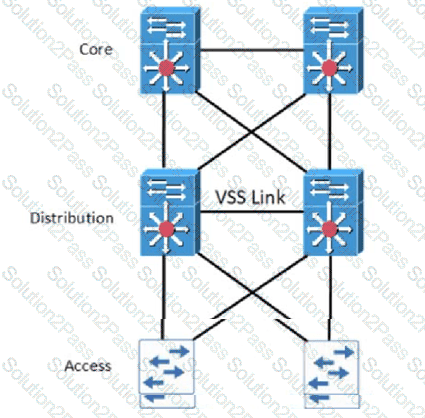
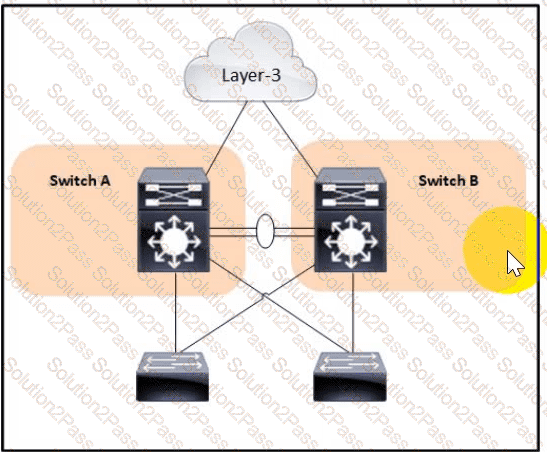
Refer to the exhibit. Which two technologies must an engineer include in the design to prevent Layer 2 loops in this topology? Choose two.

A.

loop guard on uplink

B.

root guard on downlink

C.

BPDU guard on downlink

D.

root guard on uplink

E.

BPDU guard on uplink

What is the purpose of Cisco Catalyst SD-WAN Cloud OnRamp?
A.

It brings secure and private connectivity agnostics to all types of links and providers.

B.

It creates Cisco Catalyst SD-WAN application-aware policies and route-critical applications.

C.

It delivers secure access to business-critical applications across a multicloud environment.

D.

It simplifies and automates the process of connecting on-premises environments to the cloud.

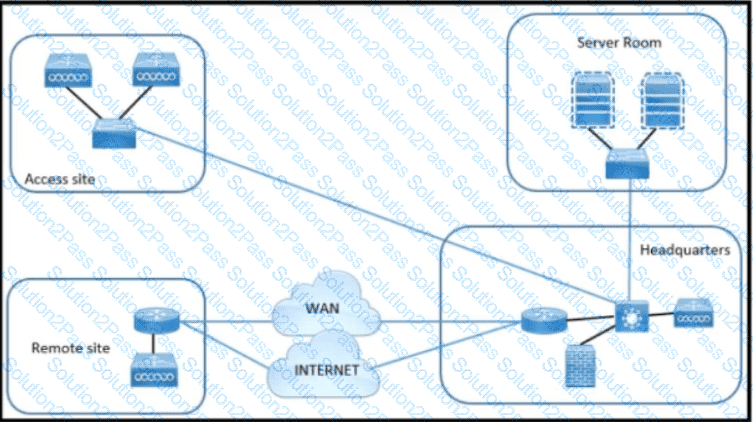
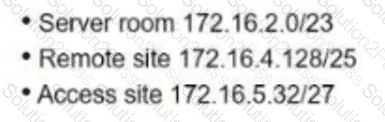
Refer to the exhibit. An architect is designing an IPv4 plan using the 172.16.0.0/16. The design must maximize the number of subnets while meeting these requirements:

    500 hosts within the server room

    100 hosts at the remote site

    25 hosts at the access site

Which plan must the architect choose?

A)

B)
C)
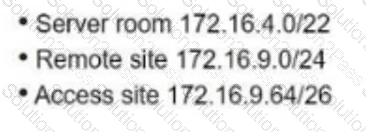
D)
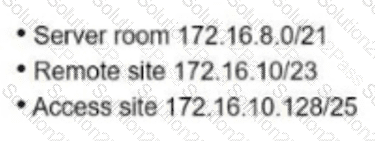
A.

Option A

B.

Option B

C.

Option C

D.

Option D

When expanding an existing Cisco SD-Access network, in addition to the control plane, which two device roles are needed to create an additional fabric site? (Choose two.)
A.

leaf

B.

cEdge

C.

WLC

D.

edge

E.

border

A customer requests a VPN solution to connect multiple sites with the company headquarters. All the sites use the same IP subnet. The engineer plans to use VPLS. Which solutions must the engineer include in the design?

A.

802.1Q connectivity on the LAN side of the CE

B.

route exchange with the service provider

C.

address translation to hide overlapping subnets

D.

different VLANs on each site

Which feature is used to optimize WAN bandwidth of IGMP network traffic among WAN Edge routers in the

same VPN?

A.

IGMPv2

B.

multicast RP

C.

multicast-replicator

D.

multicast service routes

What is the role of a control-plane node in a Cisco SD-Access architecture?
A.

fabric device that connects wired endpoints to the SD-Access fabric

B.

map system that manages endpoint to device relationships

C.

fabric device that connects APs and wireless endpoints to the SD-Access fabric

D.

map system that manages External Layer 3 networks

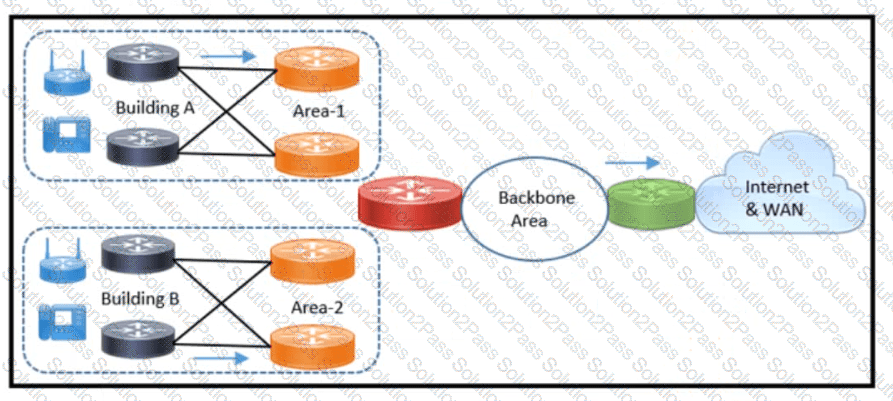
Refer to the exhibit. An architect must design an OSPF solution for an enterprise customer. The design must meet these requirements:

· Limit the link flap impact to Area-1 and Area-2.

· Any link failure must have minimal impact on voice and video traffic.

· Which two OSPF solutions must the architect include in the design? (Choose two.)
A.

Reduce the frequency of OR and BOR elections.

B.

increase hello and how timer.

C.

Tune LSA and SPF throttling timers

D.

Enable manual route summarization and configure all nonbackbone areas as stub networks.

E.

Advertise default routes from the backbone to nonbackone areas.

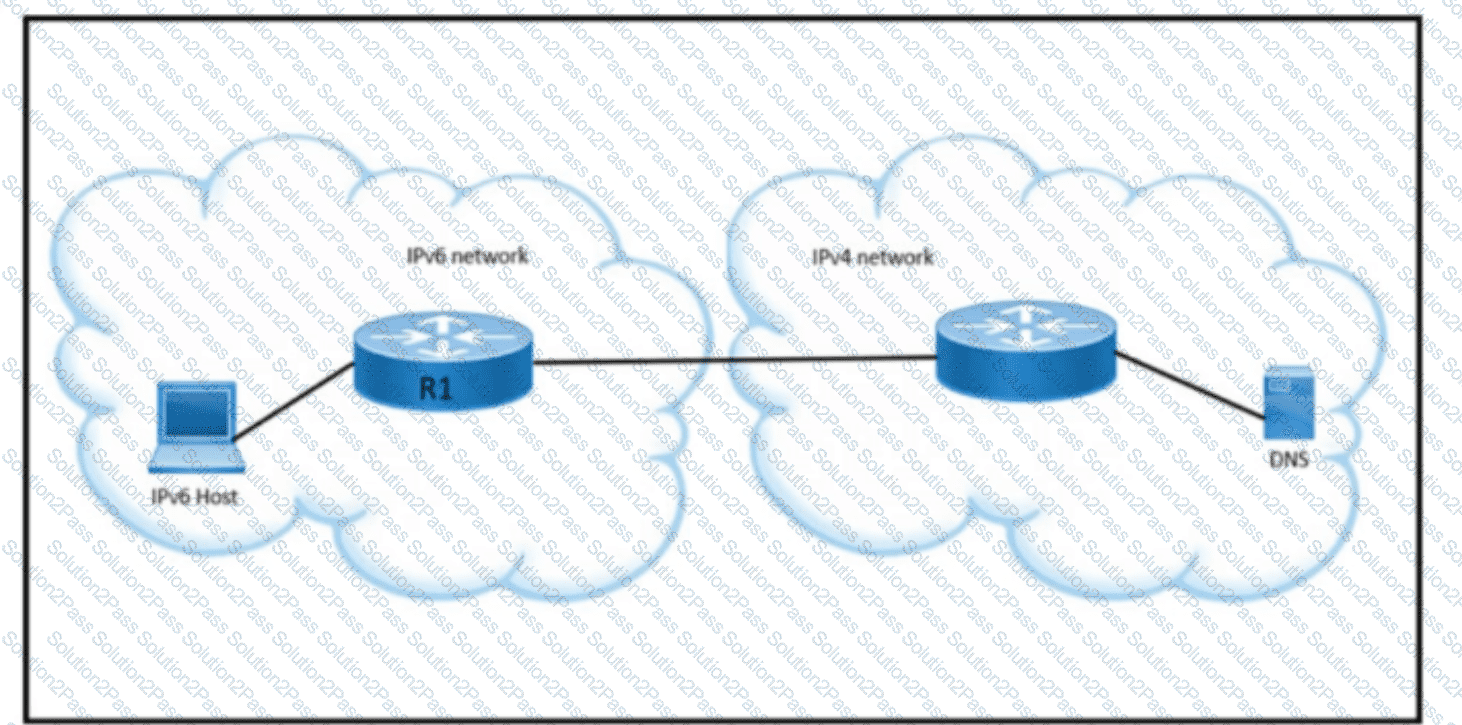
Refer to the exhibit. An engineer must connect the IPv6 island to the IPv4-only network to provide IPv6 hosts access to file servers and DNS services in the IPv4 network. Which NAT should the engineer choose?

A.

stateless NAT66

B.

stateful NAT66

C.

static NAT-PT

D.

dynamic NAT-PT

Which feature of Cisco SD-WAN Secure Direct Cloud Access divides user traffic into different zones and VPNs or VRFs?

A.

centralized data policy

B.

secure segmentation

C.

perimeter control

D.

application-awareness routing

In a cisco SD-Access brownfield deployment scenario, which configuration deployment must be taken with Cisco DNA center?
A.

Subnet stretching

B.

LAN automation

C.

Automated UNDERLAY

D.

Manual underlay

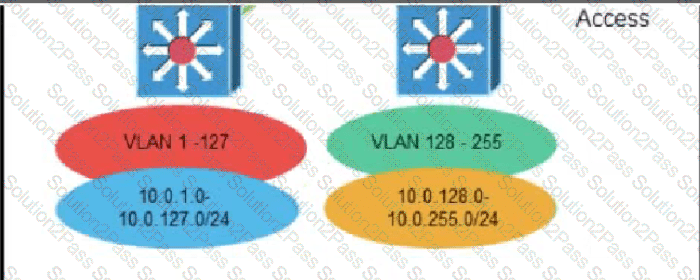
Refer to the exhibit. An architect is designing a Layer 3 campus network. The design must hide network instability, reduce network overhead, and conserve critical device memory. Which route summarization solution must the architect select?
A.

The aggregation layer must advertise a default route toward the access layer. The VLAN subnets must be summarized into 10.0.0.0/16 at the aggregation layer and advertised to the core layer.

B.

The core layer must advertise a default route toward the aggregation layer. The VLAN subnets must be summarized into 10.0.0.0/16 at the access layer and advertised to the aggregation layer.

C.

The aggregation layer must advertise a default route toward the core layer. The VLAN subnets must be summarized into 10.0.0.0/16 at the aggregation layer and advertised to the access layer.

D.

The core layer must advertise a default route toward the aggregation layer. The VLAN subnets must be summarized into 10.0.0.0/16 at the aggregation layer and advertised to the core layer.

Refer to the exhibit A customer requires a Layer 2 network designed to support:

    500 active logical ports

    trunking of 30 VLANs

    convergence of less than 1 second

Which Spanning Tree Protocol must be selected?

A.

RPVST+

B.

MSTP

C.

CST

D.

PVST+

Page: 1 / 6
Total 379 questions
Copyright © 2014-2026 Solution2Pass. All Rights Reserved